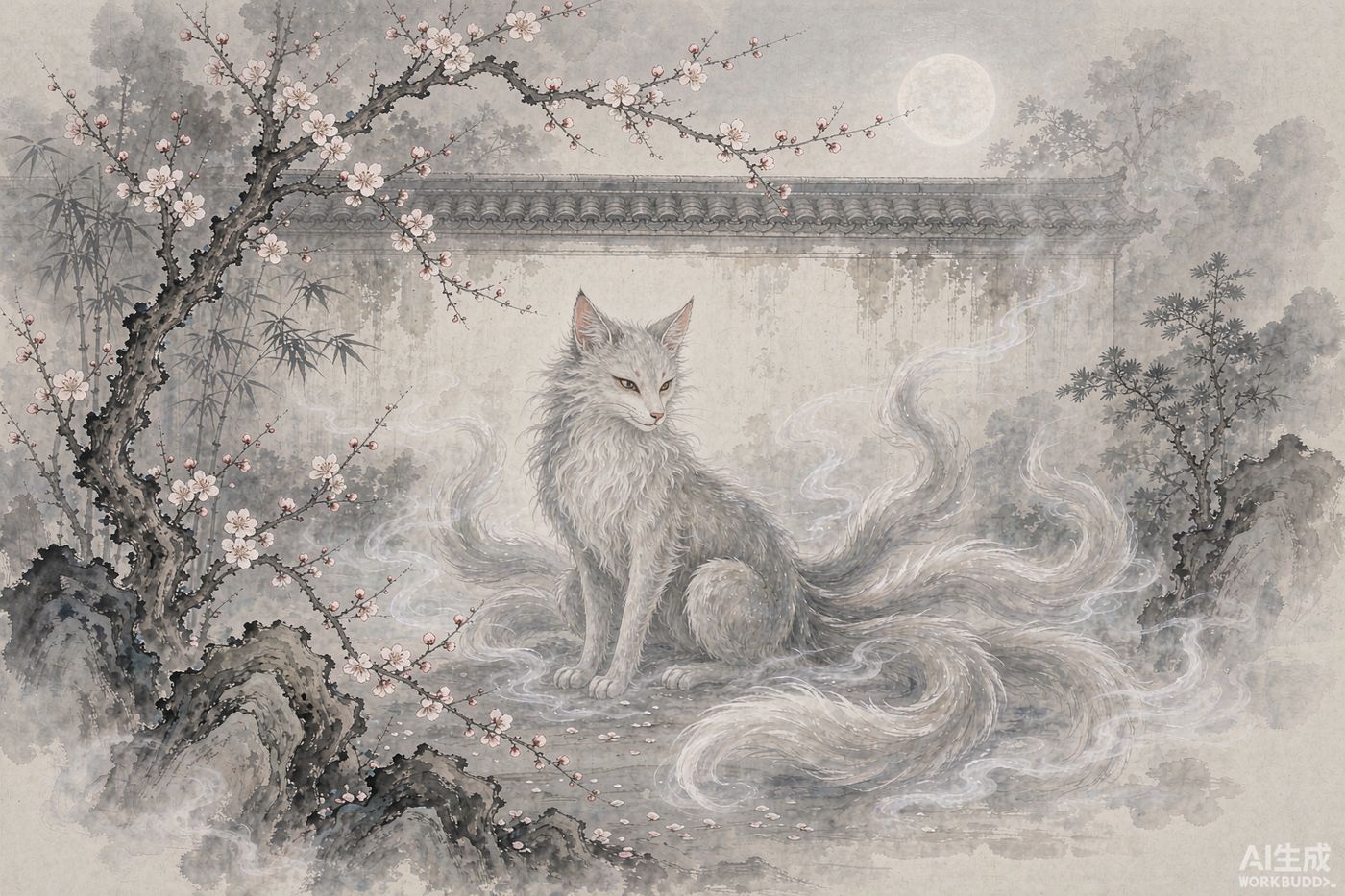
Every long-lived literary tradition has one creature it cannot stop rewriting. China has the fox.
Act I: The Omen
In the beginning, the fox was good news. The nine-tailed fox appears in the earliest strata of Chinese myth as an auspice — a sign that heaven approves. When the great Yu, tamer of the floods, met a white nine-tailed fox at Mount Tu, it was read as a promise of fertility and dynastic fortune; he married the girl of the Tu-shan clan and founded the line of Xia. On the stone reliefs of the Han dynasty, the nine-tailed fox sits in attendance on the Queen Mother of the West, in the company of the moon-hare and the three-legged crow — furniture of paradise.
The logic is the one the whole system runs on: seniority is power. Foxes are clever, long-lived, and watch human settlements from their edges; folklore concluded that a fox which lives long enough becomes something. A tail per century. At nine tails, near-divinity. The question the tradition spent two thousand years arguing about was: divine what?
Act II: The Catastrophe
The dark turn came early, and it was political. Somewhere in the medieval centuries the tradition settled on a scapegoat for the fall of the Shang dynasty, three thousand years earlier: Daji, the beloved concubine of the last Shang king, was — the story decided — a nine-tailed fox in human form, sent to hollow out a dynasty through its king’s desire. Every cruelty of the collapsing court, the lake of wine and the forest of meat, the tortures devised to please her: the fox did it.
This is the fox as weaponised beauty — and it hardened into one of the most durable misogynist tropes in the language: huli jing, ‘fox-spirit’, is to this day the standard Chinese insult for a woman blamed for seducing someone else’s husband. The fox had become the form taken by a society’s fear of female influence, and for centuries that is mostly what it was.
Act III: The Predator of the Tales
In the zhiguai collections the political monster was domesticated into a personal one. Now the fox is the beautiful stranger met on the road, the girl who comes to a scholar’s study at night — and the danger is no longer dynastic but vital: she drinks his essence through his desire, and he wastes away in ecstasy. Hundreds of such tales survive. The formula is strict — encounter, rapture, decline, exorcism — and its fear is a young man’s fear, told by young men studying alone for the examinations, of the world outside the books.
But a formula repeated two hundred years begins to crack from inside. Some tellers started to ask: what if she is not lying?
Act IV: The Mirror
The fox’s fourth act is the glory of the genre. In the Tang tale Miss Ren — the oldest great fox-wife story — the reveal comes early, and it changes nothing. The scholar Zheng learns that the woman keeping his house is a fox, and stays; and she repays him with a faithfulness that shames every human in the story, resisting a rich predator with a speech on loyalty that turns him into a benefactor, and dying at last because she loved a man enough to travel against her omens.
By the time Pu Songling sat down to write his Strange Tales, the fox had become the instrument of the genre’s central experiment: hold a non-human up to humanity and see which one behaves better. His fox-girls are mischievous, devoted, jealous, generous — the laughing Yingning, half fox and raised by a ghost, trades her wild joy for a human family’s peace and breaks the reader’s heart doing it. The predator had become a person; the omen had become a question. What is a human, that a fox should want to be one so badly?
Why It Matters Now
The fox-spirit’s arc — omen, catastrophe, predator, mirror — is the arc of the whole tradition learning to look at its monsters twice. It is also, not incidentally, the reason the creature refuses to die: she is today the heroine of a hundred Chinese and Korean television dramas, a thousand web-novels, entire franchises of games. Every generation rewrites her. She has been heaven’s blessing and a dynasty’s ruin; she is used to it.