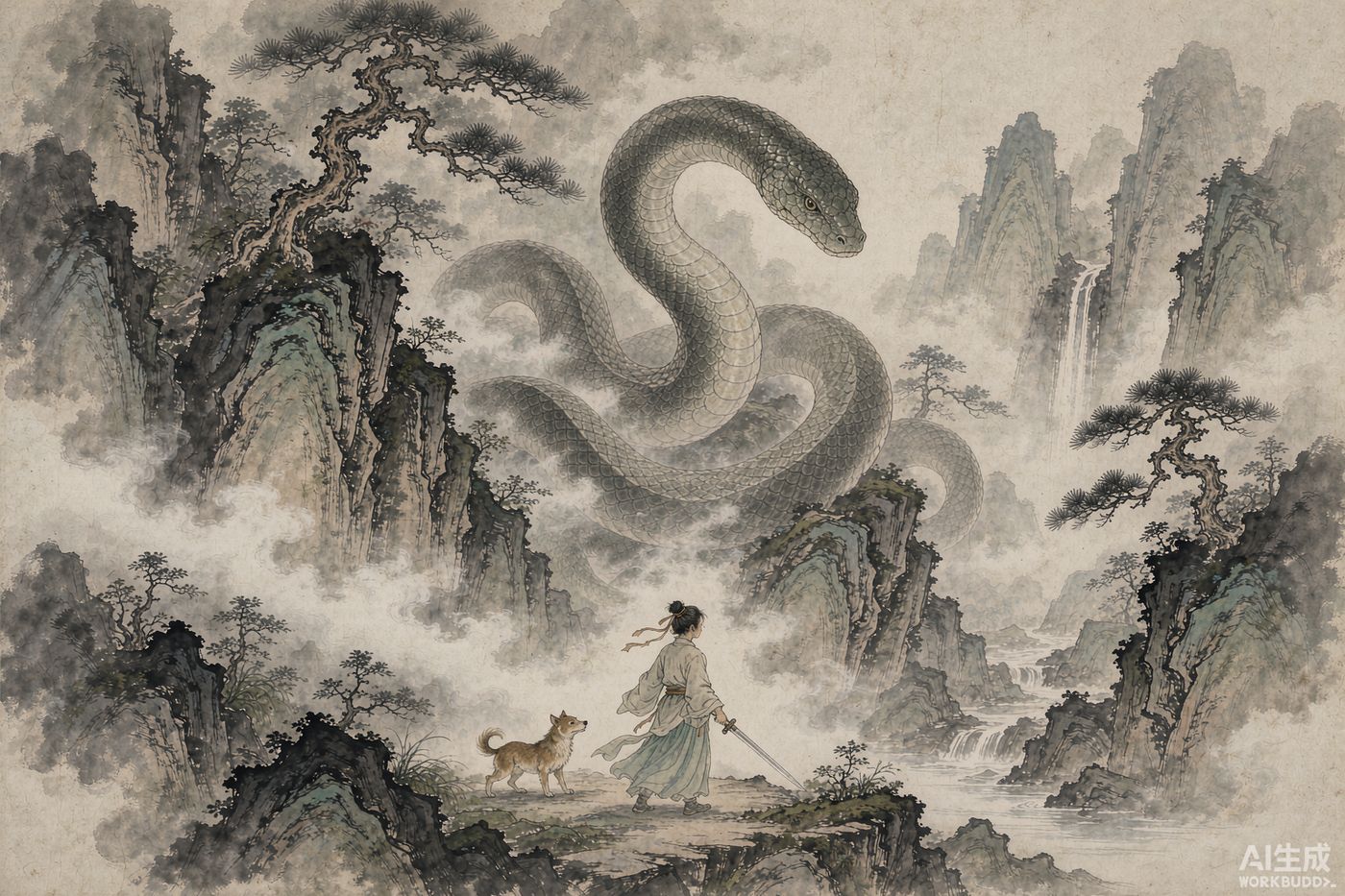
In the Min country of the southeast there was a mountain range called Yongling, and in a hollow of its northwestern slope lived a serpent seventy or eighty feet long and thicker than a team of oxen. The people lived in terror of it. Officers sent to govern the district died of it. They offered it cattle and sheep and got no peace. Then it began to speak — through dreams, and through the mouths of shamans — and what it said was that it wanted a girl, twelve or thirteen years old, every year.
And the officials agreed. They bought the daughters of slave families, and the daughters of convicts, and kept them fattened for the eighth month, when they were led to the cave mouth and left there. The serpent came out and took them. Nine years this went on; nine girls it ate.
In the tenth year the proclamation went out again, and in the village of Jiangle a girl named Li Ji, the sixth daughter of a poor man named Li Dan, came forward to be sold.
Her parents wept and clung to her. She was their youngest; they had no son. Li Ji answered them with terrible practicality. “I am no use to you,” she said. “I cannot carry on the family, and I cost you food. Sell me, take the money, and it will be some comfort in your old age. If I go, one girl at least goes of her own choosing.” They would not let her. She went anyway, in secret, and took the price.
But before she went up the mountain she made demands of her own: a sharp sword, and a snake-hunting dog, and several dan of rice boiled with honey into sweet dumplings. These she took to the cave. She laid the honeyed dumplings at the mouth of the lair, tied the hound, and sat down to wait with her sword across her knees.
The serpent came out for the tribute — a head like a granary, eyes like mirrors two feet across. It smelled the honey and stopped to eat. Li Ji loosed the hound.
The dog went for the serpent’s head, barking, and as the great head swung down to it, Li Ji came in from behind and drove her sword into the serpent with both hands, again and again, into the wounded places, into the spine. The serpent thrashed out of the cave in its death-agony, lashed the ground flat, and lay still.
Li Ji went into the cave. She found the skulls of the nine girls, and carried them out one by one, and set them in a row in the light, and looked at them for a while. “You were timid,” she said to them at last, “and so you were eaten. How pitiful.”
Then she walked home down the mountain, at her own pace, and the hound walked with her.
The King of Yue heard of it and made her his queen, and raised her father to office, and gave her mother and sisters wealth. Songs were made about her that are still remembered. But the heart of the story is not the reward; it is the picture at the cave mouth — the little girl with the rice-balls and the dog, and the mirrors of the serpent’s eyes coming on in the dark, and the only person in the whole district who thought to bring a sword.