Lanrui of Handan was a singing-girl who played the se. Her younger sister Yurui had bitten arms with a scholar of the village named Ge — the old oath — but Ge was poor, and the madam’s price was high, and the match could not be made. Lanrui had the custom of great houses; everything she was given privately she passed to Ge, to stand as his courtship gift for her sister. Ge was grateful to her.
Then Lanrui sickened and died of consumption, and Ge grew more desolate than before. Not only did he not dare speak of the marriage — he could not even buy a single night’s happiness, and looking into an empty purse he was ashamed. His wish went wrong and the anger gathered in him, and he died of love.
He came to the courts of the dead. The king took pity on him as an innocent and sentenced him to be reborn.
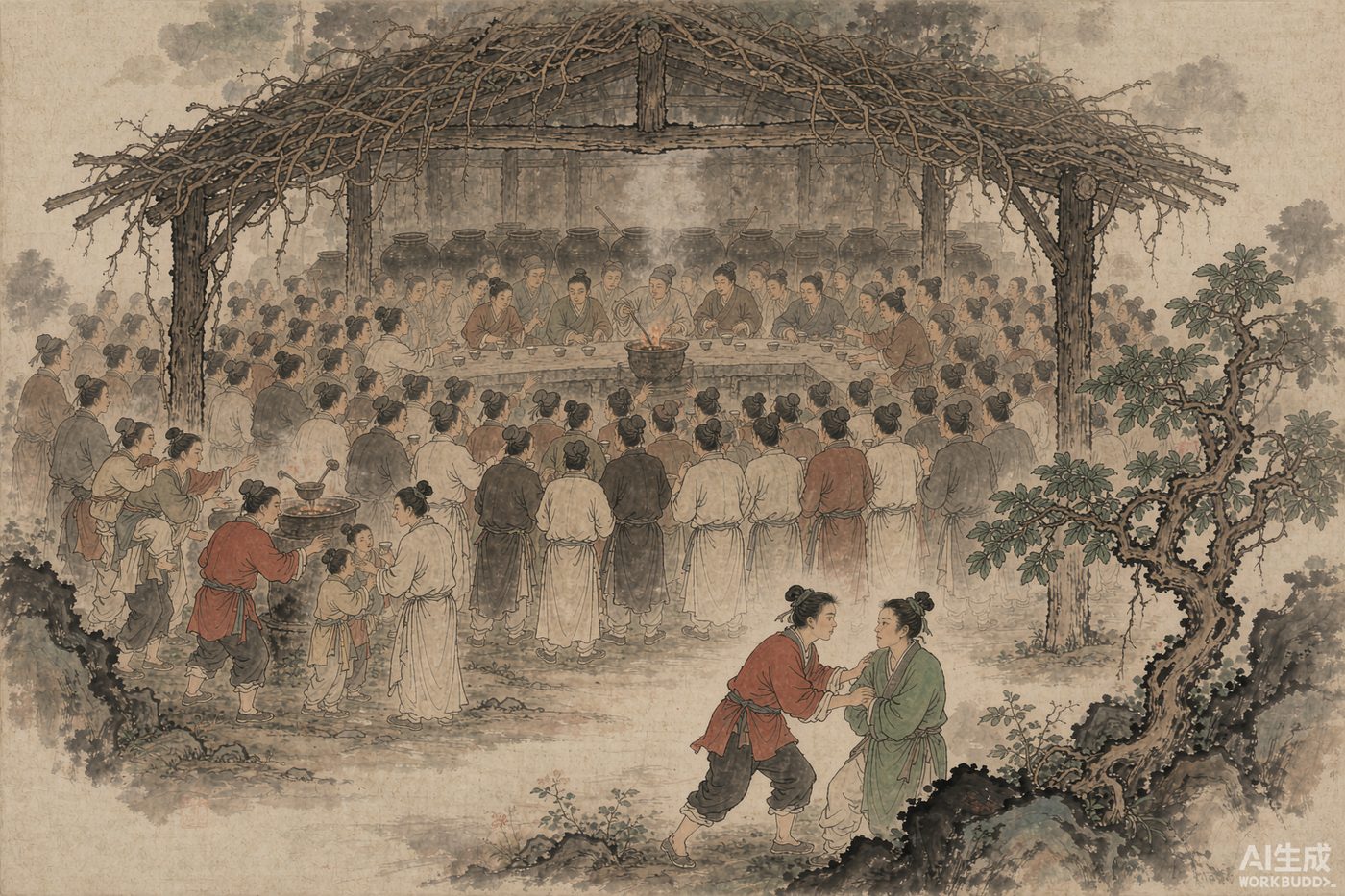
He was taken to a place where vines had been pulled into a shelter and stones set out as tables. Several hundred men and women were there, struggling over ladles and dippers, drinking at the mouth of a furnace. Ge was thirsty and went to join them.
Then a woman came out from behind the shelter. It was Lanrui.
She asked in astonishment how he came there, and he told her everything.
She said: “You died of love. Did you think your sister would go on living?”
And she wept, and the tears ran down.
Ge took a ladle to the furnace. She waved her hands and forbade him to drink.
He asked why. She waited until the drinkers had all dispersed, and then said:
“Do you not know where this is? This is Mengpo Village. She has gone to wish old Lady Kou a long life, and left me in charge of the cups for the time being. If you so much as touch the dregs, you will lose your original self and there will be no road back to life. While your former causes are still clear to you, why not slip away now, and keep your old promise to my sister?”
Ge said: “The old promise cannot be relied on. Being born again is no use to me. What will you teach me to do?”
She said: “Let me see what I can arrange.”
She led him behind the shelter, where stone jars stood row on row along the wall.
She pointed. “This is the wit broth. Those who drink it have talent. This is the long-life broth. Those who drink it live many years. This is the concord broth. Those who drink it make people happy.”
Ge asked: “And what is it the crowd out there is drinking?”
She laughed. “That is all chaos broth, brewed from the fire of the scorched heart and the spring of dripping tears.”
At the last jar she pressed him to drink.
He asked its name.
She said: “This is the ingot broth. The reason you hated living and were glad to die is that you were short of this one thing.”
He forced down a few mouthfuls; it stuck in his throat and would not go down.
She said: “Filthy stuff like this was never meant to go into a scholar’s belly. But since it is going to let a lover hold up his head, the stuff is not vulgar either.”
He still looked unwilling.
She said: “Let me urge one more cup on you — west of Yang Pass there are no old friends.”
He smiled despite himself and managed half of it.
She said: “That will do.” And she led him out and showed him the road home.
By then he had been dead five days. Because there was nothing to bury him in, the body had been left on the bed with only an old woman from the kitchen to watch it. She saw the corpse suddenly jerk up, crying that its belly hurt, and put its fingers down its throat and vomit in a great gush — and the stuff ran into the ground glittering, like quicksilver.
He had them bring baskets and spades and dug some feet down: thousands and tens of thousands of them, all immovable worthies.
He went at once to the madam’s house. Yurui had heard he was dead and had eaten nothing for three days. He told her the truth of it, and they were both overjoyed, and he took her home with the silver as her price.
Because he remembered what he owed Lanrui, he had her coffin moved and buried with rites. The Ge family afterwards multiplied, and he ordered that the grave be swept every spring and autumn, and made it a rule for ever.
The Duo comment: “Ten bushels of pearls to measure, a thousand li to cast the net. With no golden house at home, where is one to store a A-Jiao? From this we know how many poor scholars are buried alive in the gentle country. Drowned in the sea of desire, bones planted under the springs; outside the Ghost Gate, standing alone in the vastness. And in the end — at whose house is the ingot broth actually drunk? Alas.”