East of Wucheng, at the Puguang temple, there was a temple boy named Yuan Hui, the son of a Wang family of the neighbouring village. Once made a monk he worked as a street-collecting novice, and was fond of drink, unrestrained, and intent entirely on going on the spree. At twenty-five he fell ill of something very foul and went home to his family, where he lay bedridden for a whole winter and summer.
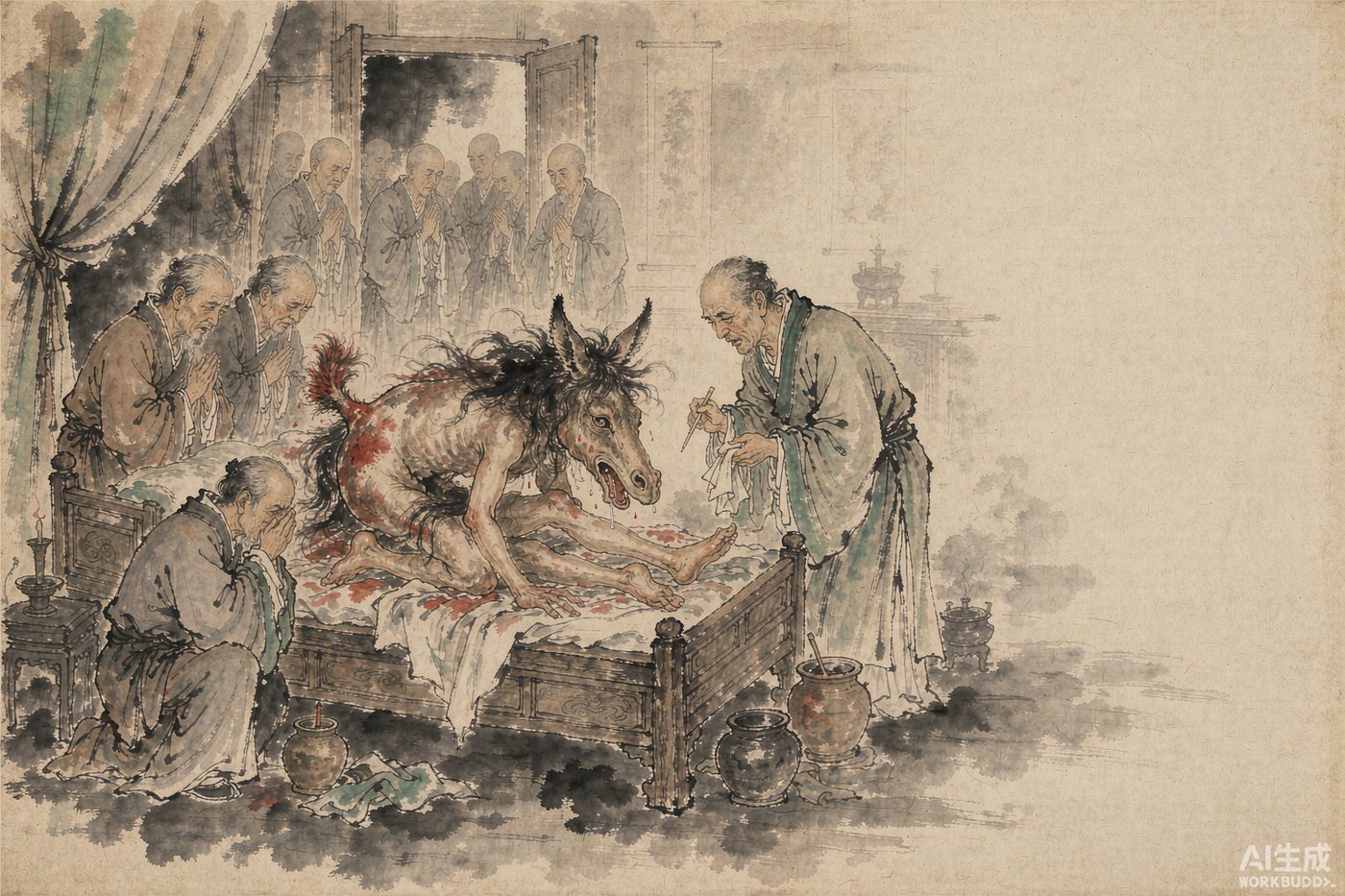
Then he went suddenly unconscious, and the whole room was weeping round him. After a while he lifted his head and gave a long bray, and pitched forward off the bed. Asked what hurt, he could just speak, and said: “Below my waist, at the tailbone, the pain is unbearable.”
A surgeon named Kong Yanzhang was called to look, and there was a short donkey’s tail pushing out through the skin.
His father, fearing the ugly sight would be published, hurriedly covered it with his clothes, and the pain got worse, so he took them off again and showed the people, and then it stopped. The next day it was a foot long. The day after, hair grew all over his body and his head and face were already donkey-shaped. Within a few days his hooves and mane were complete, his two ears pricked up, and he brayed and cried and stood on four legs, upright — a real donkey.
The family discussed killing him. The temple monks said: “No. This is Heaven showing a warning and making his evil retribution plain, to punish those who come after. To kill him would be to turn your back on the principle of Heaven and will bring misfortune on your household.”
So they kept him in a stable without bit or bridle. He brayed and ate without stopping, and bit people at random. When a saddle was set in front of him he pricked his ears and waited as though pleased, and could carry heavy loads long distances, two hundred li a day.
He lived ten years before he died.