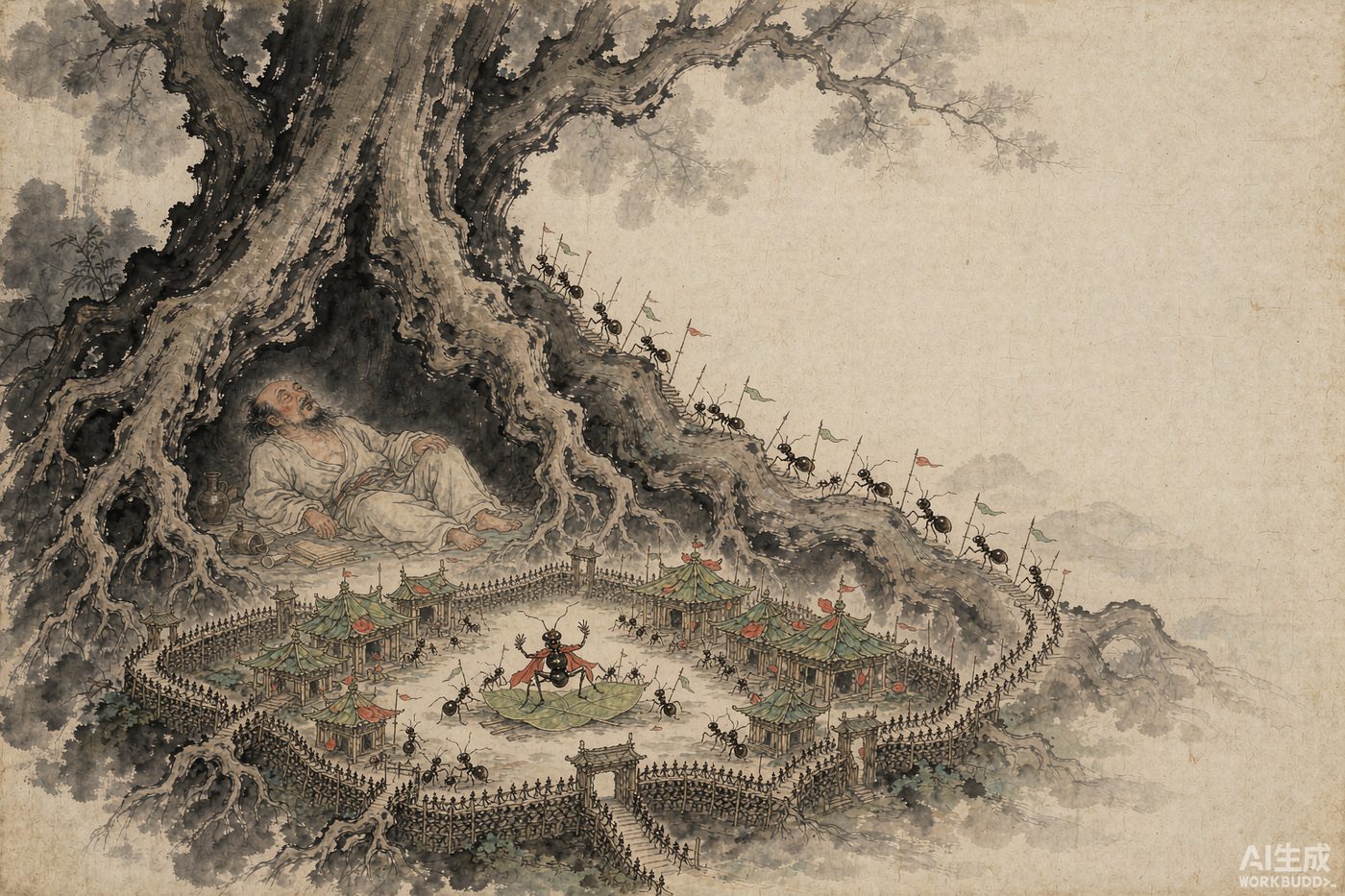
In the Wu country, a man who acts as middleman in the sale of fields and houses is called an ant.
There was an old broker named Jia who had been in the trade thirty years and was modestly comfortable. He bought a kitchen-maid and she bore him a son, and he went to Chu Shao, a provincial graduate, to have the boy’s fortune calculated.
Now Chu was a great joker, with a talent for the remark that carries two meanings. He said, in play:
“I have examined your son’s nativity. He is certain to be very great, and you will be given a patent of nobility.”
Jia said: “My trade is a low one. How should my name get onto the register of officials?”
Chu said, in perfect seriousness: “Not at all. In antiquity the scorpion was entitled General, the firefly was called the Rector of the Rectified, the butterfly was enfeoffed as Marquis of Powder in the Kingdom of Fragrance, and the bee seized the governorship of the Flower Terrace. Every insect is noble. Why should the ant alone be base? Besides — the Way is in the ant and the cricket, and Master Zhuang of Meng admired it; all that remains is that the moth should learn the art in season.”
Jia did not know he was being mocked. He went about repeating the graduate’s words to his colleagues, who raised their hands and congratulated him.
“Chunyu Fen’s incense has caught light at last, and he will carry a million ants up to heaven with him!”
Jia was delighted, and from that day thought of himself as a future nobleman.
The boy, unfortunately, was a dunce. At eighteen he could just about get through three pages of the Great Learning. Someone asked his father: “Is your son reading the Zuo Commentary yet?”
“The Left Commentary he has finished,” said Jia. “He is on the Right Commentary now.”
This was because the boy could be heard all day reciting “Right Commentary, chapter one. Right Commentary, chapter two.”
At twenty he was as slow as ever. Jia began to fear the prophecy was failing, and took the question back to Chu.
“There is a great destiny in him,” said Chu, laughing. “But why so fast? An ant turns black in five years, red in ten, white in thirty. There is a fixed number in it. I should wait, if I were you.”
Jia said yes, yes.
Then the boy took to gambling and gradually abandoned his books entirely.
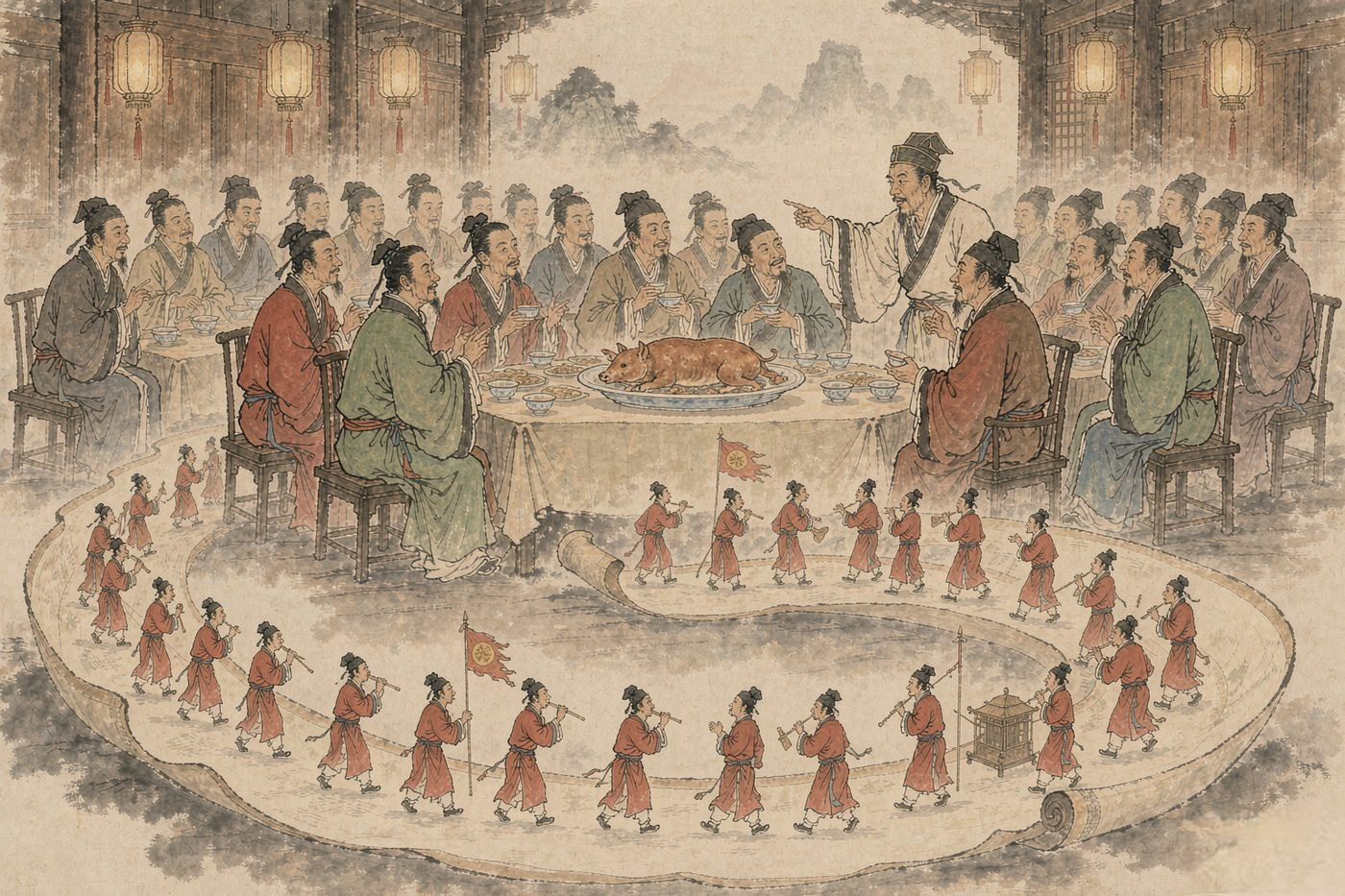
When Jia reached eighty, the guests came up into the hall to wish him long life, and Chu was among them. Jia raised the old matter again.
“You have a noble title already,” said Chu. “Why lean on a promising son to get you a patent?”
“What title is that?” said Jia.
“A Member of the Go-Between Faculty. Promoted Secretary in the Department of Land-Disposal. Externally raised to be Prefect of Contract Prefecture. Enfeoffed by rule as Gentleman of the Deed. Advanced to Grand Master of the Draft Agreement.”
The whole company roared. His son hid his face and laughed too.
“And you, my boy,” said Chu, “when you come to enjoy your father’s protection, if you are not made Commissioner of the Tea-House, you will at least be a Recorder in the Office of Exchange.”
Only then did Jia understand that he had been made a fool of, and his hopes of a patent died.
The Duo comment: The men of Wu sneer at a low official as having a great career ahead of him — an ant’s great future. And yet the future, even for them, does come up out of the ants. Must one wait for the power that reaches the cabinets in the Records of the Western Capital, or the honour equal to a prince’s in the Dream of the Southern Bough, before one knows that the prophecy was not a jest? That Jia’s did not come true is simply the case of the ant that hankers after mutton, while the mutton does not hanker after the ant. The officer of the Lacquer Garden said it more sharply still.