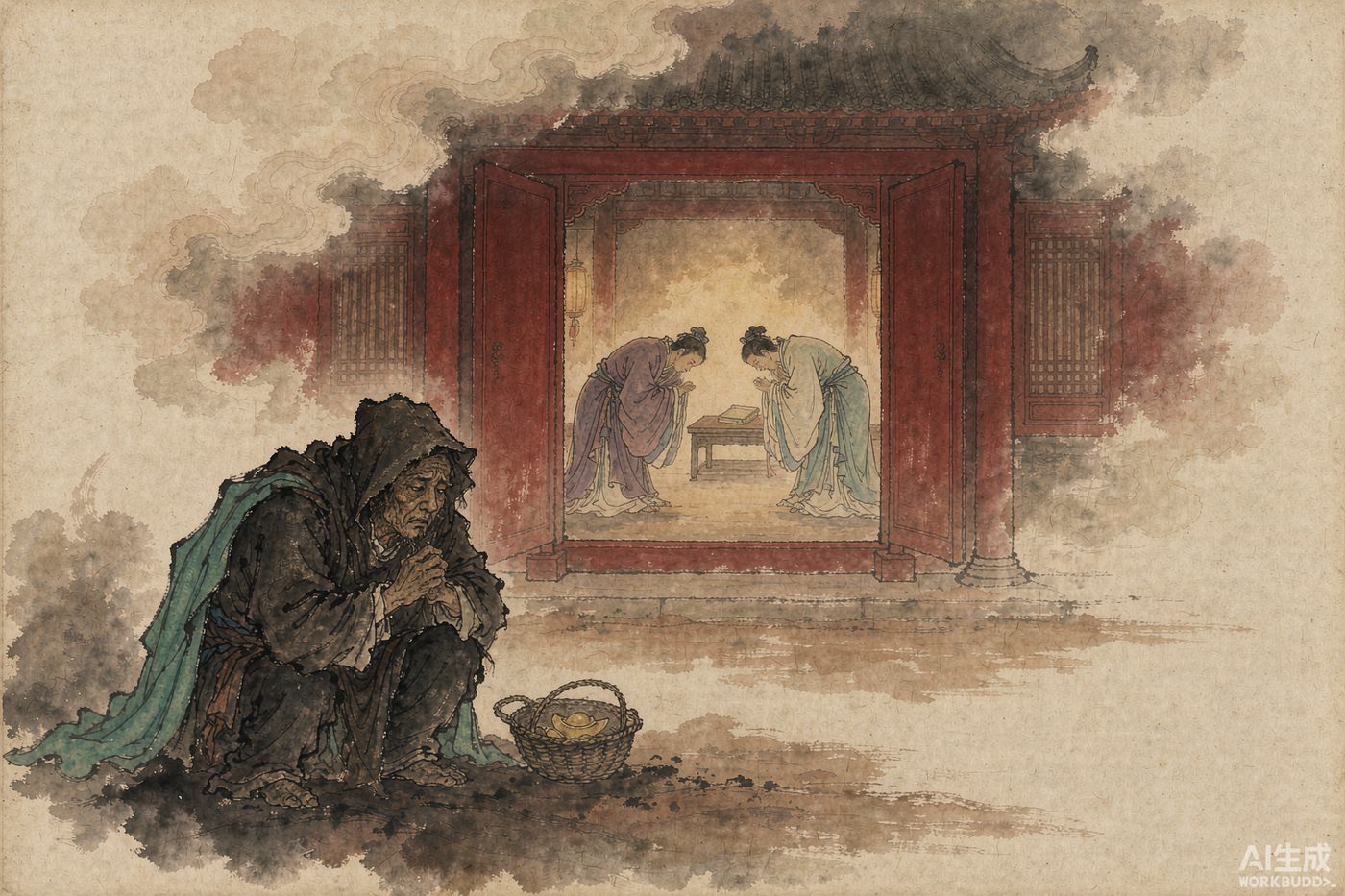
During the Jiajing reign the Grand Secretary Yan wielded power and favours. One night, sitting in his inner hall, his false sons and adopted sons came in throngs to pay court. He let them enter; they all crawled in on their knees. Once in, they touched heads to the ground, with sweet words and flattery vying to please. Yan, pleased with himself, said: “Such a vice-president’s post, so-and-so shall fill; such a censor’s post, so-and-so.” They kowtowed in thanks. Rising, they scurried left and right, a thousand postures at once.
After a while the eave-tiles rustled. The group gave chase; a man fell. Lit, he wore ragged clothes patch on patch, and stood dumb. Yan suspected a thief and ordered him seized and sent to court. The man knelt forward: “I am no thief — I am a beggar!”
Yan said: “Since you are a beggar, why come here?”
The beggar said: “I have a hidden grief; if you pardon me, I will report one word and die.” Yan allowed him. He said: “I am Zhang Lu of Mozhou, a beggar; my mate is Qian Tuzi. In spring the merchants gathered; wherever Qian went, people gave him cash and rice. I got some too, but never as much as Qian. I asked why. Qian said: ‘We beggars have a fawning bone and a flattering tongue. You do not hit the mark; how can your take match mine?’ I asked to be taught; Qian flatly refused. So I thought: among your gates, those who beg for mercy in the dark must have fawning bones and flattering tongues tenfold Qian’s. So I travelled far to come, crouching to listen and peeping through the gaps, for three months now! My mimicry is rough; alas, my trace is exposed. I beg your great mercy for a lenient sentence.”
Yan was startled, then looked at the group and laughed: “Even beggars have a Way. Your fawning bones and flattering tongues are truly the teachers of these fellows!” They assented. He pardoned the crime, ordered them to take the beggar away and teach him in turns, morning and night; within a year he learned and returned. Thereafter Zhang Lu’s begging stood above Qian Tuzi’s.
The Duo comment: Zhang Lu learned from Yan’s gates; but from whom did Yan’s gates learn? From Yan. The former Ming’s register of officials is a beggar’s genealogy. Strange, Zhang Lu, to found another branch.