A certain Mr. Wang of Shaoxing had held the stipend of a licentiate for years, and a rich family in the village engaged him as tutor.
Because their own rooms were cramped, and a new house about a li away happened to be offered for sale, they bought it and put him in it. “Our own place is not yet cleared out,” they said. “The pupils and the school servants will come in tomorrow morning. Can you sleep there alone for one night without fear?”
Wang prided himself on his nerve, and it was a new house besides — what was there to fear? So he told a servant to carry the tea-things and light him to the study.
He walked all round the inside of the room, then went and loitered at the gate. It was night by then, and the moonlight was very bright. He saw a faint flame flickering at the foot of the hill. He went over to look: the light was coming out of a white wooden coffin.
Wang thought: is this ghost-fire? But ghost-fire should be blue-green, and this flame had a touch of red in it. Could it be the vapour of gold and silver? He remembered something in the Zhixiang: several Central Asians in mourning dress had carried a coffin out and given it a makeshift burial beyond the city wall; the constables followed the trail, and what was in that coffin was all gold and silver. Might this coffin not be of the same kind? There was nobody about. He could break it open and take it.
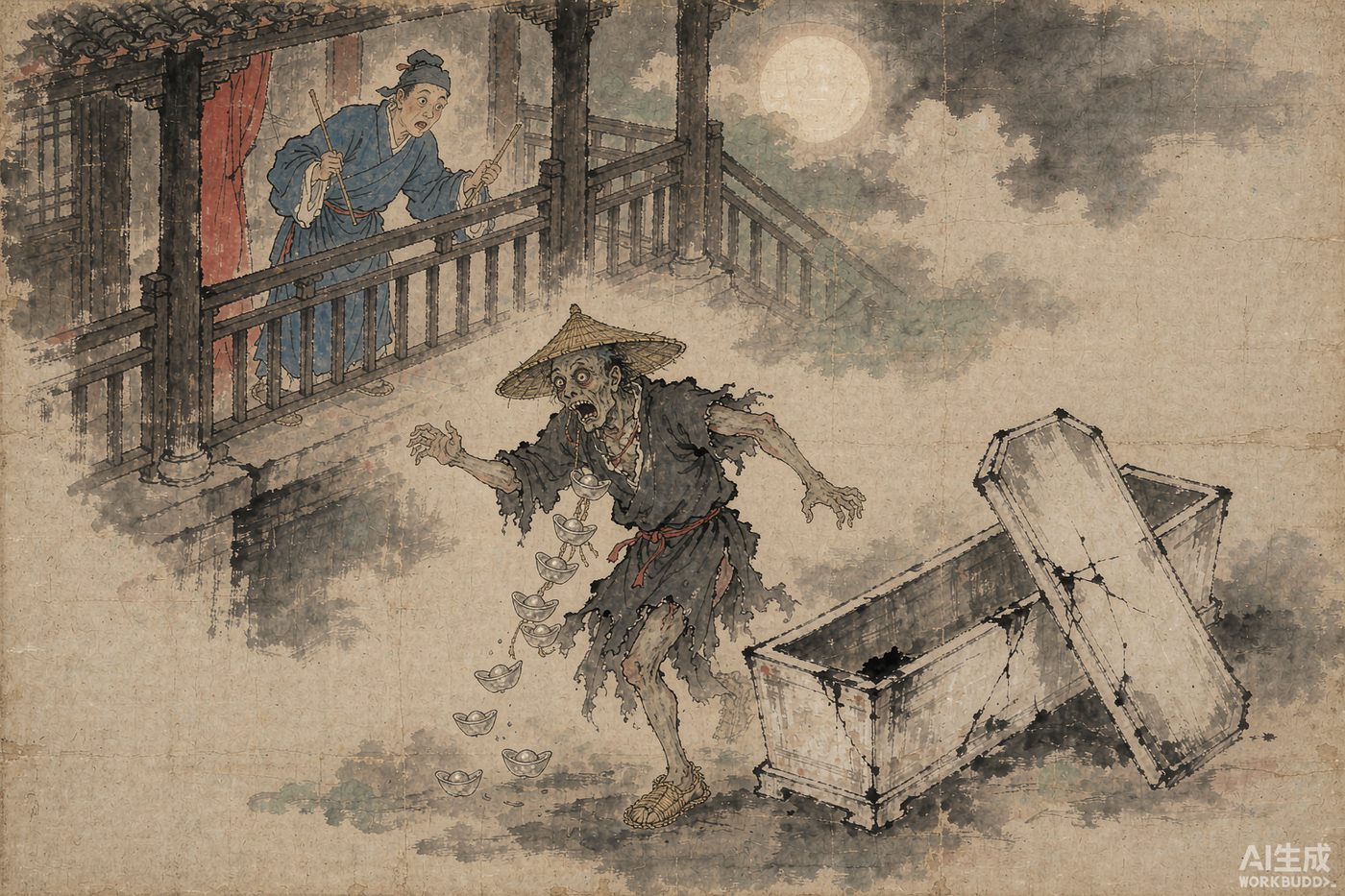
So he took a stone, knocked out the nails, and pushed the lid off from the back end — and there, starkly, was a corpse, face blue-black and belly swollen, in a hemp mourning cap and straw sandals. In the Yue country the custom is: where the parents are still living and the son dies first, he is coffined in this fashion.
Wang recoiled in amazement; and at every recoil the corpse gave a jump, and at the second recoil the corpse lurched upright.
Wang ran for his life, and the corpse came after him.
He got indoors, went up the stairs, shut the door and barred it. He had barely got his breath back when he thought the corpse must be gone, and opened the window to look. The instant the window opened the corpse lifted its head in delight and sprang in from outside.
It beat on the door and could not get through. Then it gave a loud, grieving cry — three cries, and all the doors flew open as if someone had opened them, and it came up the stairs.
Wang had nothing for it but to meet it with a stick. The moment the corpse reached the top he struck at it and hit its shoulder, and the ingots of silver hanging there spilled onto the floor. The corpse bent to pick them up. While it was stooping, Wang put all his strength into a shove and sent it rolling down the stairs.
Then he heard a cock crow, and from that moment there was no sound at all.
Next day they looked: the corpse had broken the bone of its leg in the fall and lay across the ground. They called people to carry it out and burn it.
Wang said with a sigh: “Because of greed I brought a corpse up the stairs; because of greed the corpse was burned. If even a ghost must not be greedy, how much less a man.”