Stories/ 夷坚志/ The Ghost Who Came Home

The Ghost Who Came Home

籌洋村鬼

SourceYijian Zhi (Record of the Listener)
AuthorHong Mai
EraSouthern Song dynasty · 12th century
Writtenc. 1160–1200
GhostFamilyJustice
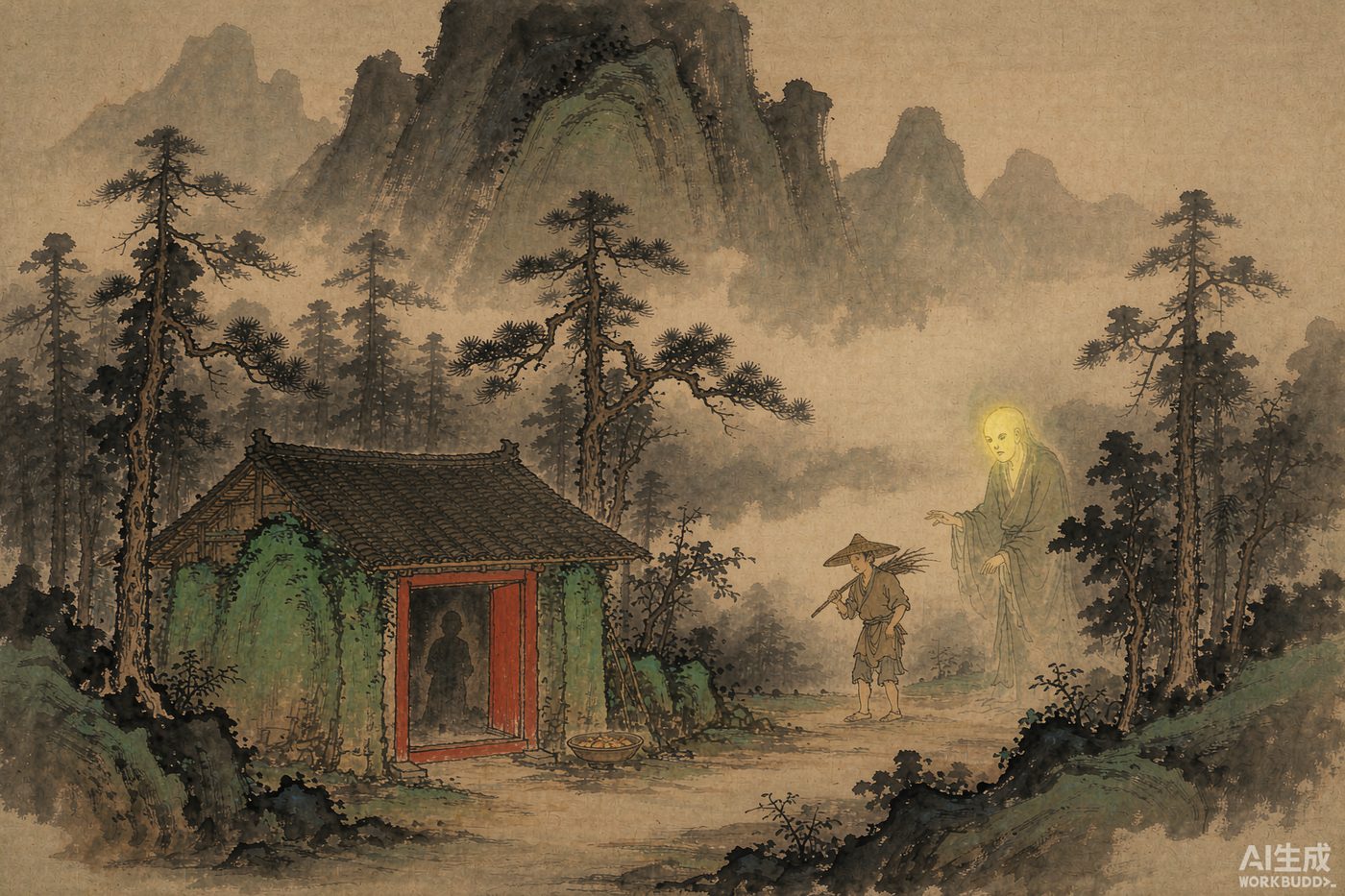
A woodcutter on a mountain path at dusk facing a pale figure among the trees while a lonely cottage door stands open with a bowl of food set outside, ink-wash painting
Illustration generated by AI, based on the ancient Chinese text.

In Luoyuan county of Fuzhou, there was a village called Guankeng. A woodcutter often went to the separate village of Chouyang to gather firewood, going back and forth many times. One day he returned rather late; as he came to a small cove he met a man coming down the mountain who called to him: “It has been a long time since we met.”

The woodcutter realized this was a man who had died; his expression fell. Slowly he managed to speak: “You are dead — why are you here?”

The man said: “I was not fated to die yet; now I live here no differently than before.” Pointing into the dense woods, he said: “I just live in there; you could come and talk.”

The woodcutter refused: “The day is near dusk; I fear my family waiting at the gate.” So the dead man said: “If you go to my home, give a message to my mother: I live here just as in life, she need not worry or long for me; only when there is wine or food, set it out at the door, and I will come and enjoy it.”

The woodcutter hurriedly bowed and went. The next day he told all to the ghost’s mother; she wept and burned paper money, set out wine and meat, closed the door and prayed; after a short while she came out to look — only the empty vessels remained.

While the man lived he had a wife and three sons; after his death his wife took the sons and remarried, and they were often beaten by the stepfather. The father, often walking alone over the ridge, was blocked on the path by the ghost, who cursed him: “What can be done about your wickedness? You took my wife and now abuse my children — what right is this?” And he raised his fists and struck him.

The man fought back; they chased each other to the cave mouth, where a passer-by happened by, wondered, and asked, and the ghost vanished. When the man got home he was covered in green bruises, and from then on dared not pass that way again.
Original classical Chinese text · 原文

福州羅源縣村墅名曰鸛坑有樵夫常以采薪至籌洋别村往反屢矣一日歸差晚行及小灣逢一人從山下來呼之曰多時不相見樵覺為已死神色沮喪徐乃能言曰爾死矣如何在此其人曰我本未合死今居此無異昔時指茂林間曰我只住其中可偕往說話樵拒之曰日勢且黄昏恐家人候門不便乃曰爾若到我家為傳語娘我住此與生時一般不用憂憶但有酒食時安排在門外自當歆享樵急揖之而去明日具言於鬼母泣而焚紙錢設置酒肴閉門祝之少還出視特空器耳其存也有妻及三子死後妻攜子改嫁屢遭繼父捶楚父常獨行過嶺鬼遮道罵曰爾之惡何由可奈既取我妻又虐我兒是何道理遂奮拳毆之此人亦與争鬬相追至洞口値有行過者訝而問之鬼乃沒迨還舍青痕遍體自是不敢復仍前過

From 《籌洋村鬼》, Yijian Zhi. Translated in full. 福州羅源縣 is Luoyuan county in Fuzhou, Fujian; 鸛坑 and 籌洋 are village names; 未合死 is not fated to die, a status that leaves the ghost neither fully dead nor alive; 歆享 is to take pleasure in the offering, the verb for a spirit consuming sacrifice; 繼父 is the stepfather.

Source. From Yijian Zhi (Record of the Listener) (夷坚志), by Hong Mai , c. 1160–1200. The original text is in the public domain; this English rendering and the accompanying notes are original work.
Where this fits in the universe: Ghosts · The Courts of the Dead

Keep Reading

Related Stories

Qing dynasty · from Zibuyu, late 18th century · 子不语

The Ghost Who Bought a Son

鬼買兒

A dead first wife, jealous of her own embroidered jacket, possesses the second wife to get it burned. Then she stays on — running the household each morning, choosing her own grave, and finally bargaining for three thousand paper coins to buy the family a son to keep her sacrifices fed.

GhostFamilyMarriage
Southern Song dynasty · 1192, the guichou year of Shaoxi · 夷坚志

The Judge of the West Lake

西湖判官

A three-foot crab caught at a city gate turns out, in a dream, to be the Judge of the West Lake — an underworld official begging not to be boiled. The general wakes too late: his sons have already eaten it, and the curse falls on the household.

UnderworldJusticeAnimal
Southern Song dynasty · 12th century · 夷坚志

The Monk Ghost of Yunmen

雲門僧鬼

A monk hanged himself at a temple in the Mayuan valley. Left alone one night, the caretaker hears a knock, looks up, and sees the dead monk enter with his tongue hanging to the floor. A lacquer-worker, it turns out, has seen him too — night after night, calling for his disciple.

GhostBuddhistHorror