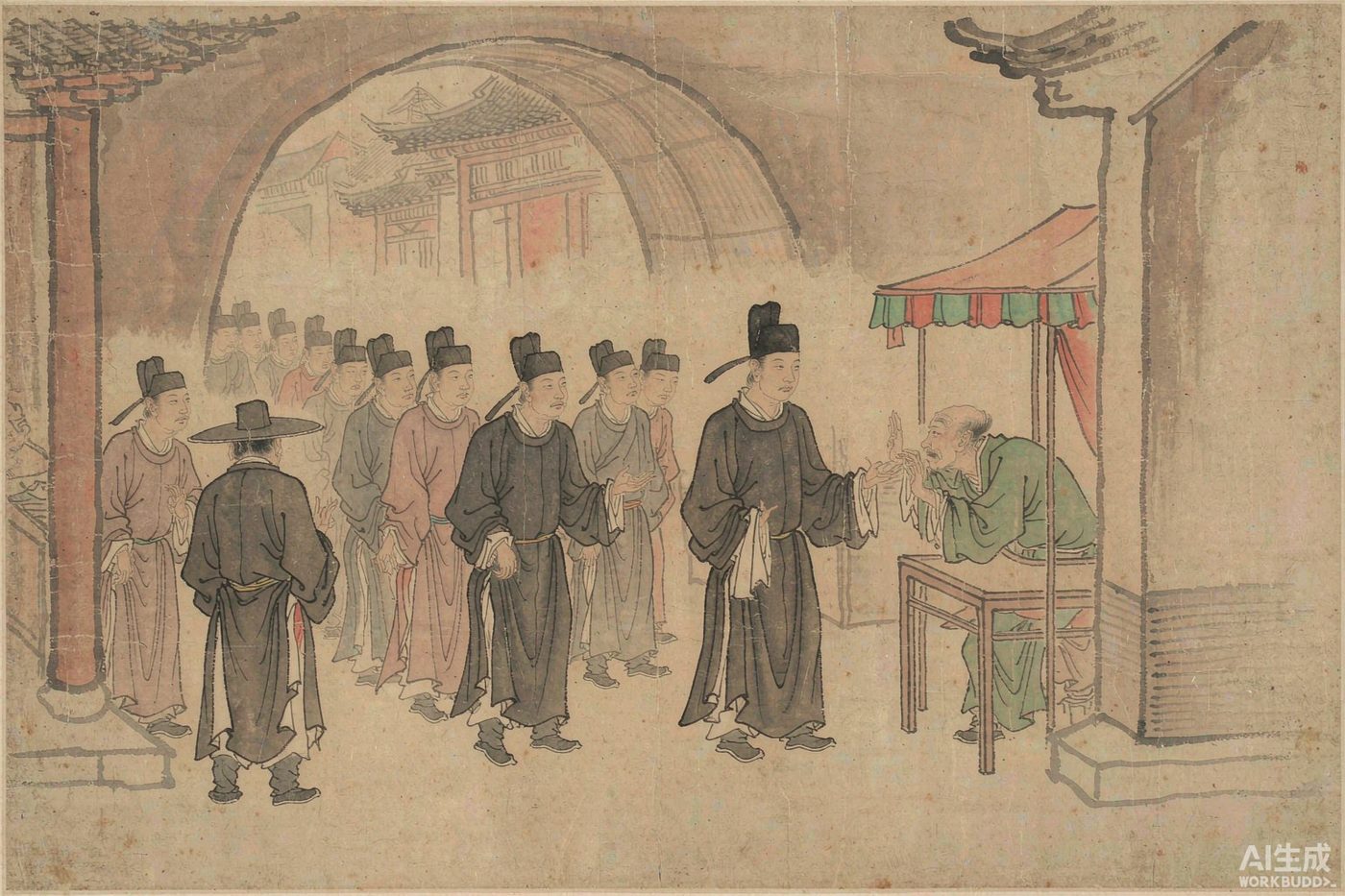
At the Liuli Market in the capital an old man put up a placard in the street: Can read the vapour and know a man’s office.
Every man on the official register came, shoulder against shoulder.
The old man seated them, and had each one breathe out towards him, and examined the breath from the side.
“This is metal vapour — the Hanlin Academy. This is wood vapour — a ministry. This is water vapour — the drafting office. This is fire vapour — the censorate. This is earth vapour — the Imperial College.”
He was never once wrong.
Then came a man who breathed out for a very long time, and the old man brooded over it four times over, as though he could not make out what office it was.
“Strange. It is like metal vapour but not refined; like wood vapour but not flourishing; like water vapour but not clear; like fire vapour but not fierce; like earth vapour but not thick. Is he somewhere between not-a-scholar and not-a-clerk?”
They asked him. He was a man who had been selected for a county magistracy and had petitioned to be given a teaching post instead.
So it is known that the cold offices and the idle ranks are all held by men without vapour. Read out his fate: he is nowhere in the five elements at all.
The Duo comment: “I do not presume to play the madman, and I do not pretend to be detached; it is simply that I know myself, and I preach by showing myself. When I took up the seal at Xingjiang I amused myself with an essay on the Professor, made from the Four Books. I append it here for a laugh:
He does not refuse a small post. Learning — emolument lies within it. Great indeed is the trouble of men: that they like to be teachers of others. To learn and not be weary — how so? Teaching too has many arts. This is perhaps one way. The men of old also wished to serve. Land and people, one who holds an office and keeps it — this is what is called the father and mother of the people.
There is a man here, chosen out of the crowd. He has no money. He drops a grade. Since he cannot command, he had better learn. At this season he puts his charge in order and goes to another state. This too is governing — let him try it. He is about to enter the gate: So-and-so is here. The lodgings are not yet settled; he leads his wife and children like a pauper with nowhere to go. Wait for the man, then come out; only after that dare he go in.
He repairs my wall and roof; those who follow him are like a market returning. Men of the common sort in office: six or seven of them. Foolish, and fond of his own way. He eats his fill all day; I have never spoken with him of the business. A tithe: he is made to tax himself fifty mu, and all of them strike their names from the register; nobody knows their village. Though some remain, they are few.
On the first day of the month he must put on court dress. The years are many, and he grows dim yet daily more conspicuous. He begs it from his neighbour, and it is half a body too long. For three months he does not know the taste of meat. At the spring and autumn sacrifice to the duke he is sure to have it thoroughly cooked before he offers it. He does not eat the bread of idleness — that is one joy. He would not take a single straw from any man. The disciples present gifts; why should I not accept? Paltry indeed. Is that not leniency? In letters I have never failed to instruct.
Fond of racing horses and trying swords — one cannot flock with such, yet to educate them, is that what I desire? For the present, put aside what you have learned and follow me. Beware of strife. Life — I have rarely seen it. He calls himself a small boy. Examined by its season: to help him forward is like ascending to heaven. From the time he brings his bundle of dried meat upward, he waits for next year.
Alas for this man alone and helpless; wishing to stop, he cannot. Excellent men are in office; outstandingly, none can be used. Hold to the old line, as if for the whole of life. What then is to be done? Let it be, let it be; do not disgrace yourself. Let me go home, let me go home — it is what I have always wished. From now on: to produce wealth there is a great way. Why must one read? The gentleman contends for nothing; I follow what I love.
If anyone should employ me again, say to him: without the sense of shame and dislike, then to learn — a beggar would disdain it, and do you say that I wish it?”