In the twentieth year of Qianlong’s reign, His Excellency Bai, circuit intendant of eastern Sichuan, bought a concubine for a thousand pieces of gold and sailed home to his post, doting on her beyond measure.
As the boat passed Zhenjiang they moored in the moonlight. The concubine pushed open the window to draw up water — and was swallowed by a giant softshell turtle.
Her master, wild with grief and hatred, swore he would not rest until he had the turtle. He proclaimed to every fishing boat that they should join the hunt: a hundred gold pieces to whoever took the monster. The boatmen vied with one another, baiting five-barbed hooks with pig’s stomach and goat’s liver, an empty wine jar tied above the line as a float, and watched the water day and night without sleeping.
Two days later they did indeed hook the great turtle. Dozens of men hauled and could not raise it, so they bent the ship’s cable to a huge stone millstone and dragged it ashore with four water buffalo. It came leaping up onto the bank, its head like a cartwheel. The crowd hacked at it with sharp axes; it rolled and gouged a pit in the ground, the shell grinding and cracking, and was a long time dying. They split its belly — and the gold bracelet from the concubine’s wrist was still inside.
So they chopped the body to pieces and burned it, and the stench was smelled for miles.
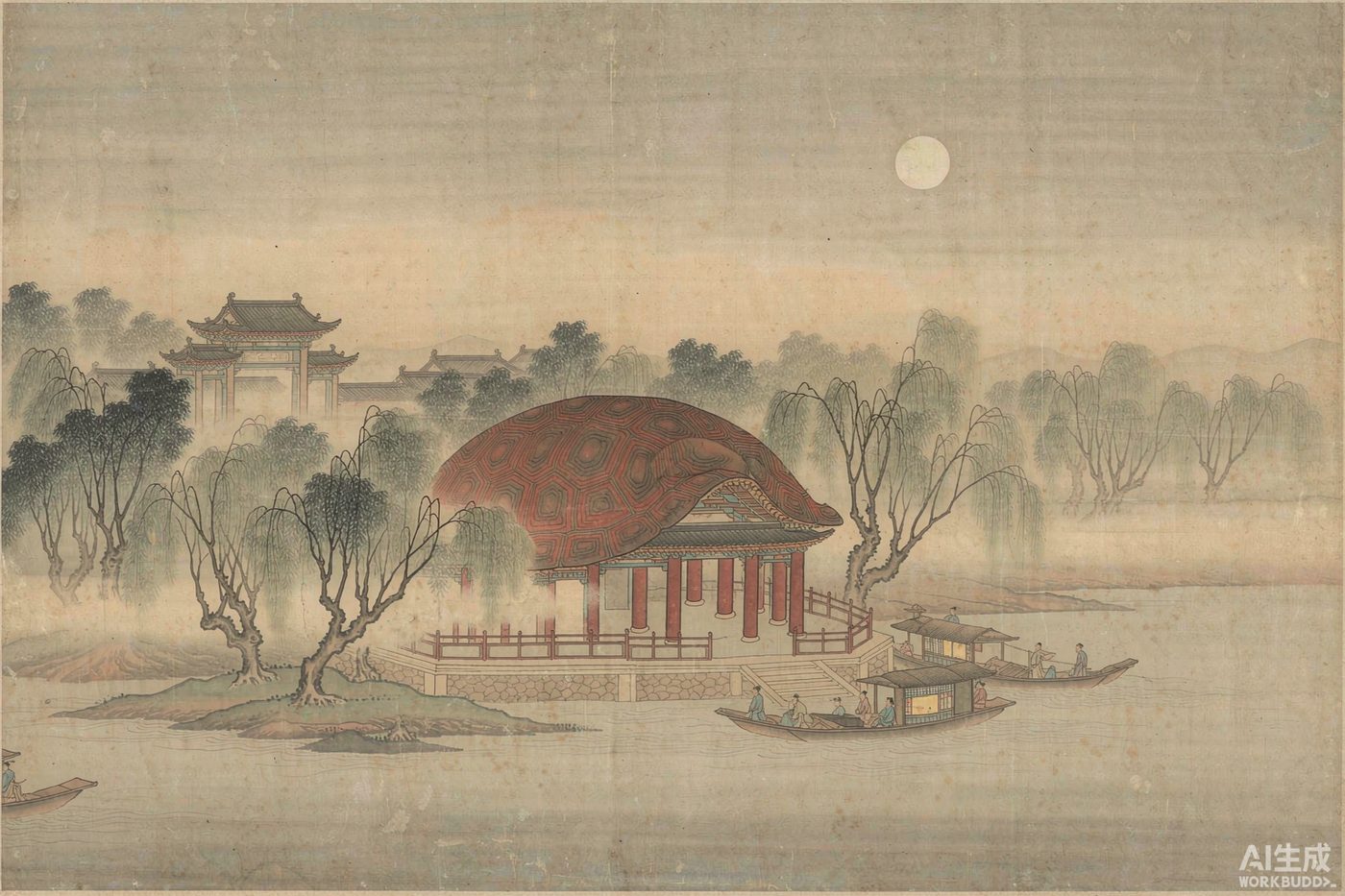
There remained the one shell, several zhang across and harder than iron, and it vexed them that there was no use for it — until they built a pavilion and roofed it with the turtle’s shell, which let the light through like panes of polished shell.
It stands to this day by the side of the main road outside the Chaoyang Gate of Zhenjiang.