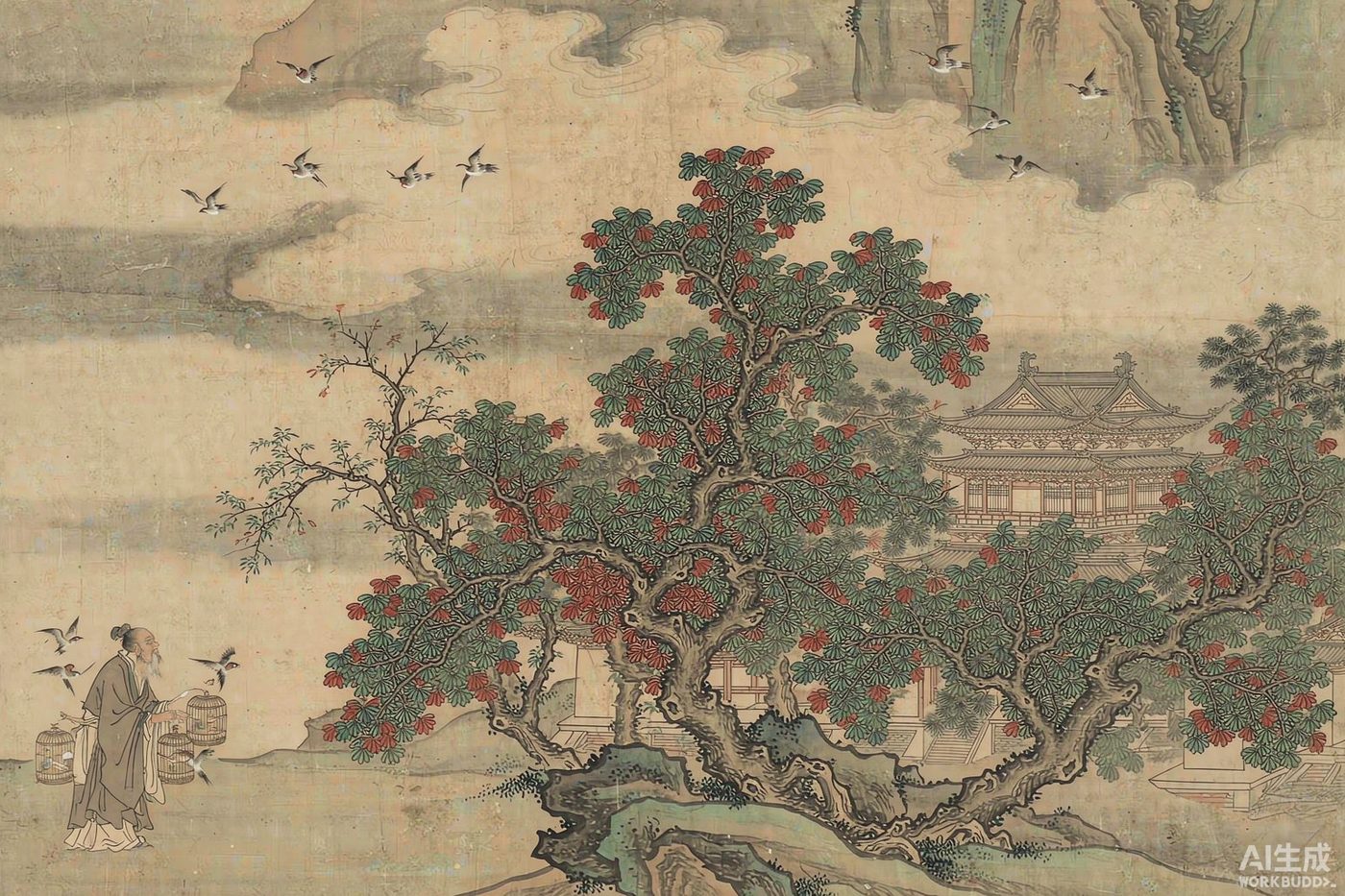
Old Mu of Taiyuan kept birds for a living. At seventy he was a widower, and took it into his head to look for a mate. He pressed every matchmaker he could find and not one brought him an answer. When he pressed further, they laughed at him.
“A son-in-law who rides the dragon is chosen in his prime. Hair ought to be black, and yours is white; a face ought to be white, and yours is black. Who would give a girl from an embroidered chamber to wait on an old man’s staff and slippers?”
Mu was furious. He took the birds out of their cages and let them all go, and set off in a temper.
One day, blundering among thick valleys with grey waste on every side and no one to ask the road, he saw a white pheasant rise on strong wings and fly away south of the hill. He followed it. Where the hill ended there was suddenly a village: in deep locust shade, walls a hundred paces long, and on the left a garden gate standing open. Thinking it some great house and not daring to announce himself, he slipped in.
Four girls came by, laughing.
“Fine weather today. Let us play at the pole.” They went up it one after another, red and green, hand over hand. One, in a faded red jacket with green collar and kingfisher sleeves, stood with her back to the flowers and said nothing.
“Is Ayīng moonstruck? Yesterday Lady Sang read the lamp-wick — one wick, four buds — and said we would have a strange encounter today. But a fine meeting is for all of us alike. Why should you go dreaming first?”
Even as they mocked her they caught sight of old Mu hidden under the flowers, and cried out: “The red luan has not shone, and the South Pole star has invaded the flower palace!”
It was Mu’s first time among so many hairpins; his head swam. He wanted to explain himself and had no tongue for it, and only stood against a tree, twisting his white whiskers.
Then word came from within: “Lady Sang is coming.” The four girls left Mu and stood in a ring.
“Has the honoured guest come?” she asked.
“There is no honoured guest,” they said. “Only an old thing.”
Lady Sang pointed at Mu, laughing. “This is your bridegroom.”
Three of the girls spat and turned and scattered. Only Ayīng stayed at Lady Sang’s elbow.
“Ayīng has some sense in her. Do not learn from those silly girls to judge by looks and quarrel with your luck.”
She led Mu into the inner rooms and said, smiling: “These children are the scattered offspring of the house of Shaohao. Drifted and homeless, they lodge here like wrens. You have an old affinity with them; I have presumed on the magpie’s good news to attach you in marriage. Do not find the owl ugly. Be a mandarin duck waiting for its mate.”
Mu agreed to everything. By phoenix-head lamps and duck-tongue incense, before a peacock screen, the marriage with Ayīng was completed, while the three other girls crouched behind the screen and giggled: “A fine falcon of a bridegroom — very like Master Wei picking himself a green heron.”
Next day Lady Sang brought out a box of purple mulberry pills and gave them to Ayīng for her husband. He ate them, and finished them in three days.
In less than half a month the black in his face had all turned white, the white in his hair all turned black, and the beard under his chin had dropped away entirely. He took up a mirror: he might have been fifteen.
When the three girls heard, they brought wine to congratulate him — bright clothes, soft chattering voices. Their names, he learned, were Juanniang, Cuiniang and Yanniang. And now that he was young, they courted him as boldly as they had scorned him, and Ayīng could not bear it, and pointed at him:
“You have only just had the duck’s legs mended onto you, and already you want two birds with one arrow?”
The three flushed. “A wife of half a month, and already sitting on the nest like a hen! Are we owls, that we would ruin your house?”
Ayīng rose, shaking her sleeve: “First you spat at him, now you lick at him. A rabble of crows! I am not eating oriole-roast to cure your jealousy.”
Lady Sang arrived in the middle of it. “Not one of you has her feathers straight. When he was old you would have left him to the luan alone; now that he is young you all want the cuckoo’s place. I should scatter you like a falcon scatters sparrows. But you share an old bond with him. Ayīng, swallow the grievance and make it a kindness; put the quarrel away. From this day, fly together, and let there be no more backbiting.”
The three girls hopped forward and apologised together, and afterwards drank to Ayīng in amends.
“I have a crow’s beak,” they said. “Do not forget, sister, that you promised the phoenix.”
Ayīng said: “So long as my sisters’ wings cover me always, how should I fly alone?”
Mu listened and laughed out loud.
“You wanted two birds with one arrow,” they told him, “and you have four phoenixes in one quilt. A mandarin duck in the water, eating swan-flesh it is not used to!”
From then on they flew by day and slept beak to beak by night, and the four women never had a cross word.
Then one day Lady Sang came white-faced.
“The great tree has fallen. Send him home at once.”
All four clung to his hands, weeping, unwilling to part. Lady Sang sent a maid in plain white to hurry him. Ayīng said: “Rather be dashed to pieces with him ten thousand times than be torn apart in mid-cloud. That is my case today.”
Mu too would not go. The maid said: “I brought you here, and I will take you back. Staying will do no good — you would only be crushed with the nest.”
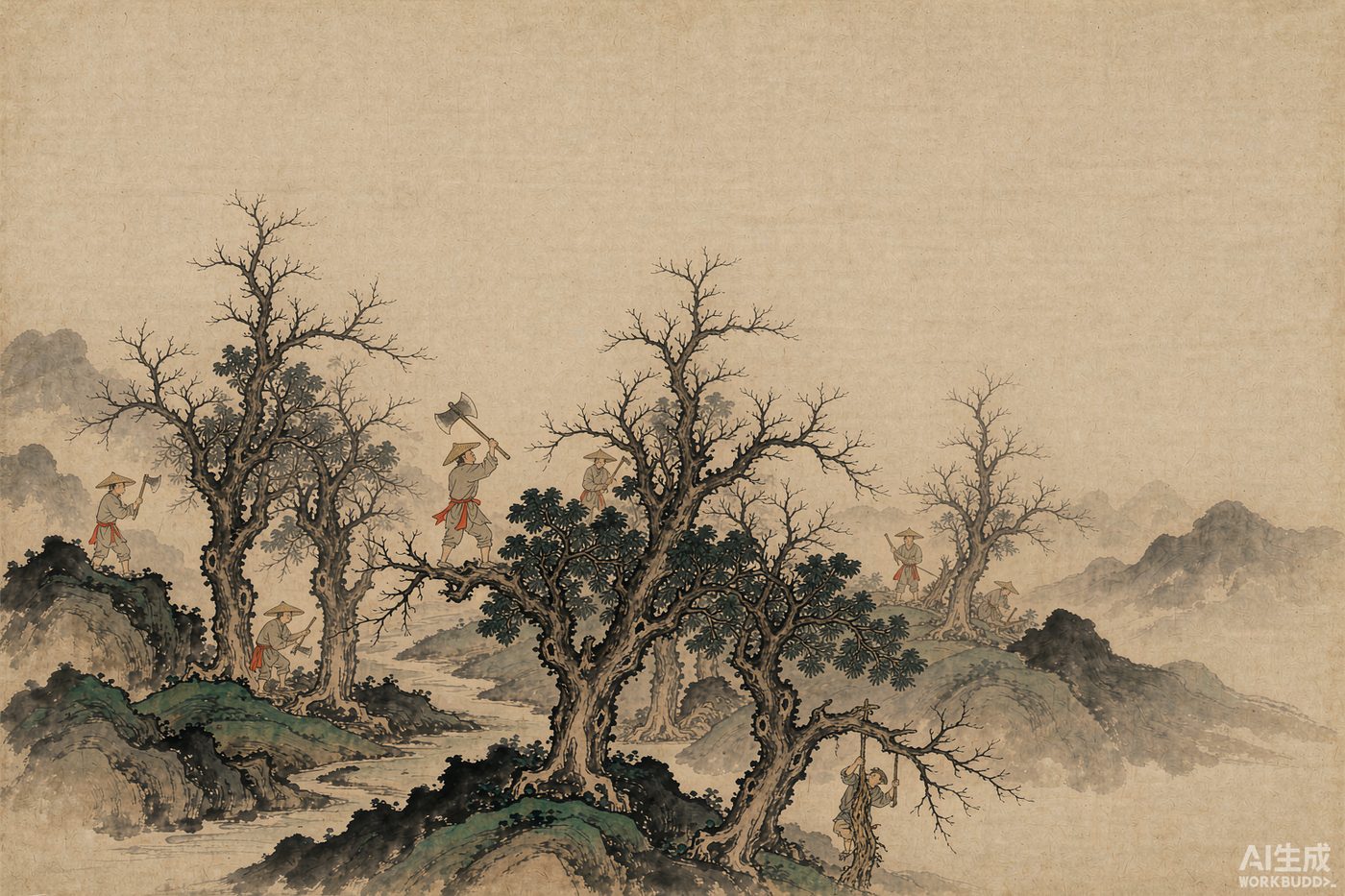
So he parted from them in tears. A few paces from the gate he looked back: the house was entirely gone. There was one mulberry tree, casting half a mu of shade, and a woodcutter with an axe beneath it, and four birds in the branches crying. He turned to question the maid — and she had become a white pheasant, and was rising into the air, and gone.
Remembering Lady Sang’s kindness, he begged the woodcutter to leave the trunk standing, and found his way home.
The Duo comment: With one shot at Rugao the wife of Jia laughed — so the pheasant is a creature that meddles in the bedroom affairs of men. Yet the Cattle-herd Boy was wifeless at seventy, and the tune The Pheasant Flies at Dawn never married him off. As for old Mu — surely it came of the merit of opening the cages?