A certain magistrate of Pucheng had abstained from the taking of life for generations. His wife was of a violent temper, and took her pleasure in slaughtering living creatures.
When her birthday came round she ordered the cook to prepare the dishes well beforehand. Below stairs the pigs and sheep stood in rows and the chickens and geese in flocks, stretching out their necks and crying, all of them about to die. The magistrate pitied them, and said to his wife: “It is your birthday, and this is where they come to die. Our Buddha is merciful; I beg you, madam, to plant a little merit.”
His wife cursed him: “If one follows the Buddhist teaching, forbids men and women to each other and forbids the taking of life, then in a few decades the human race will be extinct and the world will belong to the birds and the beasts. Do not talk that old schoolmaster’s talk to me.”
The magistrate saw that she was not to be reasoned with, sighed, and went out.
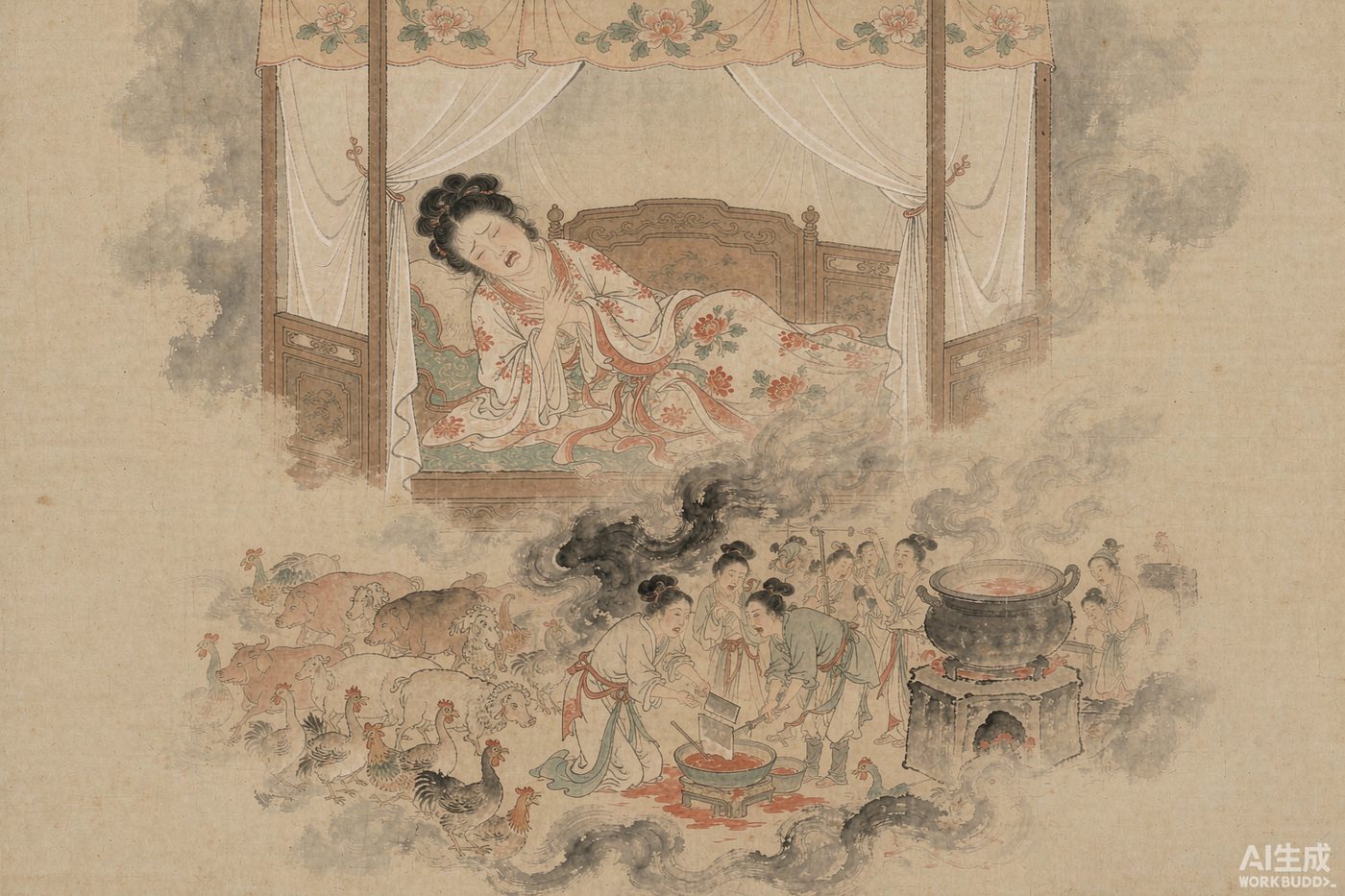
The lady shut the door and lay down for a daytime sleep. She did not notice her own body going into the kitchen. She saw the cook sharpening his knife with a hiss, and the maids and servants standing in a ring to watch — and then of a sudden her soul joined with the pig and became one body with it.
The cook came straight on, bound her four feet, lifted her onto the white wooden bench, pinned her head down, and drove the sharp blade into her throat. The blood burst out; the pain went through to her lungs. With a gulp she fell into the cauldron of boiling water; the hair was torn out, the scurf scraped away, until hardly a strip of skin was left whole. Then they cut from the neck down to the belly, and the pain was past bearing, and her soul broke apart with the liver and the guts and burst out at once.
She felt herself drifting with nothing to hold to, and then she was one with the sheep, and howled aloud in her terror. The maids and servants only sniggered; not one of them came to the rescue. The cruelty of that slaughter was twice the pig’s. And so with the chickens killed and the ducks cut down: every one of them she underwent in her own body. Peeping out, she saw that the killing was finished, and her frightened soul grew a little calmer.
Then an old servant came in carrying a golden carp, and her soul attached itself to that as well. A maid laughed: “The mistress is excessively fond of this one — make haste and chop it into fish balls for her supper.” The cook stripped off the scales, picked out the gall, took off the head and tailed it, laid it on the block, and minced it with a zheng, zheng of the knife. And now each stroke of the blade was a separate pain, as though she had become a hundred thousand million bodies all suffering the fish’s death by inches. She screamed with all her strength, and after a while she woke.
A little maid came in and said: “The fish balls are ready. Will the mistress take her supper?”
She ordered them taken away at once. And thinking back on that terror, bead after bead of sweat ran down her.
The next day she told the magistrate to call off the banquet. He questioned her closely, and she told him the whole dream. He laughed and said: “You never had any faith in the Buddha. If you had not been made to suffer all these miseries, how should you ever have put down the butcher’s knife?”
His wife laughed too, in spite of herself. From that time on she gave up meat and ate plain food, and kept the prohibition on taking life together with her husband.
— The author’s comment (condensed): a hundred chicken feet and ten thousand sheep’s heads — how many lives does the tip of one tongue cut short? To forbid men and women to each other, and to forbid the taking of life, is to lay the axe to the root of the teaching; but the Confucian books speak to the wise, and the Buddhist books speak to the foolish. To the wise the matter begins with husband and wife, with fishing but not netting, with shooting but not at a bird at roost; to the foolish there is only the one rule, and it is abstain. As for those who would have faith and abstain from nothing — the wife of the Grand Astrologer was never happy in this world, and nobody ever saw her carried up to the lotus terrace on the strength of a single meatless meal.