Stories/ 子不语/ The Spirit Who Played the Father

The Spirit Who Played the Father

怪诈人父

SourceZibuyu (What the Master Would Not Discuss)
AuthorYuan Mei
EraQing dynasty · Qianlong era, c. 1736–1798
Writtenc. 1788
TricksterMonsterSatireMoney
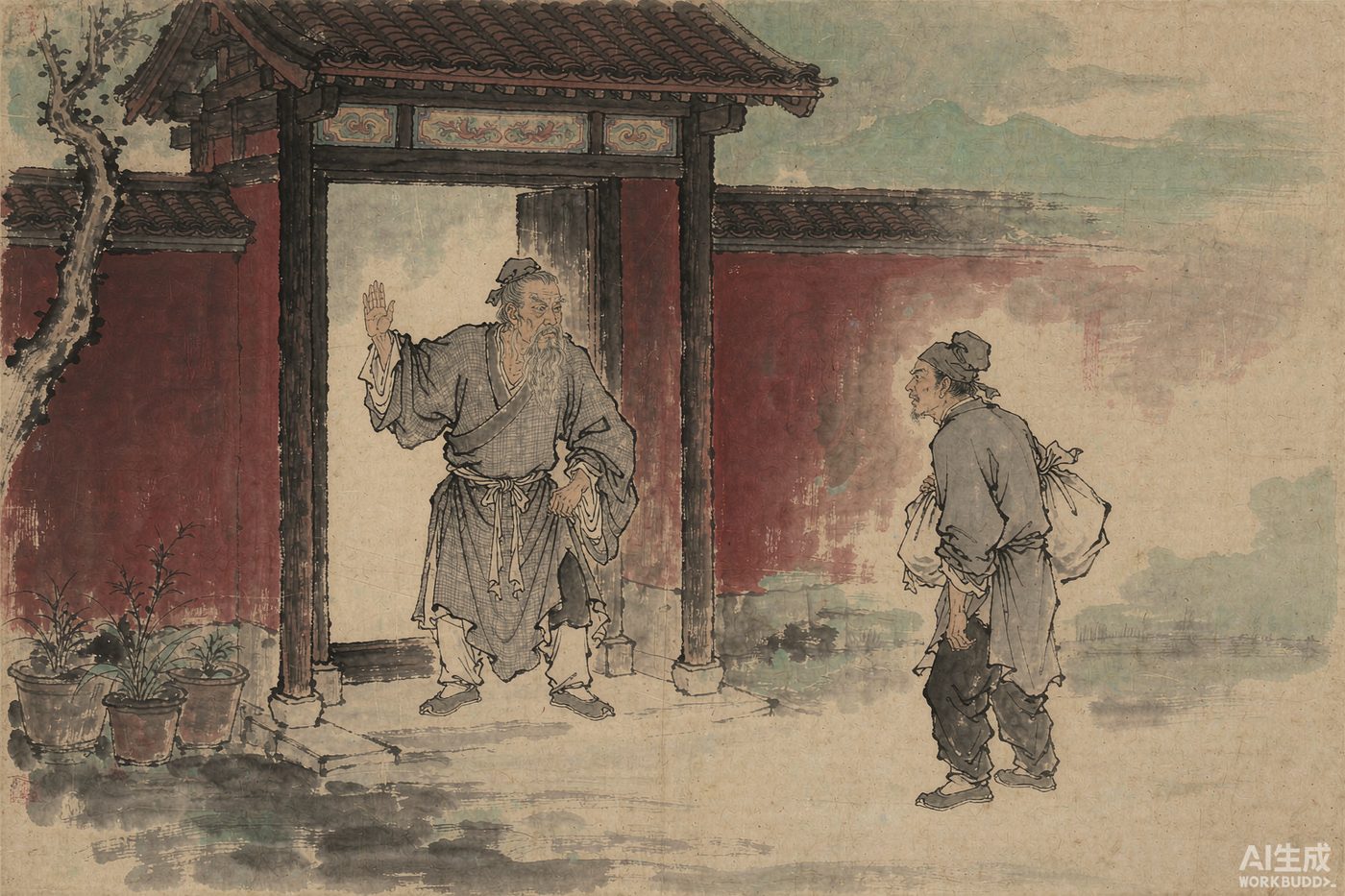
An old man with a long grey beard in a mouse-grey silk robe stands in a doorway with one hand raised palm out to refuse entry to a startled travelling merchant holding a bundle
Illustration generated by AI, based on the ancient Chinese text.

The licentiate Li Yushuang had a maidservant named Chunyun, of some beauty. She was fifteen. Li wanted to take her as a concubine, and had already come to an understanding with his wife about it.

One day in broad daylight Chunyun saw a man come down from the roof-tiles. He put his arms round her coiffure and sniffed at it: “Your hair smells very sweet. You are going to be greatly honoured. You should follow me, not your master. Your master is a poor scholar who keeps a school; even if he passes the provincial examination he will end as nothing more than a school official. Tell your master to yield you to me, and to supply me with wine and food, and I will come and live in your house as a husband.”

Li was furious when he heard it, but there was nothing he could do. That night the spirit came and lay with the maid.

She begged her master to provide wine and food. When he did as she asked, the house was quiet day and night; otherwise there was a plague of bricks flying and tiles being thrown. Li had no choice but to discuss with people putting the house up for sale.

Li taught at the Shi family’s house on Wangxian Bridge and was not often at home. One day a merchant named Sun Gengwen came to look at the house. He knocked, and an old man with a grizzled beard in a grey squirrel-fur robe came out to meet him, waved his hand, and said: “This house is my ancestral property and is not for sale. Do not listen to the nonsense of that boy Yushuang, or take it over privately between you; you will find yourself in a lawsuit later.”

Sun was greatly alarmed, and went off and told Li, reproaching him: “While your father lives, a son may not act on his own.”

Li said: “My father died more than ten years ago, and there is no such old man in the household.” Then they knew the spirit had been mocking them, pretending to be his father, and the two of them laughed together.

After that people knew the house was haunted and it could not be sold. Li told the maid’s parents to take their daughter home and not ask for her purchase price. The maid gashed her own face and cut off her hair, and swore she would not go home. Her mother, fearing the spirit would do her harm, tied her up with rope, bundled her home, and married her to a scholar. The spirit never came again.
Original classical Chinese text · 原文

李玉双孝廉家有婢,名春云,颇有姿,年十五,李欲纳为妾,与其妻有成说矣。春云白日见瓦上一男子下,拥其髻而嗅之曰:「汝发甚香,当大贵,宜从我,勿从主人。主人处馆穷儒,虽中举,不过一教官终耳。你向主人言,命其让我,且供我酒馔,我便赘汝家。」玉双闻之大怒,然亦无如何。是夜,怪竟来与婢配合。婢求主人具酒馔,如其言,则日夜安宁;否则,飞砖掷瓦之祸毕作。玉双不得已,与人谋将此屋招人承买。玉双馆于望仙桥施氏,不常在家。一日者,商人孙耕文来看屋,敲门,有苍须老翁衣灰鼠袍出迎,摇手曰:「此屋是我祖遗,并未出卖,勿听小儿玉双妄语,私相授受,将来要受讼累。」孙大骇,走告玉双,责以「父在,子不得自专。」玉双曰:「先君亡已十馀年,家中并无此翁。」乃知为怪所揶揄,冒认为父,彼此大笑。 自后,人知屋有怪,屡卖不成。玉双乃命婢父母领女还家,勿索身价。婢剺面剪发,誓不肯归。其母虑为怪所害,以绳缚之,捆载还家,另嫁一士人。怪竟不来。

From 《怪詐人父》, Zibuyu juan 14. Translated in full. 孝廉 is a provincial graduate (juren); 处馆 means to keep a family schoolroom, i.e. to be a hired tutor; 赘 means to marry into the wife's family as a resident husband.

Source. From Zibuyu (What the Master Would Not Discuss) (子不语), by Yuan Mei , c. 1788. The original text is in the public domain; this English rendering and the accompanying notes are original work.

Keep Reading

Related Stories

Southern Song dynasty · 12th century · 夷坚志

The Fifth Young Lord

五郎君

A man too poor and too drunk to keep his beautiful wife loses her to a young god who visits at midnight and pays in silk. He is furious — and then he does the arithmetic, casts an image of the god in gold, and worships it. When the authorities finally jail the couple, the god breaks open the prison and burns the government offices to the ground.

DeitySatireOfficialdom
Southern Song dynasty · 12th century · 夷坚志

The House in the Cypress Wood

呂使君宅

A soldier loses his way and finds a mansion in a cypress wood with fine horses at the gate. The widow who owns it is nearly forty, keeps a dozen maids, and presses him to stay — and it is he who refuses, on the grounds that a rough soldier is no match for such a woman. She argues him into it. Then he meets her elder sister.

GhostLoveMoney
Qing dynasty · Qianlong era, c. 1736–1798 · 子不语

The Temple That Ran on Poison

鸩人取香火

A Daoist raises money, builds a temple and puts up a statue. On consecration day a ruffian insults the god in front of the whole crowd — and drops dead with blood from all seven openings. The incense trade booms and the priest grows rich. A year later his accomplices fall out over the money.

DeitySmall GodsSatire