The Temple of the Ten Aunts stands west of Duqu. Nobody knows in what age it was built. Its lintels are of iris and its beams of cassia, its walls peppered and its curtains of thoroughwort, and within are set up ten women in kingfisher plumes and bright ear-pendants, every one of them a beauty.
A student of the imperial college was passing. He went into the temple to look at the images, and went home and dreamed; and suddenly he was standing in the corridor.
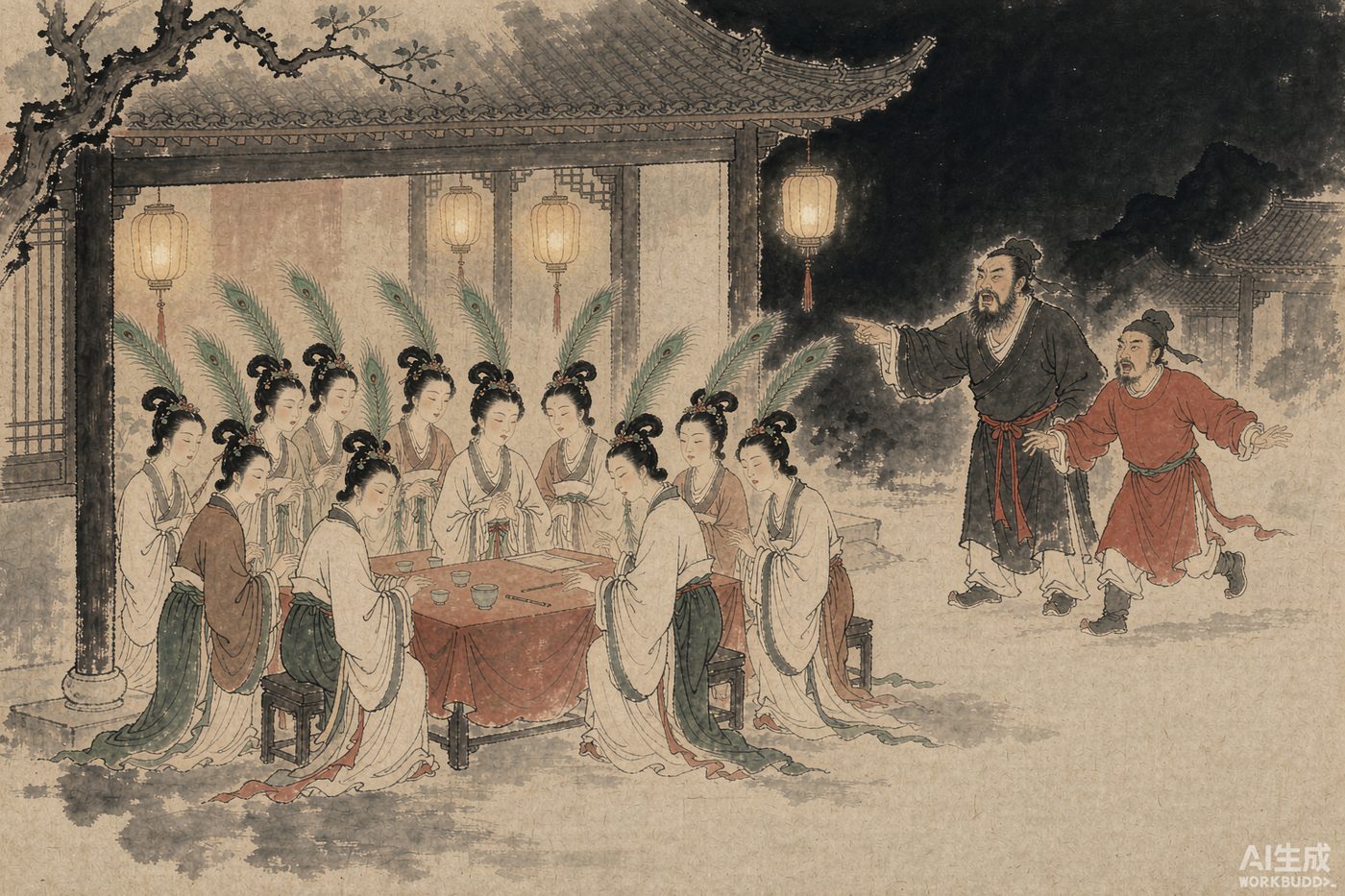
The autumn river of stars lay across the sky, dew lay bright over the ground. The sparse stars brightened and dimmed, and half a corner of a red tower showed. Then he glimpsed four or five maids with gauze lanterns coming down the steps before a crowd of beauties.
One of the women looked up and sighed: “Tonight the Palace of Vast Cold is shut. I wonder how the Lady in the Moon bears sleeping alone.”
The others said: “Do not fret for her. We live here without a man between us, and we yield nothing to the Little Maid of Green Creek.”
And then a maid raised her lantern to trim the wick and saw the student crouched in the dark of the corridor, and shrieked: “What mad boy is this, spying on beauties of the realm?”
They all came to look, and laughed. “We were only this moment saying there was no man here, and here is a guest. It quite redeems us. Come in.”
They took him into the room, set two mats side by side, and seated him in order. In a moment rare food and good wine covered the table.
The eldest aunt said: “Drinking in silence is dull. Tonight we have a fine guest. Let us play an elegant forfeit.”
They all laughed. “The leader is never vulgar. She opens her mouth and at once it is elegance.”
The eldest aunt said: “I do not presume to elegance. Each of us quotes a line from the Four Books and follows it with the name of an ancient. Whoever fits pays nothing; whoever does not pays by the rule of Golden Valley.”
They agreed, and she filled a great cup and offered it first to the student. He excused himself: a guest does not take the lead. She drank it off herself, turned up her palm and stood.
“Mencius saw King Hui of Liang. — Wei Zheng.”
They cried out together: “Excellent! The riddling of Wu Zi, the guessing of the Han scholars — nothing finer than this.”
It came to the second aunt. “He can be employed to administer his levies. — Xu You.”
The eldest said: “The later one outdoes the earlier. The great shaman has pressed down the small.”
The third aunt. “The five grains do not grow. — Tian Guang.”
The fourth took it up. “Lay by the shields and spears. — Bi Zhan.”
The fifth aunt looked at her sideways, smiling. “You two are perfectly matched. The poetry world has found its pair of hens.”
The fourth aunt looked at her with the whites of her eyes. The fifth dipped a finger in her hair-oil and flicked it at her face. “To sit in mud and ashes. — Hei Tun.”
The fourth aunt writhed three or four times. “The girl truly has the Zuo obsession in there.”
It came to the sixth aunt, who stammered. “The so-so-sovereign…”
The third aunt said: “Which of us is not without a man? Must you say the word so many times?” And she reached for the cup to fine her.
The eldest aunt said: Feng, it is a feng; it is still one feng. What harm?
The sixth aunt flushed to the cheeks and got it out in jerks: “The sovereign loves courage. — Wang Meng.”
The seventh aunt bent her head, smiling. They pressed her. She said: “I have one, only I fear it is not refined.”
The eldest said: “Little witch, always playing tricks. There is a guest here. Do not talk nonsense.”
But the seventh could not hold it in. “Its straightness is like an arrow. — Yang Huo.”
They all clapped hands over their ears and would not hear it.
The eighth aunt said to the ninth: “Let you and me fetch the Jie drum and wash off the filth for this silly girl.” And gravely: “That Tai Bo may be called the utmost in virtue! — Yu Rang.”
The ninth aunt said: “The intercourse of friends. — Diwu Lun.”
The tenth aunt rose. “I am the youngest. I will do my poor best to finish the marten for my sisters. Though there were a thousand, ten thousand men, I would go on. — Yang Xiong.”
The student was still sweating over his own when he heard the tenth aunt, and had a sudden illumination. He said: “The water of Ox Mountain was once beautiful. — Shi Xiu.” And was rather pleased with himself.
The eldest aunt said: “A man of talent and wide reading, who does not fear to cite melon and inquire into events — how has he come down to the Water Margin?”
The student shouted back: “He can produce the Sick Guan Suo. Am I not allowed the Desperate Third?”
They all laughed into their hands. The eldest aunt said: “You are mistaken. She meant Yang Ziyun, of the Grass Mystery Pavilion.”
The seventh aunt said: “That degenerate Yang Huo knows nothing but stealing bows. What would he know of Ziyun or Ziyu?”
The student was crushed. The third aunt said: “Mouths are many and I am one. Better simply to drink three.” He raised the cup and emptied it three times. The eldest aunt laughed: “Your book-bag is rather narrow. Happily your wine-bag is rather wide.” The four quarters roared.
After they had drunk a while the fifth aunt rose and said: “A meeting like this must have poetry.” She had the maids bring brush and inkstone.
The seventh aunt said: “The fifth aunt is always fishing out the book-satchel. This time we want only collected lines from the ancients, each of us a full regulated verse.”
The eldest aunt said: “Who would have thought the wanton child had rules in her breast.”
She had the maids move the lantern to the wall, and took up the brush first:
Married to a Xiao lad who loves to wander far, and every fair scene only makes grief grow. Her peach-blossom face is too thin to hide tears; the paulownia’s heart is solitary and takes autumn easily. In the paradise park there are letters, many carried by cranes; by the painted screen she cannot sleep, waiting for the ox-herd. Others need not know what is in her heart — again she takes up the light quilt and climbs the jade tower.
The second aunt:
Where does the dream come from, that it should be cloud again? The wine before the hall, and the day already dark. I think he too must pity Song Yu — yet would he let Wen Jun be seen so easily? The kingfisher-feather phoenix fan lies cast aside, the gold-powdered butterfly skirt is a regret. Passing through the flowers one by one, I will not look back — pale red and fragrant white, crowd upon crowd.
They went round the room eight more times, each aunt building a complete poem out of stolen Tang lines, and the praising of one another’s was relentless and exact.
Then they handed the brush to the student.
He sweated, his hand shook as though he were lifting a great tripod. He sucked the brush some dozens of times, and breathed against the wall like an ox.
The eldest aunt said: “Brush down in the heat of inspiration is the joy of the poetry world. Why do you torment yourself so?”
The third said: “Ten years polishing the Capital Rhapsody, twelve on the Metropolis — that is only the usual practice of men of letters.”
The seventh said: “As you say. Tonight we will stake a million extra night-watches to see how Young Wen gets on with his folded hands.”
The student felt the cold words closing on him from every side. With an effort he wrote seven characters on the wall:
Since Pangu parted heaven and earth
The eldest aunt was startled. “You intend to rhapsodise the six directions? And where does this line come from?”
He said: “It is the ancestor of all the blind men’s ballads. Hang it at the city gate and not one word of it has ever been added to or taken away.”
The eldest aunt said: “Balladry in poetry. The altar of the Li Sao has lost its colour.”
The seventh said: “Most of the poetry elders of the day already honour balladry as their founder, and set it to strings, and the women’s quarters listen in rapture. Is that not better than vomiting the heart and carving the lungs?”
The whole hall roared. The student’s face fell, and he crouched and said: “That was a joke. Let me change it.”
He made a show of chanting to himself and wrote again. The fifth aunt, looking over, saw that it was the first line of the Thousand Family Poems, and that he had written the character for noon as the character for ox. She clapped a hand over her mouth. He gripped the brush harder and looked thoughtful.
Then a man in cap and belt came in.
The student laid down his brush at the chance. The ten aunts hurried to attend on either side. The man sat down at the table and said:
“I am Du Shiyi, of Huanhua Brook. Since the Tang I have been sacrificed to in this temple. I did not imagine that village ignorance would take Reminder for Ten Aunts and let a crowd of women in skirts settle themselves in my hall. I put up with it only because I supposed you at least knew something of letters. And now you bring a white-bellied boy here to smear my walls with ordure. From this day forward, clear out three she-li and stay clear. Do not say the Du family’s white-handled long spade is blunter than a chancellor’s sword-point.”
The ten aunts prostrated themselves and asked forgiveness, but his anger was not spent, and he had the student pushed out of the door ahead of him.
The student said: “What ill-bred guest is this, driving out a poet?”
The tenth aunt whispered in his ear: “This is Du Shaoling of the Tang.”
The student said: “And who is Du Shaoling?”
The tenth aunt said in fury: “You do not even know Du Shaoling, and you come here to talk about poetry, and involve us in it.” And she and all ten of them fell to slapping his face.
Then he heard a great voice from the hall: “He is an utter outsider. Why waste more words on him?”
Before the shout ended he woke — and for the life of him still could not work out who Du Shaoling was.
He told the dream to everyone he met, and none of them could hear it without laughing.
Afterwards the scholars of the place destroyed the women’s images and restored the sacrifice to Du Shiyi. And anyone who passes and thinks of writing a poem on that wall is told the story of that student, and thinks better of it.
The Duo comment: “Shaoling wished, with ten thousand broad chambers, to shelter every poor scholar under heaven — and yet this student could not lodge under the eaves for a single moment. From this we see that the man who loves talent as his life is the man who flees the vulgar as his enemy. A lime-washed wall is easy to smear; the long spade is hard to offend. Truly, keeping watch over the shrine at Huanhua Brook is no easy post.”
Condensed from the original: the full tale contains ten complete lampoon-verses assembled from collected Tang lines, and the whole of the drinking game, of which roughly half is given above.