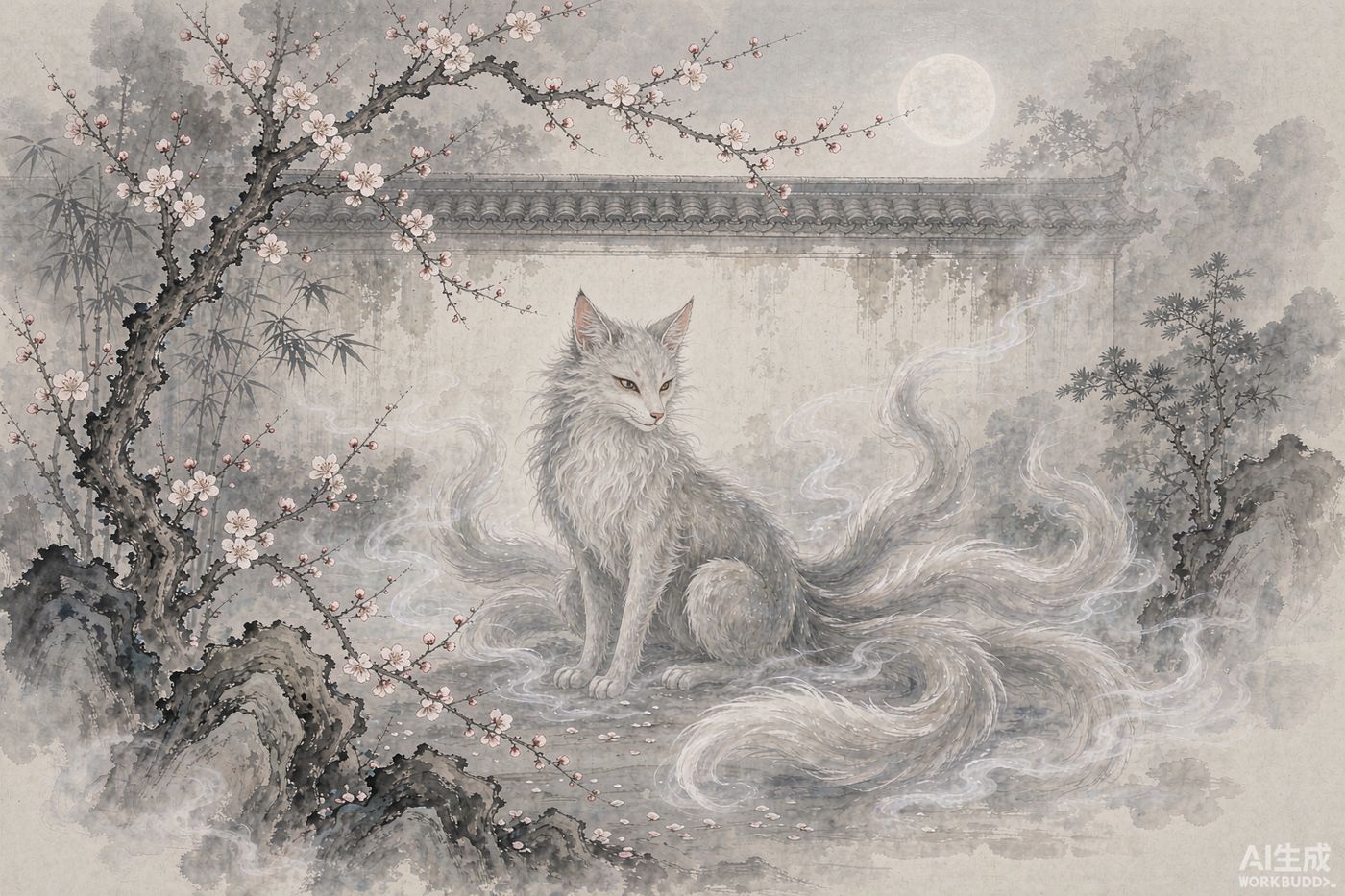
No creature in the Chinese supernatural has had a longer or stranger career than the fox (狐, hu).
It begins as an omen. In the earliest texts the nine-tailed fox is a creature of auspice: it appeared at the court of the sage-kings, and its cry was read as a promise of fertility and dynastic fortune. It attended the Queen Mother of the West on Kunlun. A white fox with nine tails was, in short, good news from heaven.
Then the tradition darkened. Foxes, it came to be believed, are the animal kingdom’s great cultivators: a fox that lives long enough — fifty years, a hundred, a thousand — gathers power. It learns to take human shape, almost always the shape of a devastatingly beautiful woman (though old foxes may appear as scholars, or white-bearded masters). And the seductive fox-woman became one of the central fears of Chinese fiction: the spirit who drinks a man’s vitality through his desire, or brings a dynasty down through a king’s. Daji, the fox-spirit concubine blamed for the fall of the Shang dynasty, is the archetype of the ruinous fox.
But that is only half the career. In the hands of the storytellers — above all Pu Songling — the fox-woman becomes fiction’s most interesting question: what does a creature that has become human do with humanity? Some foxes prey. But many, in the tales, love — faithfully, sacrificially, better than the humans around them. Miss Ren keeps a poor scholar’s house and dies for accompanying him. Yingning marries into a human family and trades her wild laughter for their peace. The fox-spirit, by the Qing dynasty, had become the genre’s mirror for testing what humans mean by virtue.
The mechanics are stable across a thousand years of stories. A fox gains a tail per century of cultivation; at nine it is near-divine. It may be detected by dogs, by mirrors, by wine, by its tail showing when it is careless. And it sits exactly on the boundary this whole universe is built around — animal and human, omen and monster, predator and the most faithful lover in the library.