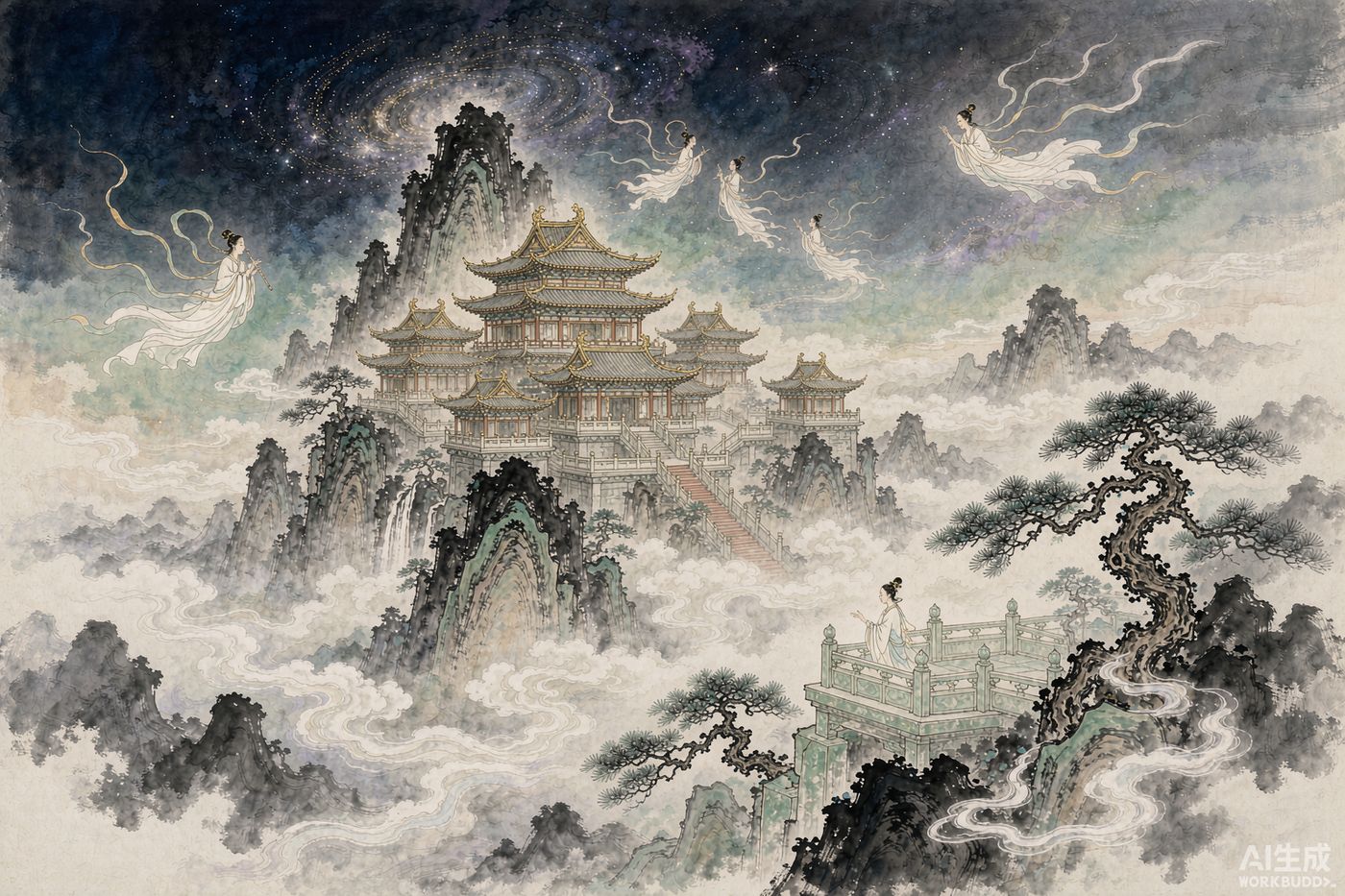
At the far western edge of the known world, the Shan Hai Jing places a mountain that is less a place than an axis: Mount Kunlun, the pillar between earth and heaven.
The descriptions accumulated over centuries into something immense. Kunlun rises in tiers — nine walls, nine wells of jade, gates guarded by the nine-headed beast Kaiming. On its heights grow the trees of life and the orchards of the Queen Mother of the West, where the peaches of immortality ripen once in three thousand years. Rivers that water the whole world are born at its feet. It is said that only those who have shed mortality can climb it; to everyone else it exists the way the horizon exists — always further west.
Kunlun matters to the story-library as the western pole of the sacred map. When a tale needs the source of an elixir, the court of a goddess, or the ultimate destination of a seeker, the road runs west to Kunlun. Its eastern counterpart — the isles of Penglai in the Eastern Sea — holds the other end of the map: where Kunlun is the mountain of the goddess, Penglai is the island of the immortals.
There is also a real Kunlun range, far to the west of the Chinese heartland, and the mythic mountain slowly fused with it. But the Kunlun of the stories is not geography. It is the place where the vertical axis of the three realms comes closest to the surface — the nearest thing this cosmos has to a stairway to heaven.