A successful candidate named Zeng was on his way to the metropolitan exam; he took an old servant and travelled north, and at night lodged at Liuzhi Temple. Dusk had fallen; he unsaddled and rested. Strolling outside, he saw willows along a bank, a long red bridge over spring water, and dozens of apricot trees with kingfishers chirping among them. Zeng crossed the bridge and came to a garden gate standing open. He wandered in, through elegant chambers, winding by the corridor to the inner bedroom — pearl blinds, coral bed, sea-red curtains not yet drawn. On a small dressing-table the mirror-case lay open, the powder-box half-unclosed, a peach petal by the rouge. He heard the patter of phoenix slippers; startled, he hid in the side curtain. It was his own wife.
He asked: “How came you here?”
She smiled: “This is the villa you newly bought; how forgetful!”
He did not recall. They sat and talked; then outside, horses neighed and men buzzed. He asked — it was the welcome of the new top graduate to the Apricot Garden feast. Zeng mounted and was escorted away: ten li of flower-dust, a proud glance. After the feast he returned; his wife waited at the door. They burned incense, spoke of old cold-window nights; both looked pleased.
Then to bed. He thought his wife was older now, and they so rich — why not add concubines to the lower ranks? As he laid his head, a man came with a card: a rich family seeking to connect with the new dignitary, offering ten measures of pearls to buy four beauties as concubines. Zeng was delighted, and summoned them. They came — plump Juanjuan, delicate Chuchu, bright-eyed Qiantao, the hair-tossing Chunliu. He had Juanjuan spread the mattress, Chuchu hold the quilt, Qiantao arrange the pillows, Chunliu remove his crown. He entered the curtain naked; the beauties undressed around him — a scene of jade flesh. He was dizzy with it.
Suddenly he heard his wife calling from behind the bed; the spring dream broke. He was angry: “Why so nagging? A moment’s convenience, and the land of warmth was already a dream.” The wife also chided. He, furious, said: “When I was poor, every step was constrained. Now fortunate and great, the Han house has its own system — must it be ruled by the rose-thorn rod of your jealousy?” The wife rose and wept to the wall: “Faithless one, remember? When you lost your post, you couldn’t get a bowl of congee at night; you pawned my hairpin for cash to buy a measure of rice. Now suddenly successful, you cast white eyes — where is the marriage-bond?” He, holding the new-dignitary airs, hearing her bring up old flaws, grew more defiant, slapped the pillow and cried: “A five-colour mandate — see if you have the face to enjoy it!”
Suddenly a laugh by his ear: “Sir, are you having a nightmare!”
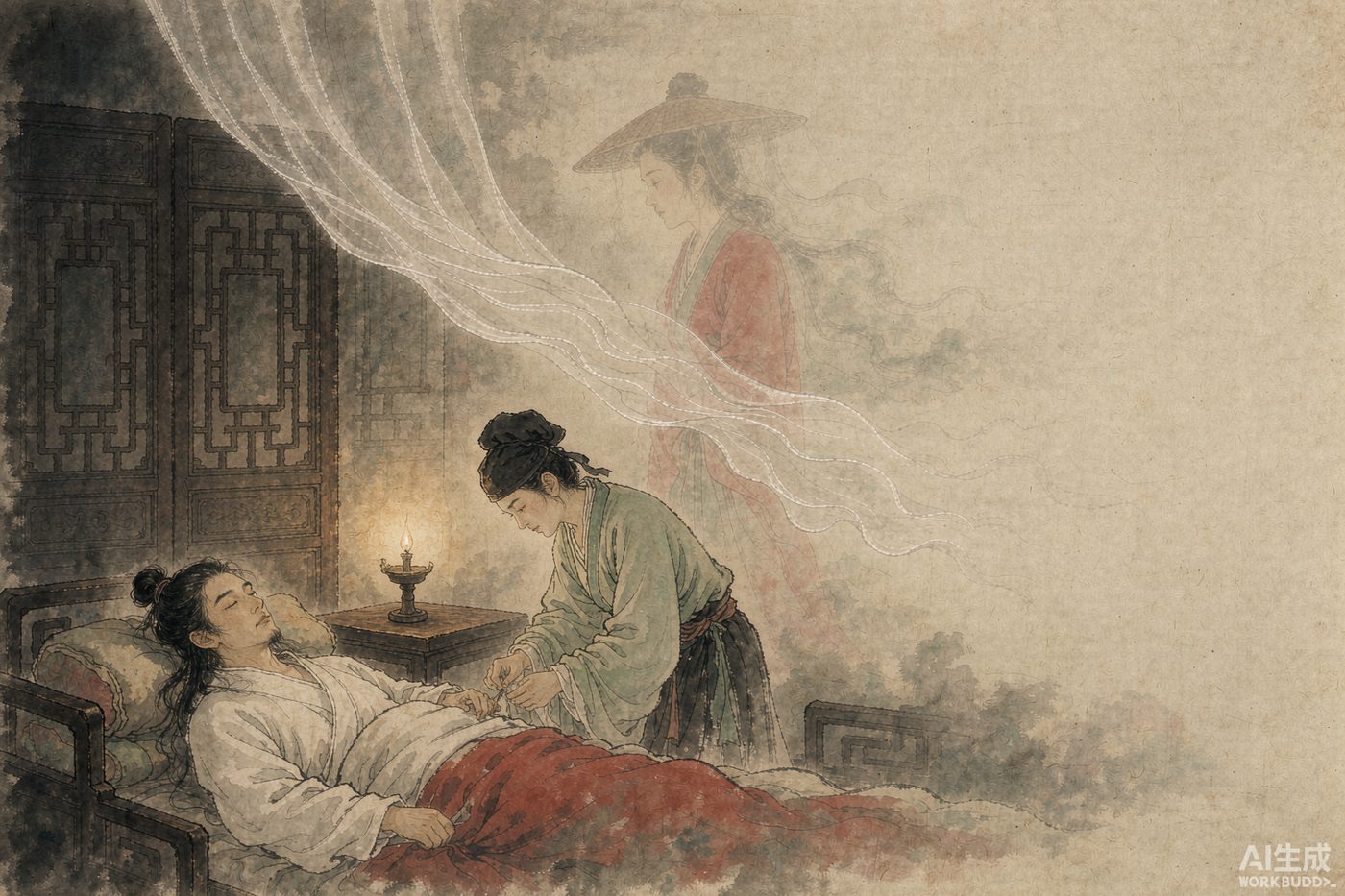
He turned from the pillow; it was the old servant catching lice by the lamp. He composed himself; holding the quilt, he laughed. The servant was blank.
The Duo comment: When a man wakes from the spring dream, none but laughs — who knows he is still in a dream? Only the perfect man has no dream, because he has no wealth-heart; and only the fool has no dream, because he has no wealth-fortune.