The standard joke about Chinese fantasy is the proverb a day in the cave, a thousand years in the world. It gets quoted as a shrug: time is weird over there, isn’t it. The texts are not shrugging. Across a thousand years of zhiguai the otherworld’s time is described with the same precision as its borders, its post-stations and its paperwork — and once you line the accounts up, four different rates emerge, each with its own instrument, its own cost, and its own way of ruining the person who experienced it.
1. Faster in: the pillow, the tree, the broken bed
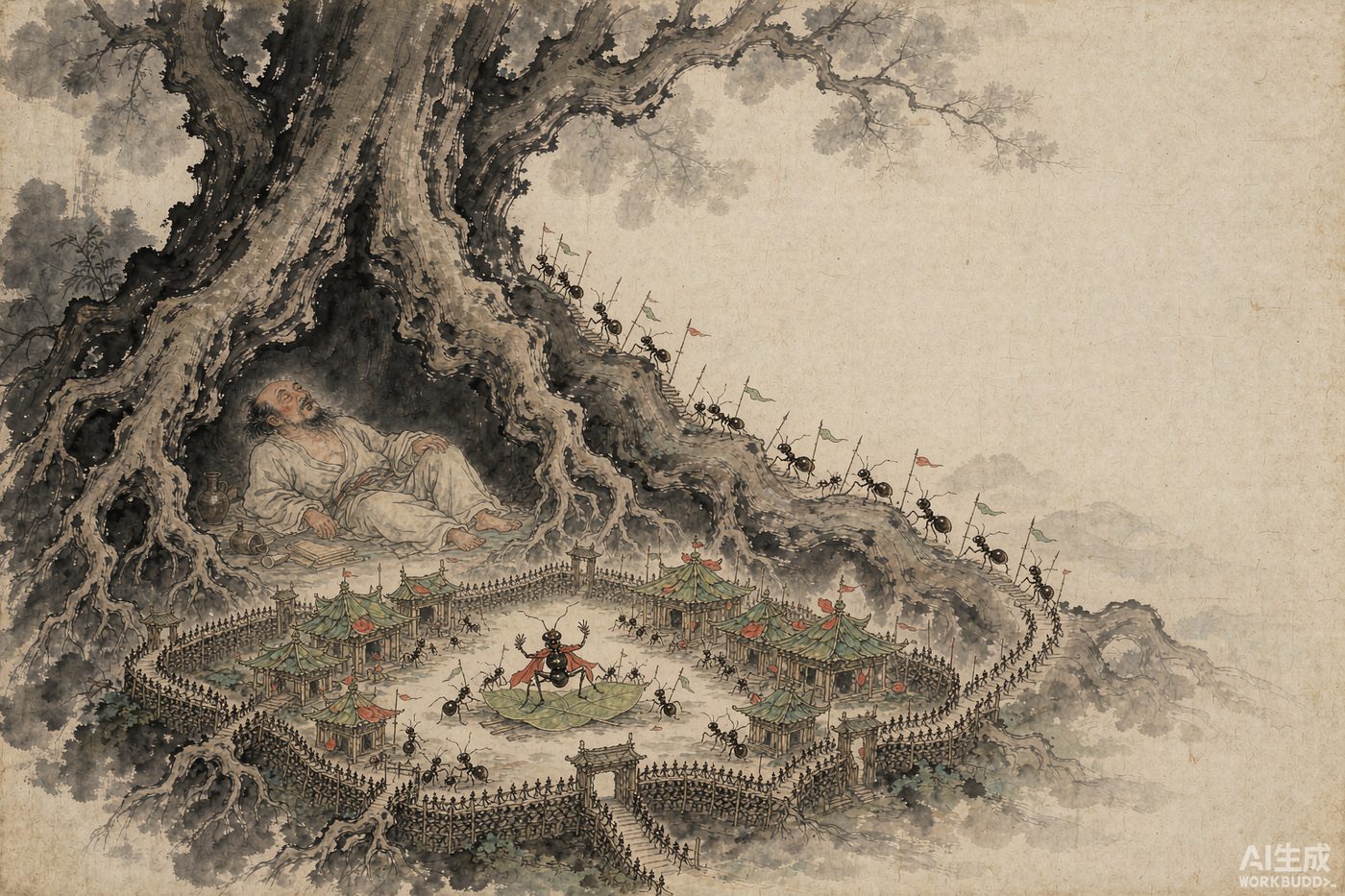
The most famous version runs inward. Chunyu Fen drinks himself to sleep under the old ash tree and wakes as a royal son-in-law; he governs the South Bough for twenty years, fathers five sons and two daughters, wins a war, loses one, buries his princess and is driven home in disgrace — and wakes in the east hall of his own house with the sun not yet down and the wine in the courtyard still warm.
The plot is famous, but the clock is the invention. What proves the dream was a dream is not that he wakes; it is that the wine is still warm. The outward world is being timed by a cup left on a table.
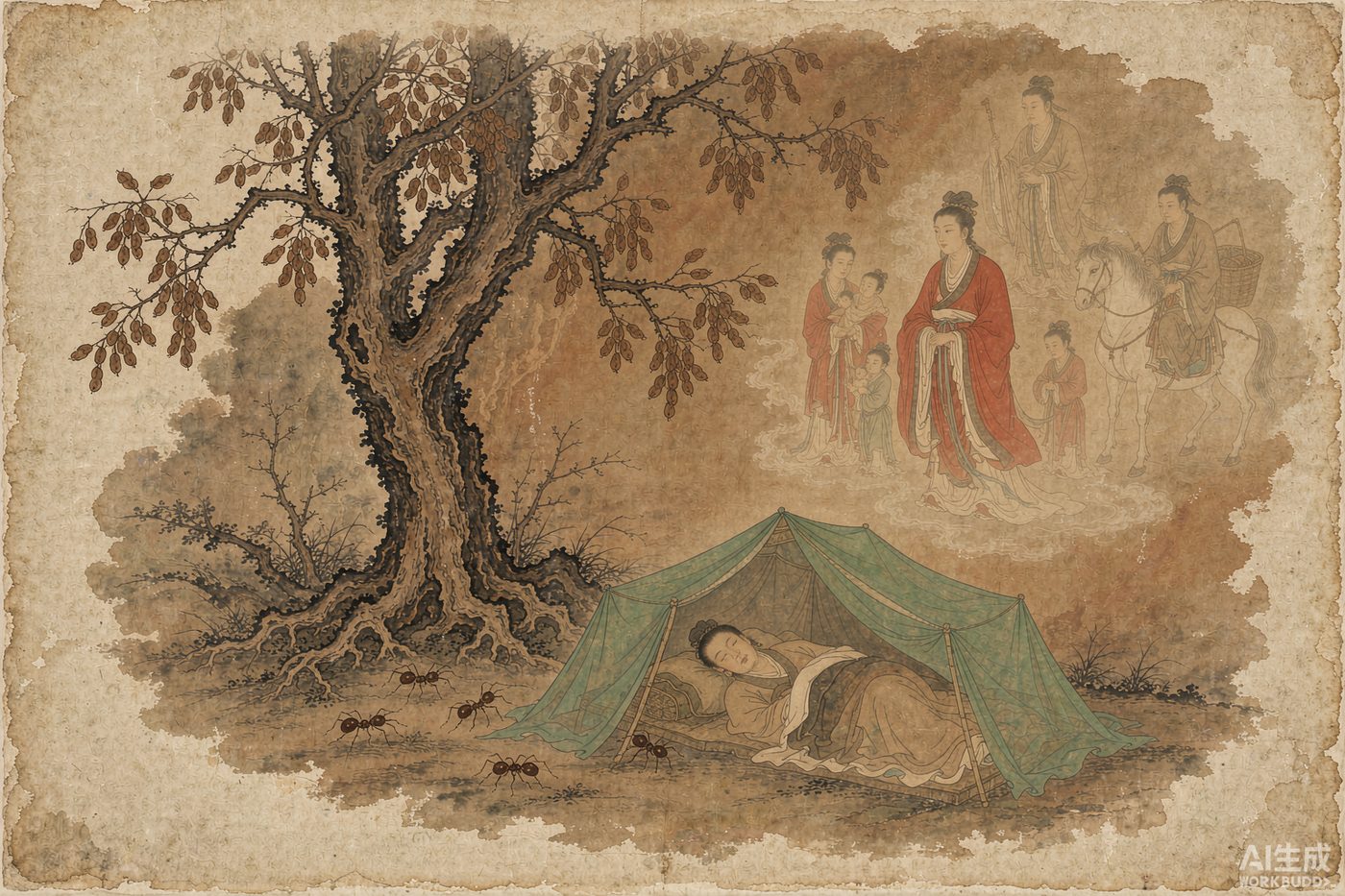
Shen Jiji’s 《枕中记》 sharpens the same device to a single pot. Lu borrows the porcelain pillow, lives fifty years — marriage into the Cui clan, the jinshi, the Hanlin, the frontier command, the slander, the prison, the restoration, the deathbed full of sons — and wakes at the roadside inn at Handan to find the innkeeper’s yellow millet not yet cooked. Fifty years is measured against one pot of grain. That is why the idiom for the whole idea is 黄粱一梦, the millet dream.
In 《梦里家园》 the arrangement becomes a commute. Young Ruan inherits his dead father’s house in the underworld and goes there nightly: marries, is given a desk-officer’s post bought for a thousand gold, runs a trading house, and in under ten years becomes the richest man in the Land of Black Sweetness — while his body lies on a broken leather couch in a wet-nurse’s house and the wet-nurse folds wadding at the bed-head at dawn. He is not confused about which is real. He inverts it deliberately: I take waking for the dream and the dream for waking, he says, on the grounds that half his board and lodging is now permanently covered.
The pattern across all three: the otherworld runs fast, and the instrument that catches it out is always something cooking, poured, or folding laundry.
2. Slower out: the mountain and the village that moved on
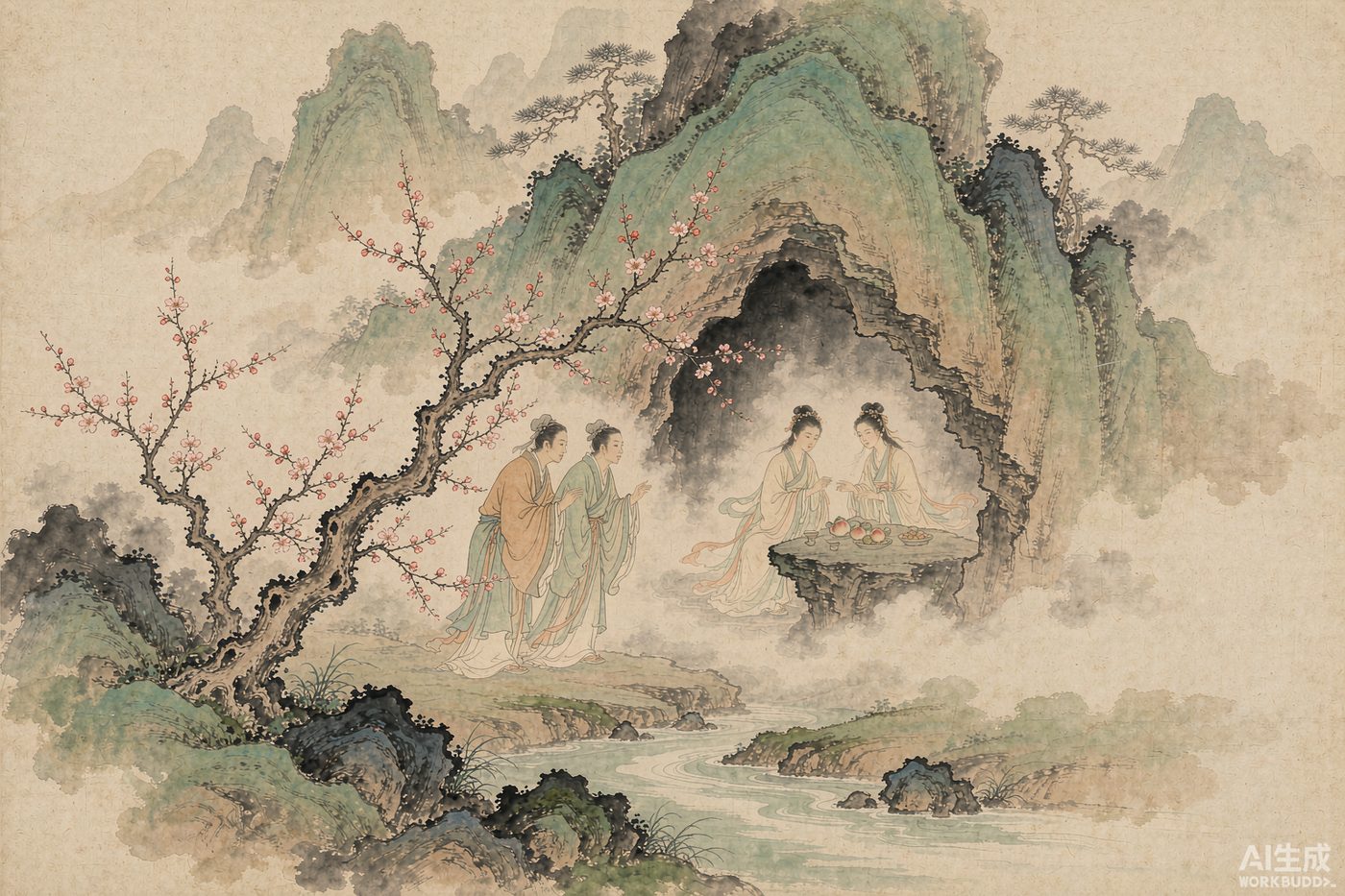
The mirror image is older. In 《幽明录》, Liu Chen and Ruan Zhao go into Mount Tiantai for bark, lose the path, and are fed hemp-seed rice and hyssop cakes by two women who already know their names. It feels like half a year. They ask to go home, are given a feast, and are let down the mountain without a word of warning. In the village, an old man leaning on a stick has to think about it.
“Liu Chen? Ruan Zhao? My grandfather’s grandfather told me about them. They went into the mountain to gather bark and never came back. That was seven generations ago.”
Note what the tale does not do: it never says the mountain ran slow, or that they were enchanted, or that the women were cruel. Immortal food was eaten, and eating immortal food moves you onto the immortals’ clock; the world simply slid past. The horror is not the lost century. It is that the men had been home, had asked to leave, and had been allowed to leave without being told — because that is what hosts of that kind do. They let you go and they let you find out.
3. The commandery that prints the exchange rate
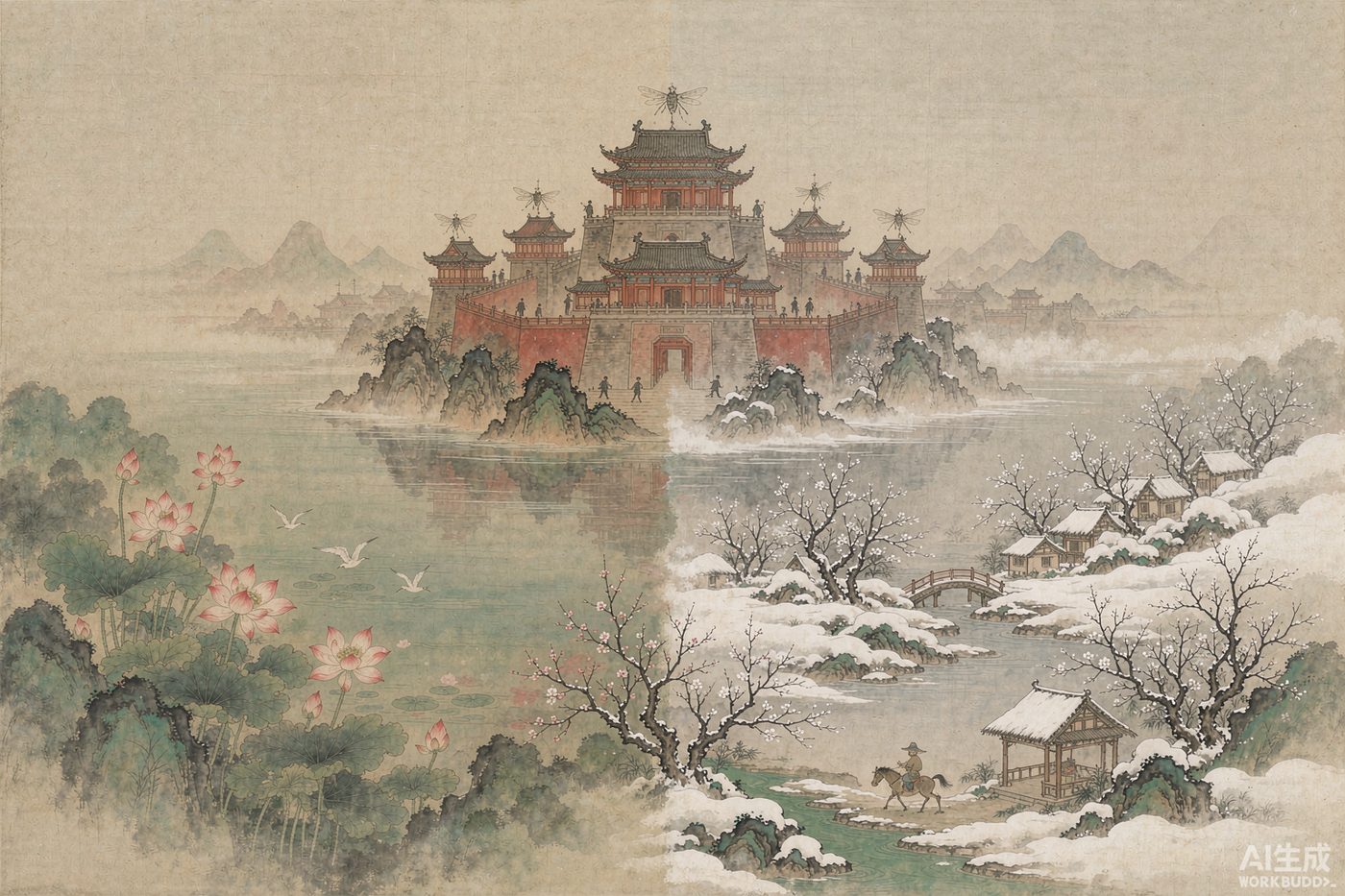
Shen Qifeng’s 《蟪蛄郡》 is the one tale that stops hinting and states the arithmetic as law. The Commandery of the Summer Cicada lies more than forty-seven thousand li from the Middle Kingdom. It takes the day for the year: morning is spring, daylight summer, evening autumn, night winter. It keeps no calendar of years; it reads the seasons off the plants. Lotus coming out is their early autumn and the Middle Kingdom’s hour after noon.
Then the two accounts are set side by side, and they are meticulous:
- Dai Li is dead-drunk on a noon couch for two months.
- Inside, he has had sixty-two years: a marriage, a son capped and ruling in his place, a government he conducted, a wife whose temples have gone white.
- He goes home, cannot forget, dreams his way back three months later. The princess has been dead eighty years and more. The son is an immortal. The concubines are all gone. Not one courtier knows him.
The exchange rate is not a dream-effect. It is a property of a place with an address, and it is stated in the same breath as the distance. This is the single most useful sentence in the whole tradition for anyone building inside this universe: the border is measured in li, and the rate comes with it.
4. Time is also delegated
The strangest variant is not fast or slow but outsourced. In 《身外身》 a young man begs to be tonsured; the old monk reads his birth data and tells him his fate still holds eminence, so he must first draw his twelve years of wealth and honour. He lives them — provincial degree, Hanlin academy, chief examinership in Hubei — and at an inn fifteen li from the monastery kicks out of a restless bed and finds himself standing in the abbot’s cell, bald, having been a monk there the whole time. The old monk comes out of meditation after some two hours and says: you have been tonsured here twelve years.
Twelve years against two hours, and the clock was kept by the body in the room. At the inn they pull back the quilt and there is only a staff — the monk’s staff had been standing in for him. The tale’s own note is that the immortals have a method of dividing the body and the Buddhists do not, and Shen Qifeng refuses to settle which happened. A related case runs the other way: in 《促织》 a boy lies ill for a year and wakes remembering, in detail, what it is to be a fighting cricket. Different creature, different clock, one span of a mother’s grief.
5. The four rates, and what measures them
Set side by side, the tradition uses four:
- Faster inside — the pillow, the ash tree, the nightly commute. Measured by the millet, the warm wine, the wet-nurse at the bed-head.
- Slower outside — Mount Tiantai, the peach valley. Measured by generations of descendants.
- Declared and surveyed — the Commandery of the Summer Cicada. Measured by distance, by plants, by two ledgers kept against each other.
- Deep time as cost — cultivation. A fox must learn the speech of every bird in the four seas before it can produce a human voice: five hundred years of work, and a human beginner starts five hundred years ahead. In the underworld the deep clock is annual: the dead frozen on the northern mountain get one thread of sunlight a year to climb out by.
None of these is offered as a mystery to be solved. Each is offered with its instrument attached.
6. Why it is never a comfort
The obvious reading of all this is Buddhist and Taoist: the world is empty, fame is a nap, so renounce. The texts do say that — 《梦中梦》 ends by laughing at a man who wakes from a spring dream and does not notice he is still in one. But the emotional payoff in these stories runs the other way, and it is sharper.
Dai Li is not consoled by his hundred years. He is ruined by them. He had a wife who aged, a son who outlived him into immortality, a realm he governed — and when he returns, the place has gone on without him and cannot be re-entered. Liu Chen and Ruan Zhao go back into the mountain and are never seen again, which is the only available ending. Chunyu Fen gives up wine and dies within three years.
What the otherworld’s clock actually establishes is loss with a receipt. Because the time was really lived, it can really be lost — and the tales keep the ledger on both sides so that you can see exactly what was spent. Shen Qifeng’s closing comment makes the moral explicit: the immortals have a method for shrinking the earth, but no method for shrinking the years, and so the levelling of the long-lived Pengzu with the child who died young is 洵非妄作 — truly not a vain invention.
7. How to use it
Do not harmonise the four rates. Like the five routes a soul can take after death, they are not competing theories; they are plot generators, and a tale chooses the one it needs. Faster-in is the engine of renunciation. Slower-out is the engine of exile. The declared rate is the engine of account-keeping — it lets a story charge the protagonist precisely. Delegated time is the engine of the double life.
The one rule the texts never break: name the instrument. A pot of millet, seven generations, forty-seven thousand li, a staff in a bed, one thread of sunlight a year. Chinese fantasy does not ask you to accept that time ran differently. It hands you the clock, lets you hear it tick, and then takes away everything that happened while it was running.