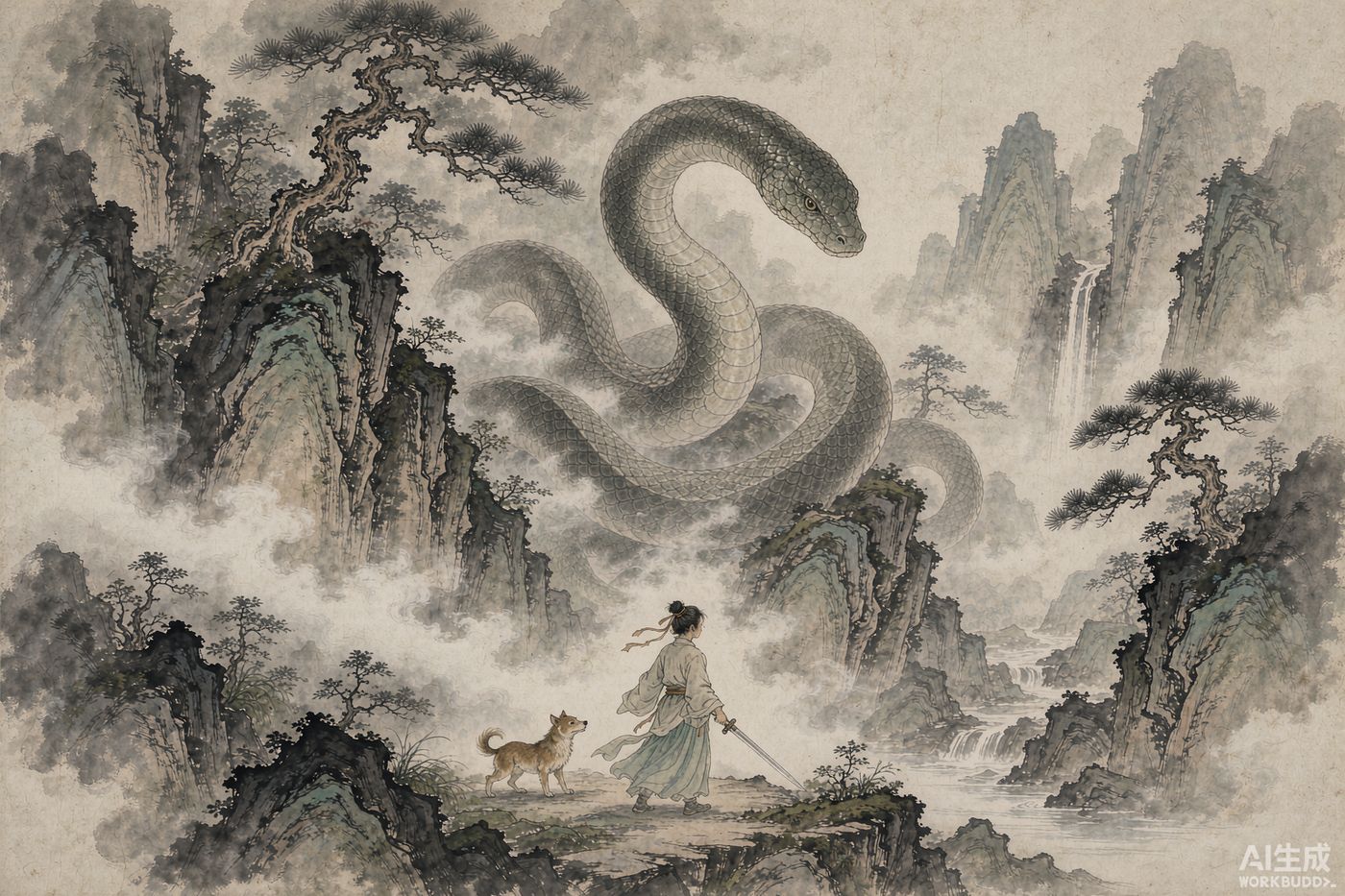
In the household of Xue Song, the military governor of Luzhou, there was a maid named Red Thread. She played the ruan, and she had read the histories, and Xue Song put her in charge of his correspondence and called her his inner secretary.
Once, at a great banquet of the army, Red Thread said to him: “The drum tonight is playing in a mournful mode. The man beating it has something on his heart.” Xue Song knew music too, and agreed, and sent for the drummer — whose wife, it turned out, had died the night before, and who had not dared ask for leave. Xue Song sent him home at once.
That is the kind of person she was.
The times were violent ones. After the An Lushan rebellion the country around the two rivers had never settled, and the military governors watched each other like wolves. Tian Chengsi, who held Weibo, had decided to swallow Luzhou. He had recruited three thousand of the hardest men in his army, quartered them outside his residence, fed them and paid them like sons, and called them his outer-house men. Three hundred of them stood watch at his gate every night. He had chosen an auspicious day and was counting down to it.
Xue Song heard all of it and sat in his hall at night unable to speak.
Red Thread came to him. “My lord,” she said, “you have been sitting here three nights. Is it Weibo?”
“It is Weibo,” he said. “And I have no answer to it.”
“I will go,” she said. “I will be back before dawn.”
He tried to forbid it. She was already gone.
She dressed herself for travelling: a short blade at her belt, a writing-brush behind her ear, a charm of the sun and moon at her collar. She walked out of the city, crossed the moat, crossed the fields, and came to Weibo at the third watch. The outer-house men were snoring in their rows outside the wall. She went over the wall like mist. She passed the three hundred at the gate, and they did not move. She came to Tian Chengsi’s private residence and found him asleep on his couch, with his boots beside him and his sword and his gold box within reach of his hand.
The gold box held the seals of his office, and the charm-stone he wore against death, and the documents of his life.
Red Thread took the box.
She did not kill him. She took his sword and laid it beside him, and left the box gone, and went out the way she had come, and was over the wall and past the guards and three hundred li down the road before the watch changed.
She was in Xue Song’s hall before the drums of the fifth watch.
Xue Song had not slept. She set the gold box on the table in front of him.
“My lord,” she said, “I was within reach of his throat and I took his seals instead. Send this back to him in the morning with a note. Tell him: the head was available, and the head was refused.”
So a messenger rode to Weibo with the box, and a letter from Xue Song: I have your box. I had your life. I am returning both, and I suggest we remain neighbours.
Tian Chengsi read it, and understood that he had been visited in the night by someone who could have opened his throat and had declined, and he wrote back with gifts of silk and horses and a promise of peace, and the war that was going to happen did not happen.
Then Red Thread came to Xue Song and asked to be released.
“I have one request,” she said. “In a former life I was a physician, and I once killed a pregnant woman with the wrong medicine. Heaven sent me down as a woman, into servitude, to pay for it. The debt is paid now. Let me leave the register of your household and go into the mountains, where I can finish what I began.”
He could not refuse her. He gave a great farewell feast, and she danced for them one last time, and at dawn she walked out of the gate with nothing, and Xue Song and his officers stood in the road and watched her go, and none of them ever saw her again.