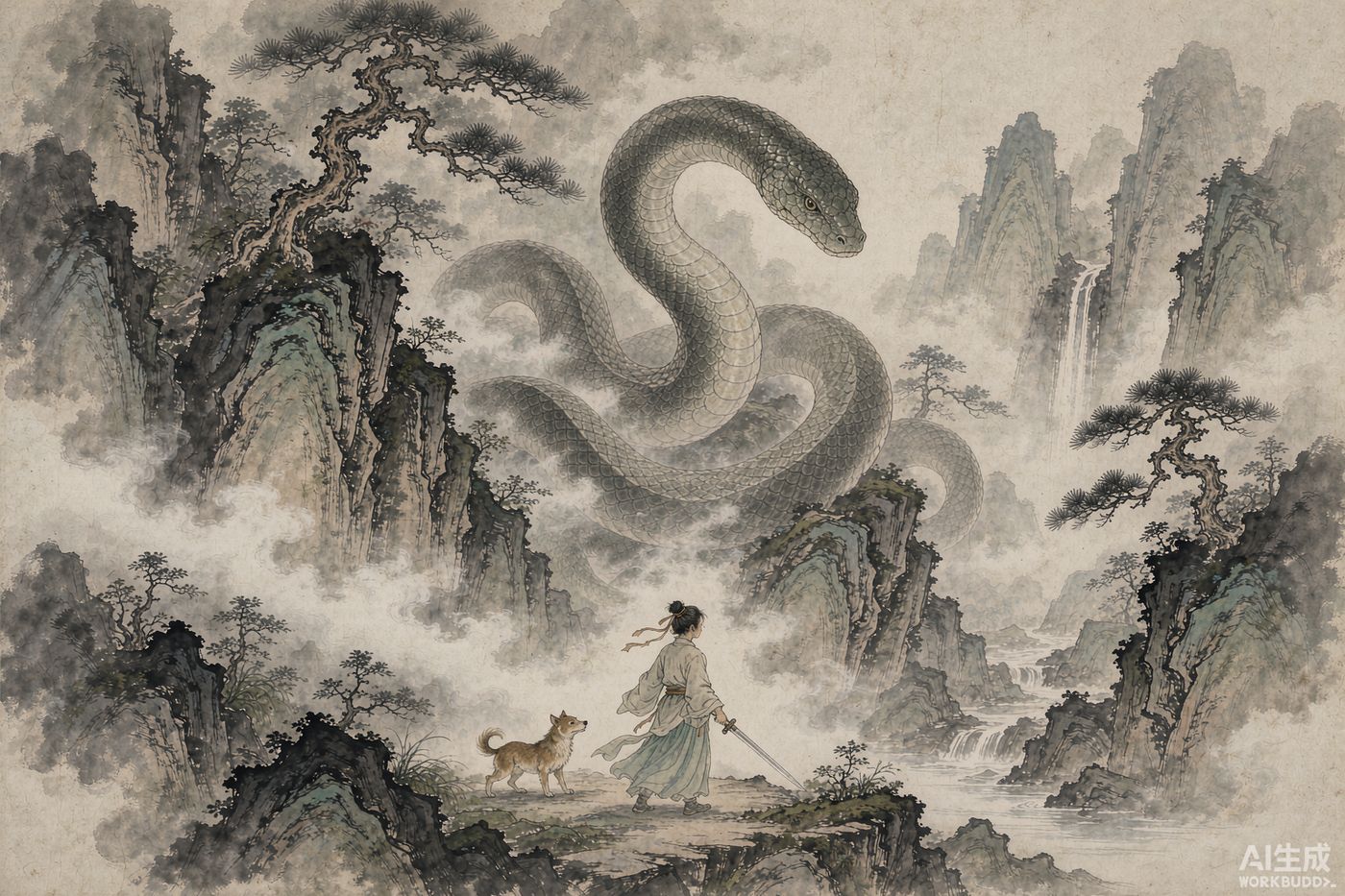
Wang of Taiyuan was out early one morning when he overtook a girl hurrying along the road with a bundle, struggling under its weight. She was no more than sixteen and very beautiful, and Wang’s heart went out to her. “Where are you off to so early, all alone?” he asked. She gave him a long, flat look. “A stranger on the road cannot help me with my troubles,” she said, “so why trouble to ask?” But when he pressed her, she sighed and told him: her parents had sold her to a great house as a concubine, the first wife was vicious and beat her morning and night, and she was running for her life. Wang offered her shelter at his home, which was not far, and she went with him gladly.
He hid her in his study and told no one — least of all his wife, Chen, who suspected at once and begged him to send the girl away. He would not hear of it.
Some days later Wang met a Taoist priest in the market. The priest looked at him closely and said, “You have something unclean about you.” Wang denied it. “The young mistress who is not what she seems,” said the priest. “You are walking into a dark place, sir, and you do not see it.” Wang went home angry at the old fool — and came to his own gate to find it locked. Climbing the wall by the tree, he crossed to the study and looked through the window.
Inside, a green-faced demon with teeth like a saw was bent over a couch, and on the couch was laid out a human skin, smooth as paper. The demon was painting it — brushing in the eyebrows, darkening the lashes, touching colour to the lips. When it was satisfied, it lifted the skin, shook it out like a garment, and put it on. And there stood the beautiful girl again, arranging her hair.
Wang’s legs barely carried him over the wall. He ran to the priest, threw himself down in the dust, and begged for help. The priest gave him a fly-whisk. “Hang it at the door of the study,” he said, “and it will keep the thing from you. But I tell you plainly: it has come this far and it will not go quietly.”
Wang did as he was told. That night the demon came to the threshold, saw the whisk, and stood there a long time, grinding its teeth. Then it tore the whisk down, ripped it to pieces, and burst in. It ripped open Wang’s chest and took his heart.
When the house stopped screaming, Wang’s wife Chen went herself to find the Taoist. She knelt in the street before him and would not get up, and the priest looked at her for a long while and then said, “There is a madman who lies in the market, a filthy beggar whom everyone avoids. Go to him. Do whatever he tells you, endure whatever he does to you, and your husband may come back.”
Chen went. The beggar was lying in the mud, singing to himself, and when she knelt and begged, he laughed and mocked her before the whole market, and made her swallow a lump of phlegm he spat up, wet and foul, in front of everyone. She swallowed it. The crowd howled. The beggar only laughed louder, scrambled up, and capered away, crying that she loved her husband too well to be of use to anyone.
Chen went home wanting to die of shame. She washed her husband’s body and prepared him for the coffin, and as she bent over him weeping, something rose in her throat that she could not keep down. She coughed — and out of her mouth fell a human heart, warm and beating, straight into the hollow of Wang’s chest. She clapped her hands over it, gathered the flesh closed, bound it tight with silk, and sat up with him through the night. By morning the chest was whole. In a few days there was nothing left of the wound but a scar the size of a coin.
The priest, when they saw him again, would say only one thing about the matter, and he said it as though it cost him something: “Fools who will not see deserve what they get — but a heart like hers is rarer than any magic I know.”