Stories/ 夷坚志/ The Woman on the Road to Loufan

The Woman on the Road to Loufan

樓煩道中婦人

SourceYijian Zhi (Record of the Listener)
AuthorHong Mai
EraSouthern Song dynasty · Jin era, 12th century
Writtenc. 1160–1200
JusticeGhost
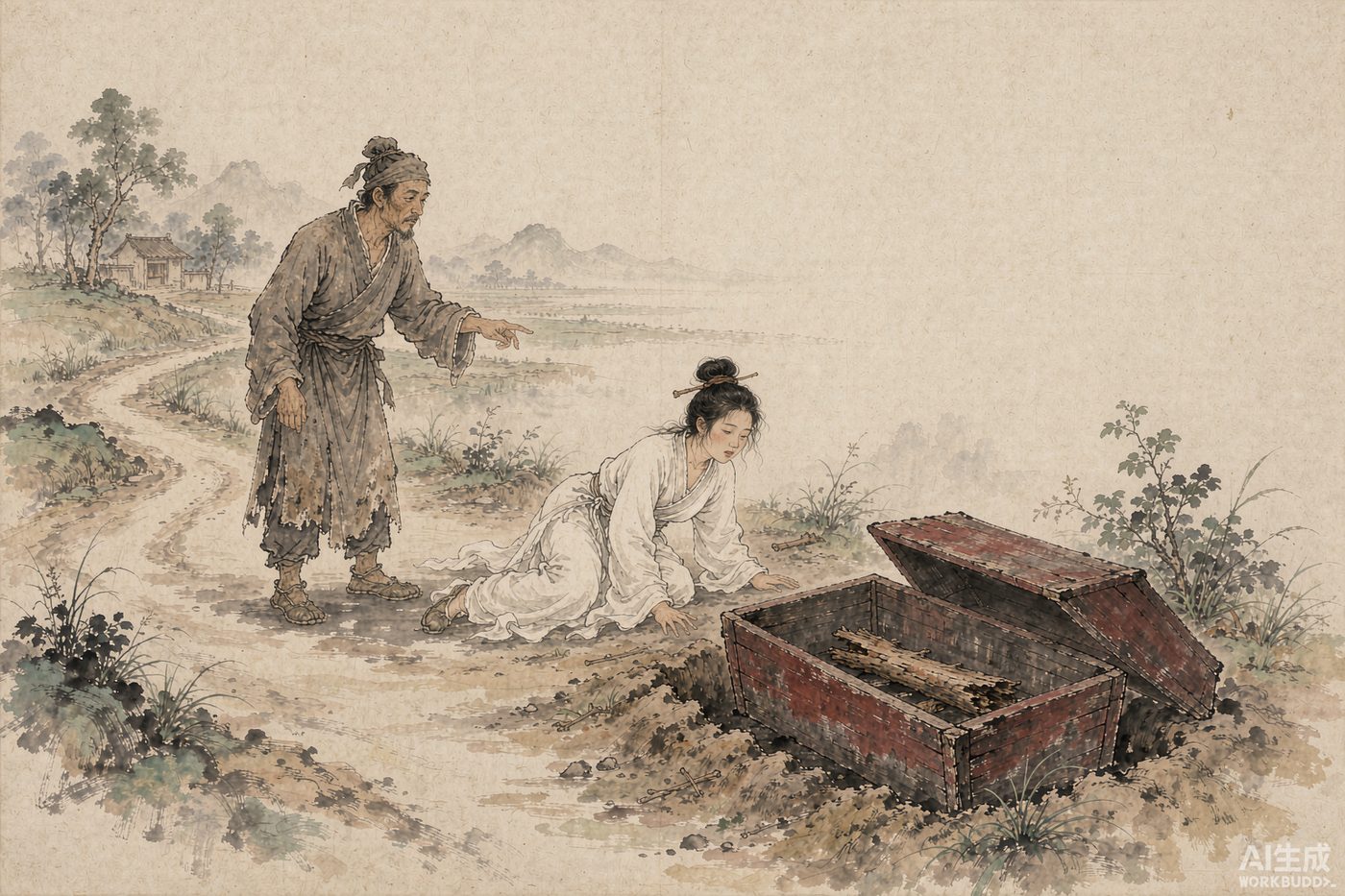
A traveller on a country road pointing the way for a woman in white who has fallen forward sighing, an open coffin holding only a piece of rotten wood nearby
Illustration generated by AI, based on the ancient Chinese text.

A villager of Feiyuan Fort in Yifang county, Lan prefecture, named Nan Yan, was on his way to Loufan county. Resting partway on the road, he met a woman in plain white with a high coil of hair, about twenty, who bowed and asked: “I have come from Loufan and am going to Lan prefecture. I am walking alone and have lost my way. Which way should I go?” He pointed the way for her, and they parted.

As they parted the woman gave a long sigh, and fell down on the ground. He helped her up and looked: she was dead.

He went to a lodging house and asked for hot water to pour into her, but she did not revive. A passer-by, seeing the dead woman and not understanding, was afraid of being implicated, and seized Nan Yan and reported him to the local security group. He was thrown into the county prison and questioned under torture. Though he confessed falsely to killing her and taking her goods, the corpse had no wound, and he could not say what he had stolen.

The prefecture sent a clerk named Ming Sheng to examine the case, who called him in and asked: “Did you really kill her?”

He answered: “Hard to say.”

Ming Sheng did not catch the name, and asked again, and got the same answer, and thought it strange. “Then is the one called Hard-to-Say not you?”

And again the answer was: “Yes.”

Ming Sheng returned to the prefecture and reported to the governor. Another official was chosen, the grave was opened and the body examined, and all they found was a piece of rotten wood in the coffin. There was nothing to investigate, so Nan Yan was released and allowed to go.

At home he served his parents with extreme filial piety and was held in high regard by the village community. On this occasion, it seems, he was protected by Heaven.
Original classical Chinese text · 原文

時分手,婦人長吁一聲,遂仆地。掖視之,死矣。言就邸舍求湯飲灌救,竟不起。傍人過者,見婦人死,不明,畏為己累,執以告保伍,遭繫縣獄,訊治。雖自誣云殺而取其貲,然僵尸無痕傷,又不能供所掠何物。郡遣曹掾明生者審究,呼問言曰:「汝實殺人邪?」對曰:「難言也。」明生不悟其姓名,再問之,復然,以為疑,乃曰:「然則所謂難言者非汝邪?」又對曰:「然。」

Opening and examination of 《樓煩道中婦人》, Yijian Zhi jia 1. The name 難言 means hard to say, and the clerk never registers it.

Source. From Yijian Zhi (Record of the Listener) (夷坚志), by Hong Mai , c. 1160–1200. The original text is in the public domain; this English rendering and the accompanying notes are original work.

Keep Reading

Related Stories

Qing dynasty · Qianlong era; the events c. 1730s · 子不语

The Widow Who Sued from the Grave

田烈妻

A magistrate holding court one evening under a bright moon sees a woman kneeling at his gate with her face covered in black cloth. He has his clerk call out the writ: whoever has a grievance, let the soul come in.

JusticeGhost
Qing dynasty · Qianlong–Jiaqing era · 续子不语

The Zombie Who Drank the Blood

僵尸食人血

A wife rises at cockcrow, rinses rice, picks vegetables, and finds her husband in bed with no head and no blood. She is arrested, tortured, and held for months. Then a neighbour goes up the hill for firewood.

MonsterGhostJustice
Qing dynasty · Qianlong era, c. 1736–1798 · 子不语

A Robber Ghost's Confession

盗鬼供状

A revenue clerk is seized by the ankle by something rising out of the floor tiles. It is a robber he condemned in a former life, and it has been screaming on the branding irons for sixty years.

GhostJusticeUnderworld