A certain College student of Wujiang, about to go up for the northern examination, went with several friends to sleep at the shrine of Prefect Kuang and ask for a dream. He tossed and turned the whole night and could not sleep.
Next day the friends each told their dreams — some lucky, some unlucky — and they interpreted them among themselves. He made a grand announcement:
“Last night I dreamed I came into this hall. Prefect Kuang left his seat, bowed me into the place of honour, and then saluted with his hands together and bent the knee, attending on me as on a superior. I declined, quite unable to accept it. The Prefect said: Sir, one day you will rise to governor-general. Your rank will stand above mine. Do not persist in being humble. He ordered his people to change my cap and sash. On the seat, seal-boxes and command-arrows were ranged in stern order. I was uneasy, left the seat and went down the steps. The Prefect bowed three times and saw me out of the gate; my foot slipped and I woke with a start. I do not know what auspicious sign this is.”
They all raised their hands in congratulation.
“Your wealth and honour will be beyond measure. Placing high in this session is only the first turn of the wheel.”
He said: “If it does come out as I dreamed, and you are all stumbling in the dust of the road, I will take you up one by one.”
They folded their hands and thanked him.
Presently he went to the capital and sat the examination — and in the first session his paper was posted and annulled. He wanted nothing but to go home, and there was nothing left in his purse. The capital is a deep pool of talent, and a College student cannot get a tutoring place; he had no way to feed himself and no way either to stay or to leave. Fortunately, as a boy he had liked to sing the popular airs. He had no choice but to join the Cuiqing company and take male leads.
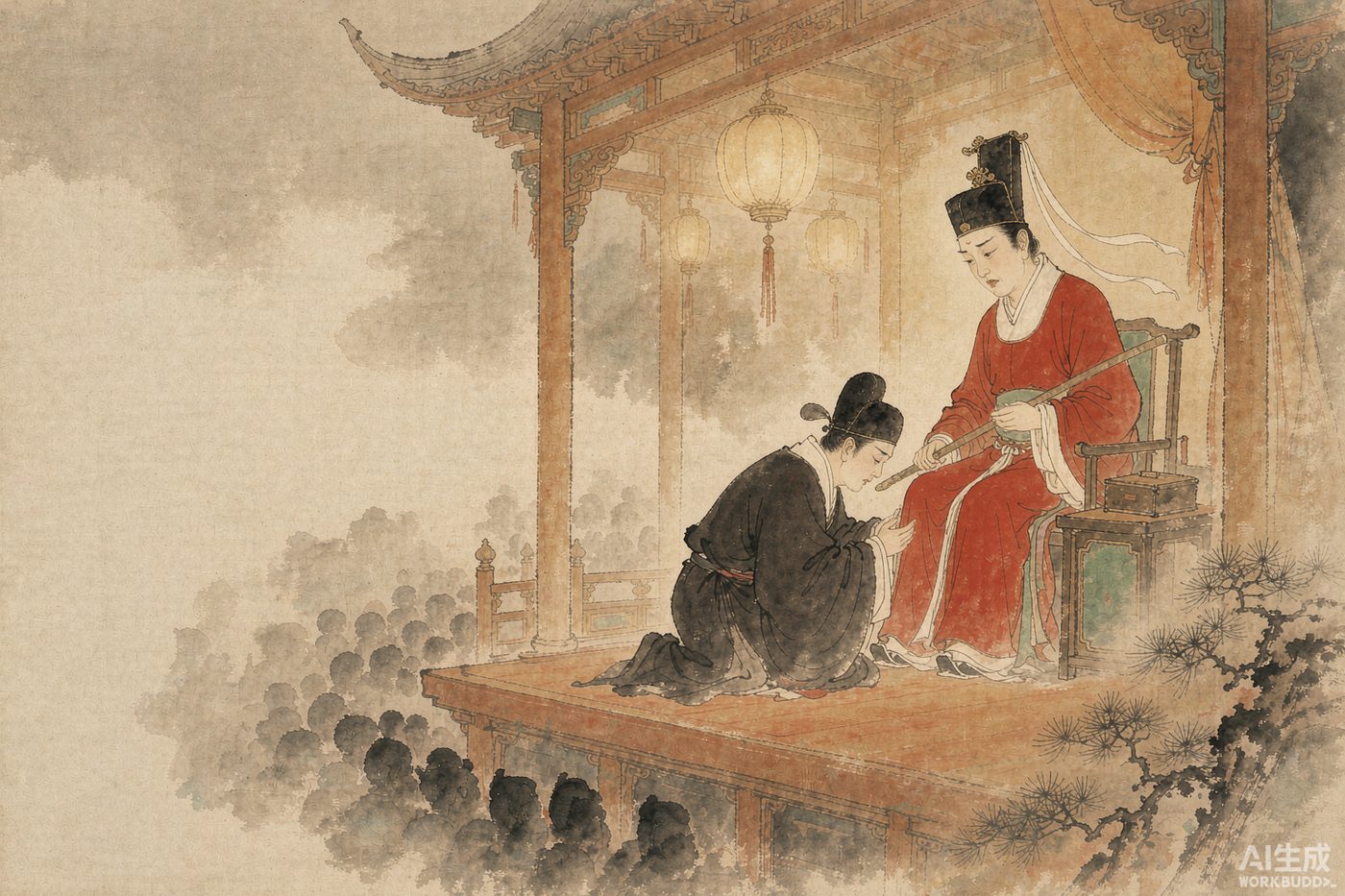
One day they were performing Fifteen Strings of Cash, at the scene “Audience with the Prefect.” He sat in cap and sash in the high seat, seal-box and arrows ranged beside him, and another actor, playing Prefect Kuang, came in to the audience and saluted with joined hands and bent the knee — exactly as in the dream he had fabricated that day. He could not help striking the table and weeping aloud.
The people in the seats thought he had gone mad. They called him and asked why. He told the whole truth. They learned that he was of an old Jiangnan family and had come up for the examination and failed. My uncle, the Academician Langfeng, took pity on him, gave him the money for cart and horse, and sent him back to Suzhou.
The Duo comment: The Zhou people’s book of dream-interpretation was destroyed in the Qin fire. After that men like Guo Qiaoqing and Zhou Xuan each judged by their own guesswork. The dream of the river-bank is written in the History of Song; the dream of falling from the bed is recorded in the History of Tang. Grain lost in the field — Minister Cai dreamed ill and it turned to good. A mirror in the seat — Director Cui dreamed good and met with ill. Then there is Cao Han dreaming of crabs, Zhang Zhan of a mortar, Li Di of a beard, Han Jun of clogs, scattered through the miscellanies, every one with its strange verification.
Yet of all the dreamers in the world, past and present, who can count them — why are only these few men’s dreams handed down? Because the rest never came true. And this young man’s fabricated dream turned out true to a hair! The Changes say: good fortune and ill, regret and disgrace are born of movement. The omen was the heart itself. It was not that a dream was able to enter illusion.