Stories/ 子不语/ The Fox's Elixir

The Fox's Elixir

狐丹

SourceZibuyu (What the Master Would Not Discuss)
AuthorYuan Mei
EraQing dynasty, c. 1770–1790
Writtenc. 1788
Fox SpiritMagicPoetryTrickster
A farm cottage altar at dusk, a handsome young man in Tang scholar's turban holding a small glowing red pearl over a bowl of paper ash, a country woman seated beside him, and a paper petition burning in a brazier
Illustration generated by AI, based on the ancient Chinese text.

In Wujin county of Changzhou there was a man named Lü whose wife was possessed by a fox. It took the form of a handsome young man wearing a Tang-style cap, and told people’s fortunes — sometimes right, sometimes wrong.

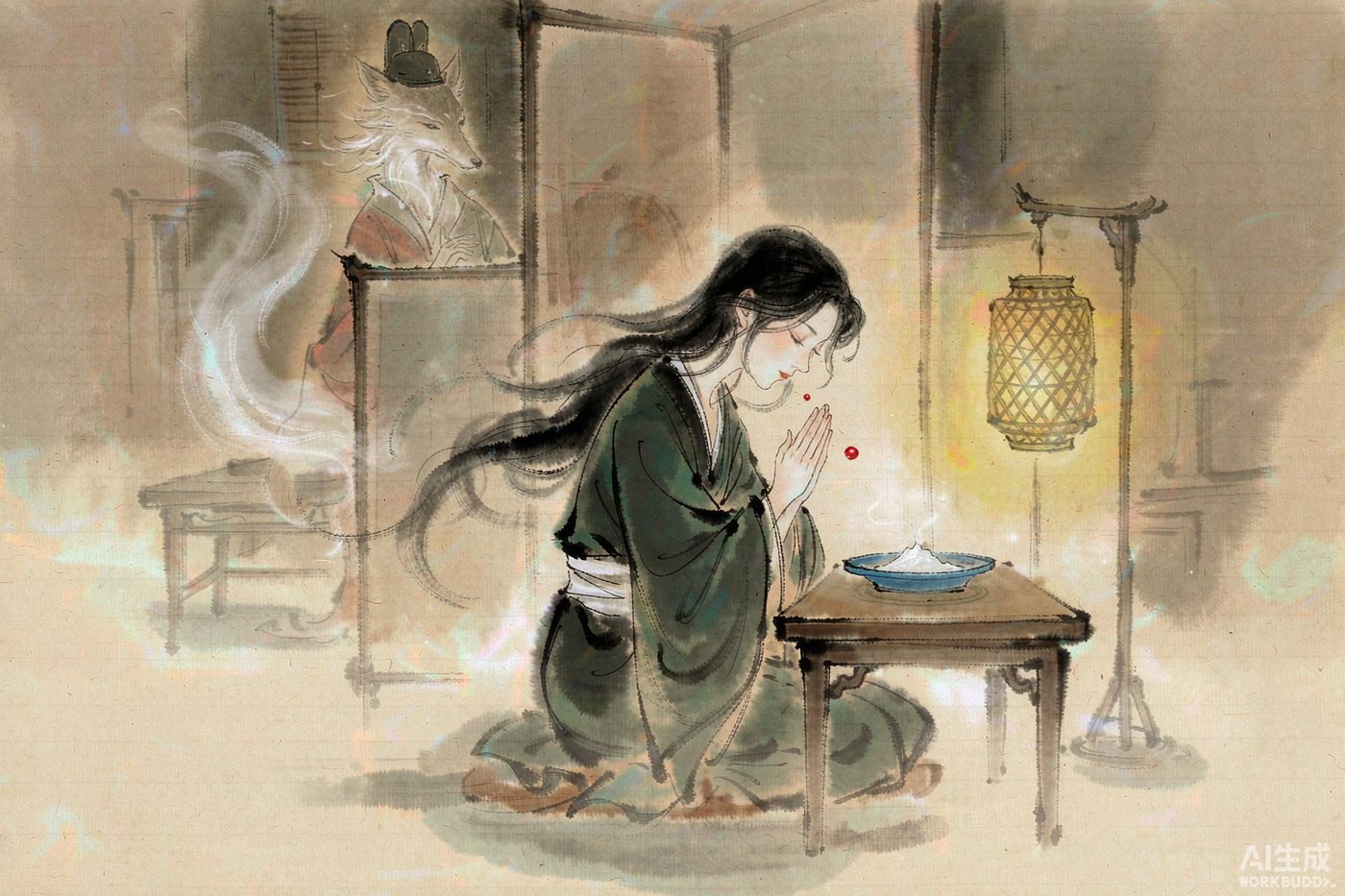
When someone came to ask a divination and the fox happened to be out, the petitioner was told to write the question on a slip and burn it, keeping the ashes in the altar bowl. When the fox came home it would spit out an object — red, like a little mirror, no more than an inch across — and hold it over the ashes in the bowl, and then it could recite aloud the burned words without a single error. When the reading was done it swallowed the thing back into its belly. Someone said: this is the fox’s elixir-pearl.

When the fox had a reply to deliver, it made the woman speak the words; and fearing she would forget them, it would pinch the middle joint of her finger with its hand — and then she could remember. Even long compositions in rhyme she could recite straight through; though once it was done, she was as unable to read as ever.

There was a certain licentiate, a cousin of the wife, who wanted to exchange poems with the fox and asked her to convey his request.

“I have a couplet,” said the fox. “If the scholar can match it, we may exchange verses:

Red-and-white peach blossoms shine on the paper window — the blossoms have no two colors.”

The wife told him. The licentiate could not match it, and withdrew in shame.

The fox is still living in that household to this day. The magistrate Qian Zhuchu told me of it.
Original classical Chinese text · 原文

常州武进县有吕姓者,妇为狐所凭。化作美男子,戴唐巾,为人言休咎,有验有不验。来问卜者,狐或外出,则命书一笺焚之,存其灰于坛中。狐来,口吐物,红色,如小镜然,大不过寸许,持向坛中照灰,便能朗诵所焚之语,丝毫无误。照毕,仍吞入腹中。或曰:此狐丹也。狐有批答,辄令妇口授之,虑其遗忘,则以手掐妇手指之中节,便能记忆。虽长篇韵语,俱能成诵,过此则依然不识字也。 有某秀才,为妇中表亲,欲与狐唱酬,嘱转致狐。狐曰:「有一对,秀才能属对,即与酬答可也:『红白桃花映纸窗,花无二色。』」妇以告,秀才不能对,惭而退。此狐至今犹存其家,钱竹初明府为予言。

From 《狐丹》, Zibuyu juan 18. Translated in full. 常州武進縣 is Wujin county, Changzhou prefecture, in Jiangsu; 唐巾 is a scholar's cap in the Tang fashion, a mark of elegance; 休咎 means fortune and misfortune; 狐丹 is the fox's elixir-pearl, the concentrated product of its cultivation; 屬對 is to compose the matching second line of a couplet; 錢竹初明府 is the magistrate Qian Zhuchu, the named source.

Source. From Zibuyu (What the Master Would Not Discuss) (子不语), by Yuan Mei , c. 1788. The original text is in the public domain; this English rendering and the accompanying notes are original work.
Where this fits in the universe: Fox Spirits · Reading the Fate: The Doom Is Fixed, the Address Is Not

Keep Reading

Related Stories

Tang dynasty · 8th century · 唐·沈既济《任氏传》

Miss Ren

任氏传

A poor scholar falls in love with a beautiful woman of mysterious means. She is a fox spirit — and she is also, by the end, the most faithful creature in the story. The oldest great fox-wife in Chinese fiction.

Fox SpiritLove
Qing dynasty · Qianlong era, c. 1736–1788 · 子不语

The Fox Licentiate

狐生员劝人修仙

A governor-general is reading late when a fox comes in sideways through the window crack, thickens into a scholar, bows — and delivers the most detailed cost-accounting of becoming an immortal anywhere in Chinese fiction.

Fox SpiritImmortalTransformation
Qing dynasty · Qianlong–Jiaqing era · 谐铎

The Fox Who Debated the Classics

狐媚

A scholar says he cannot be seduced because he wants neither beauty nor gold — only the books on his shelf. The fox agrees, and quotes the classics back at him.

Fox SpiritTricksterLove