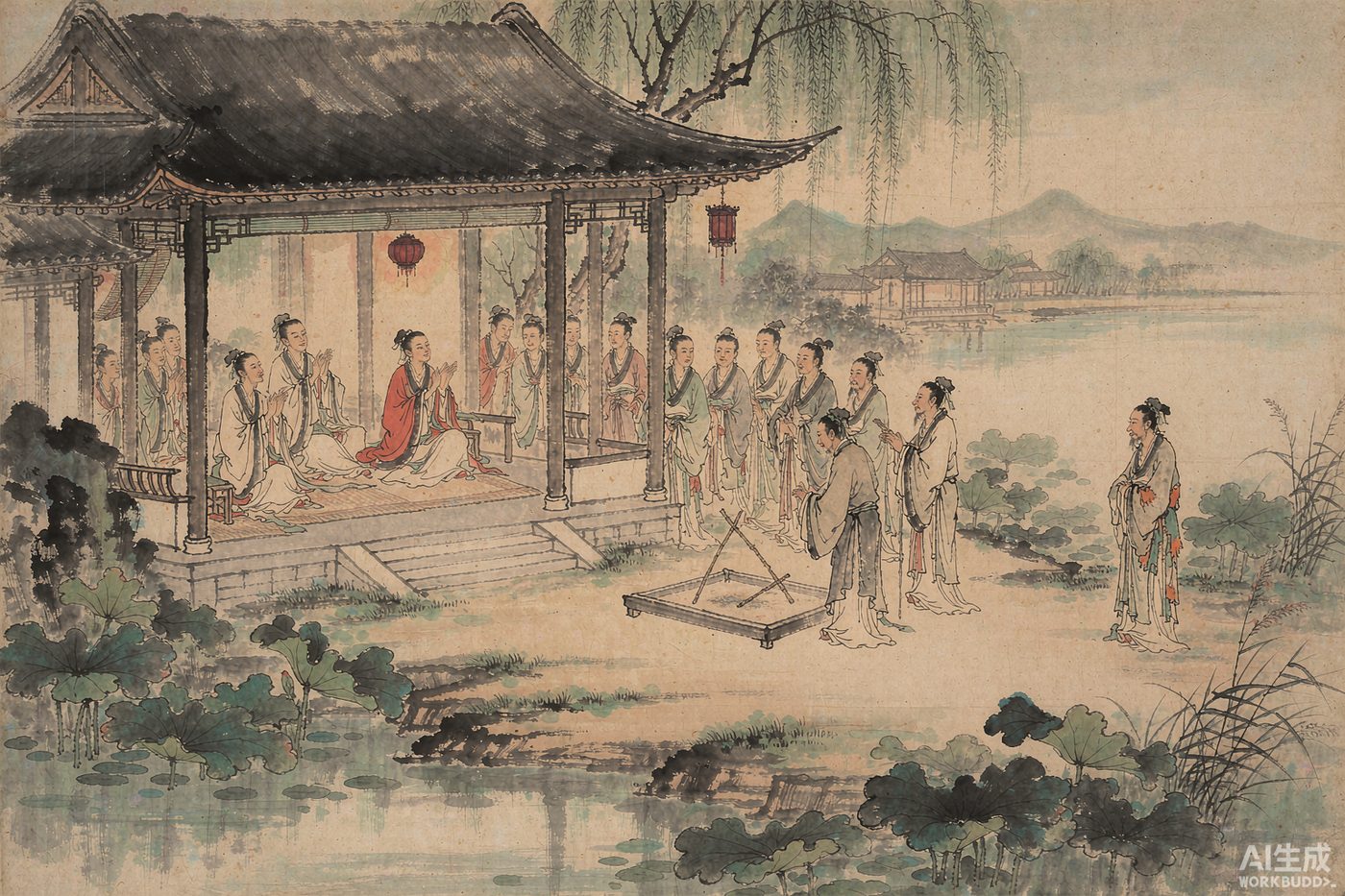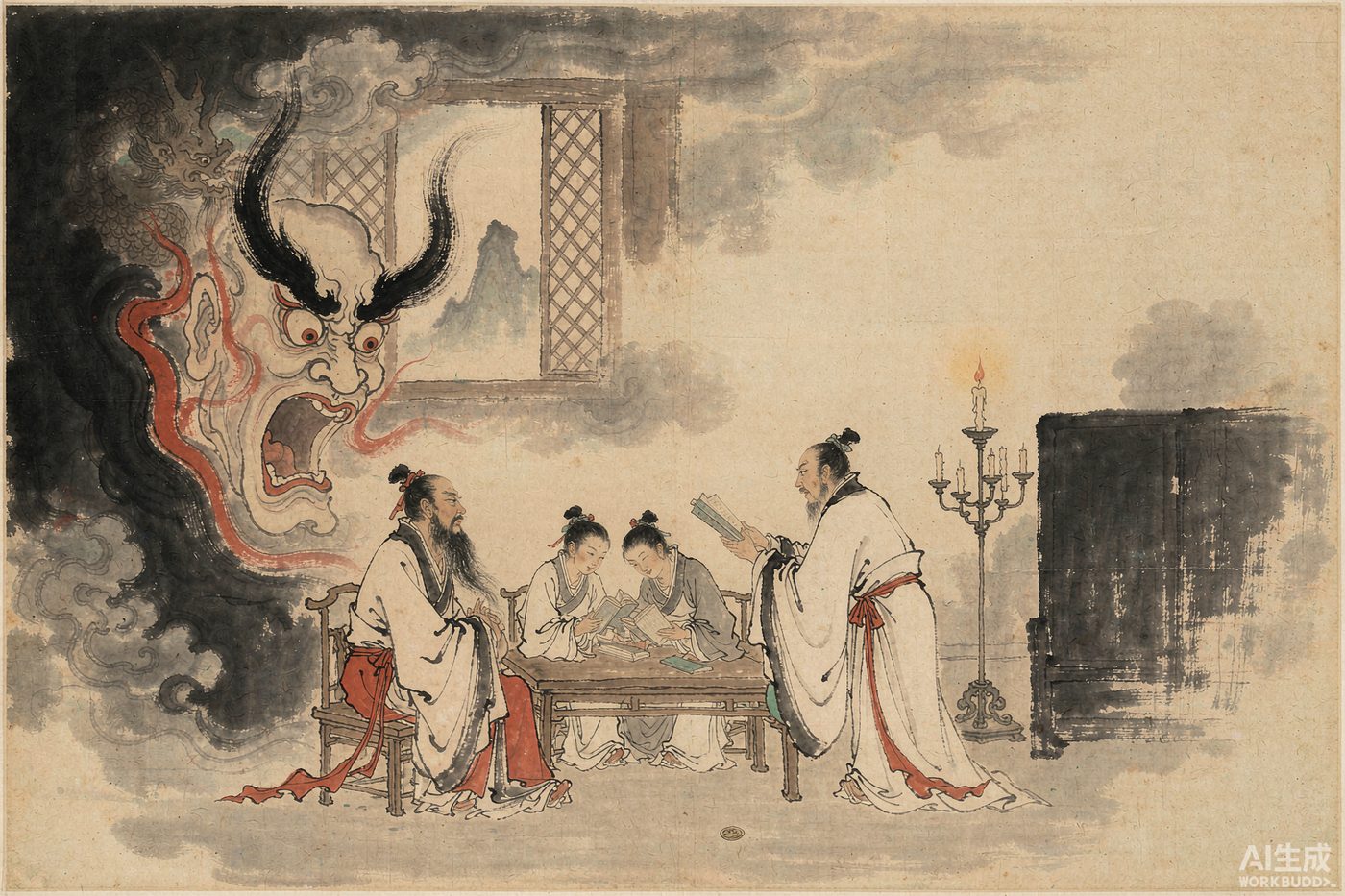
Zheng Lanfen of Zhongzhou lost her father young. Her mother doted on her and had her sit in the schoolroom every day, with ivory book-tags and brocade rollers lying in heaps across the desk. Her mother used to tease her: “This is the thousand-li colt of our house — only it is a mare and not a stallion.”
Lanfen answered: “So long as it can gallop across the arena of letters, that is still better than the pigs and dogs of the Liu family.”
And so her name in the women’s quarters became noisy in the village.
She once wrote a hexagram on Money:
Money. It profits to be steadfast.
The Image says: the square takes its right place within, the round takes its right place without. Square and round in their places — that is the great meaning of heaven and earth. Money has the square hole; that is what is meant by Elder Brother. Elder brother and younger brother, father and son, husband and wife — and the fortune of money prospers. When the fortune prospers, the way of the household is settled.
She took the most solemn sentence in the canon and hung a coin on the end of it.
Her maid A-kang was clever and sly. One day she went to pick flowers in the garden and did not come back for a long while; Lanfen sent her fifth brother to look, and learned that the servant Liao the Second had cornered her.
So Lanfen wrote another, in the manner of the Songs of the Five Sons:
A-kang occupies her post, takes her ease, and ruins her office; all her colleagues are of two minds about her. She wanders without measure and plays in the garden of solitude. There is Liao the Second of Youqiong, and because no one was looking he took liberties in the court. Her younger brother Fifth Son, obeying his mistress’s command, waited at the edge of the garden. Fifth Son was greatly resentful, and set out his mistress’s warning in song:
And five songs followed, in the full archaic manner, about the duty of a household, about laziness and wantonness, about the ruin that follows, about the dignity of the house, and a last one in which the singer grieves and begs the girl to come home.
Wit of that order was usual with her.
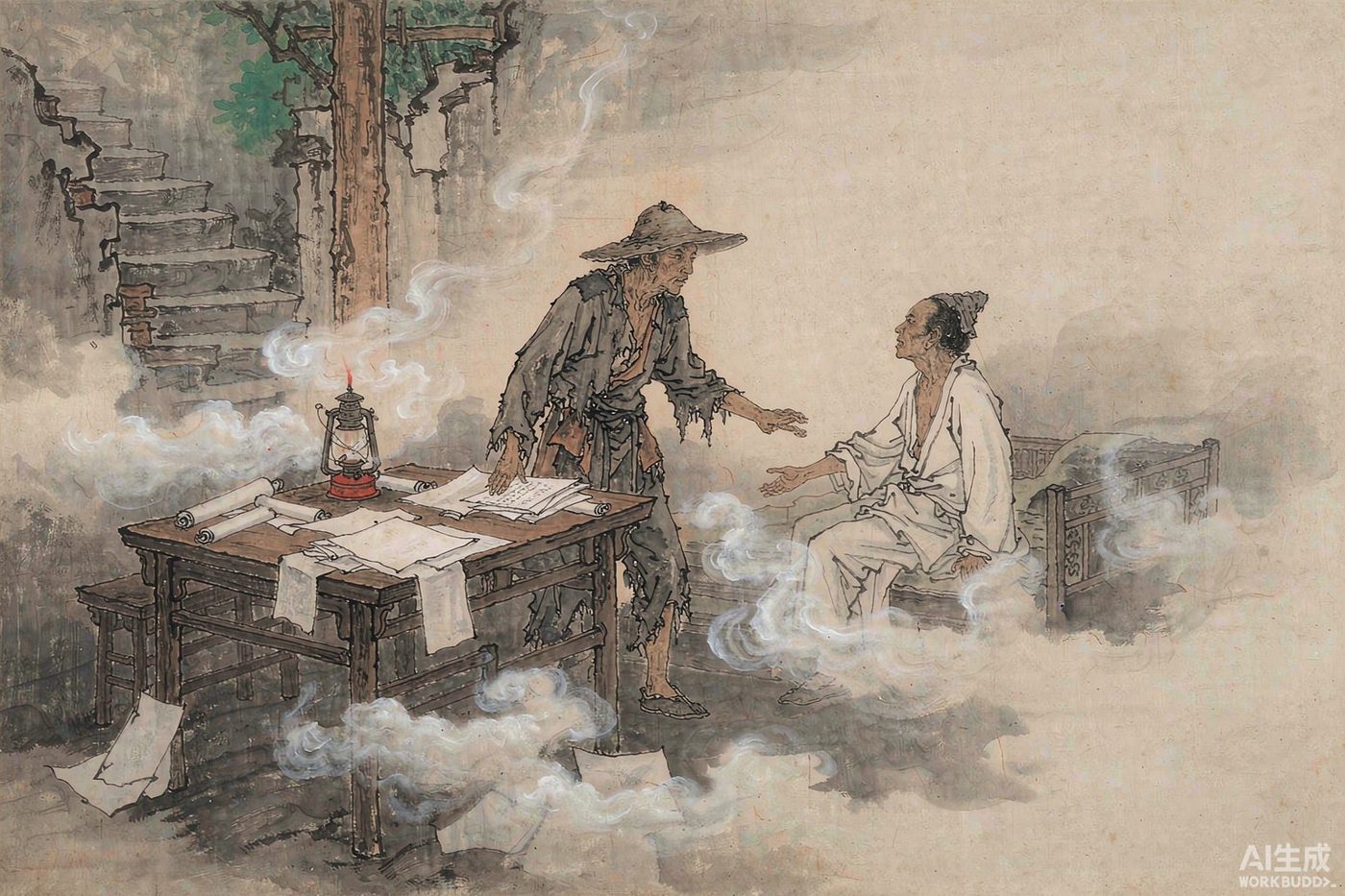
One evening she sat at the lamp writing her Spring and Autumn of Face Powder. She had not done more than a few lines when her wrist went soft and her body tired, and she fell forward on the desk and slept.
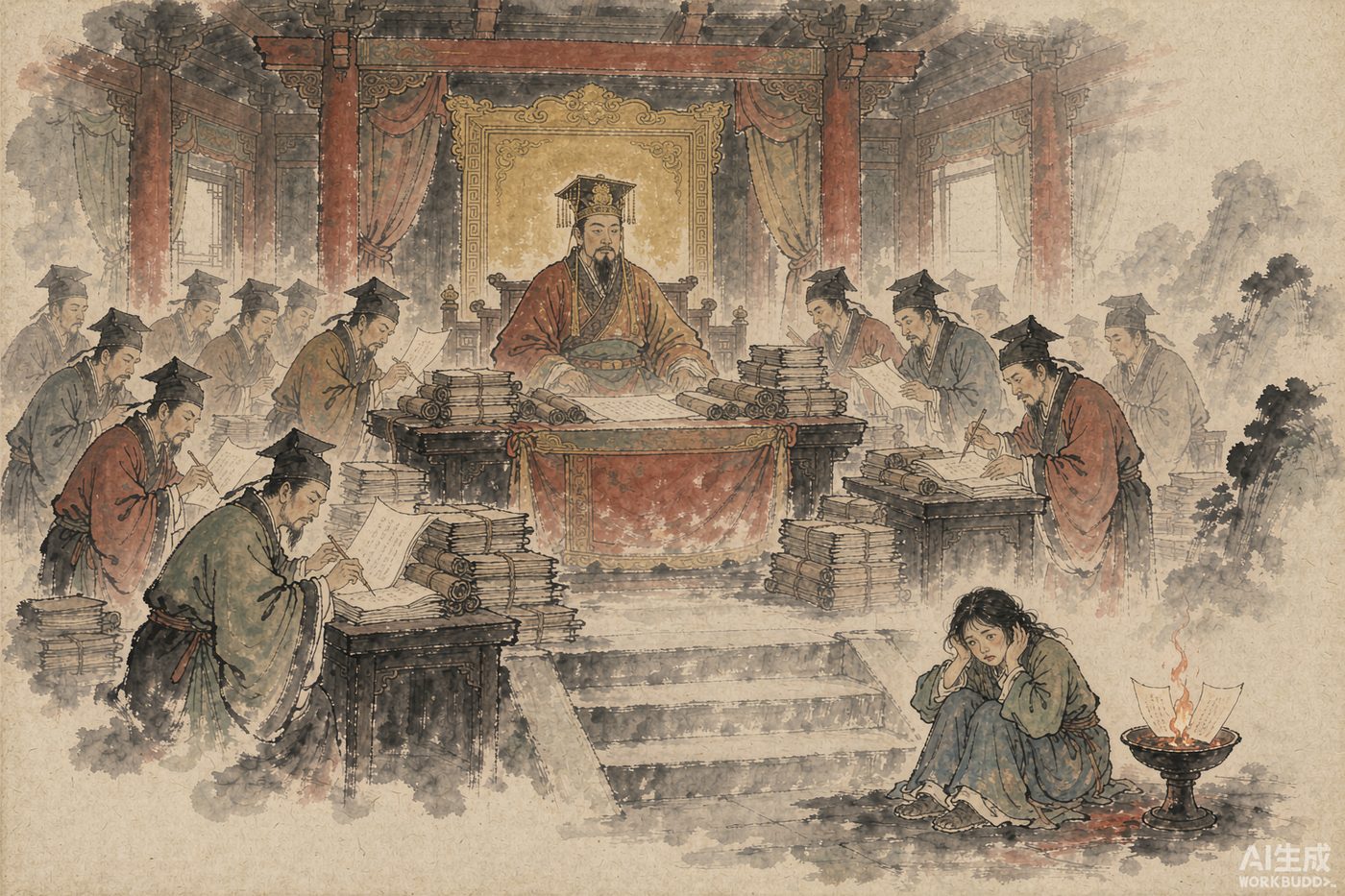
She found herself at a hall with a gold plaque across it: The Place of the Great Writings of the Six Classics.
A figure in crown and tassels sat upright. Several men in scholar’s caps collated books in the two corners.
One came forward with a volume: “This is Yang Ziyun’s imitation of the Changes.”
The seated one said: “The Changes went from Shang Qu to Tian He, five transmissions in all. Wang Bi worked on principle, Jing Fang on number, and neither reached the bottom of it. How can people like this presume to imitate it? Besides, he bent his body to the usurper Wang Mang. Though he has the strange characters of his Grass Mystery, it is not worth looking at.”
Another: “This is the forged text of Zhang Ba.”
“The Documents came out of the wall of Lu; the old text has not been transmitted for a long while. Mei Ze’s twenty-five chapters preserve something of its likeness. Who is Zhang Ba, that he dares to fabricate?”
Another: “These are Shu Guangwei’s poems supplying the lost ones.”
“The ideas are chosen and the words not unfaithful to the teaching of the Odes. But fish swim in the clear pool, birds gather in the wood — that is pure Jin-dynasty diction. How can he presume to climb up to the Odes?”
Another: “This is Liu Xin’s collected Rites.”
“The forged text of Hejian is genuinely hard to detect. The single section on the Artificer is plainly a private composition by a Han scholar, patching the gap where the Winter Office is missing.”
Another: “This is He Xiu’s outline of the Chunqiu.”
“Sticking to Gongyang, blind to Zuo, crippled by Guliang — the ravings of a fool, that is all.”
Then other books were heaped up — editions cutting the Lunyu, writings attacking Mencius.
The seated one flushed and said angrily: “Imitating Zhuangzi, answering the Li Sao — that is still only a petty scholar playing with his brush. But to cut apart the sacred canon and the traditions of the wise and mock them at will deserves the tongue-plucking prison, to make the retribution plain.”
Before he had finished, a man hurried forward and threw himself down at the seat.
The seated one said: “Zheng Jiaji — what have you to say?”
He answered, hesitating: “Zheng Xuan assisted and winged the sacred canon, and counted himself as having served the teaching of names. He did not expect that a distant descendant in the women’s quarters would alter the text of the classics and make a game of it. What is to be done?”
The seated one said: “This is scorning the words of the sages. The crime should be ranked higher. But in consideration of the ignorance of the women’s quarters — cut her allotted span of years, to redeem the fault.”
Lanfen was crouching outside the hall. She heard it, and her heart shook and her soul shuddered. She missed her step going down and woke with a start.
That night, by the lamp, she burned her old manuscripts and repented deeply.
Later she was betrothed to a scholar of the same village — and died three days before the wedding. It was the return for scorning the words of the sages.
The Duo comment: “Wine is the gentleman’s fare; this girl is a Confucian among gentlemen. Her flower-bright tongue is gorgeous beyond a thousand years. And yet — for one day that the Peony Pavilion is staged in the world, Master Tang suffers one day below ground. Who knows that this is not the same case opening? A Xiangren of my house once wrote a Monthly Ordinances of the Women’s Quarters, with lines like ‘the lip-salve thaws, the blind becomes a hook; the clothes are damp with the soaking heat, the powder-rain falls in season’ — which also shows a clever heart. And the red paper was still wet when the yellow earth covered her. She brought it on herself; who is to blame? I note it here, and sigh once for her.”
Condensed from the original: the full tale contains the complete hexagram on Money and all five of the archaic songs, of which excerpts are given above.