A certain gentleman of eastern Guangdong was provincial judge of Hetang. A man named Nie had been falsely condemned in a capital case, and the judge cleared his name; in gratitude the man offered his daughter Shuer as a maid. The judge, recognising the sincerity of the offer, accepted her.
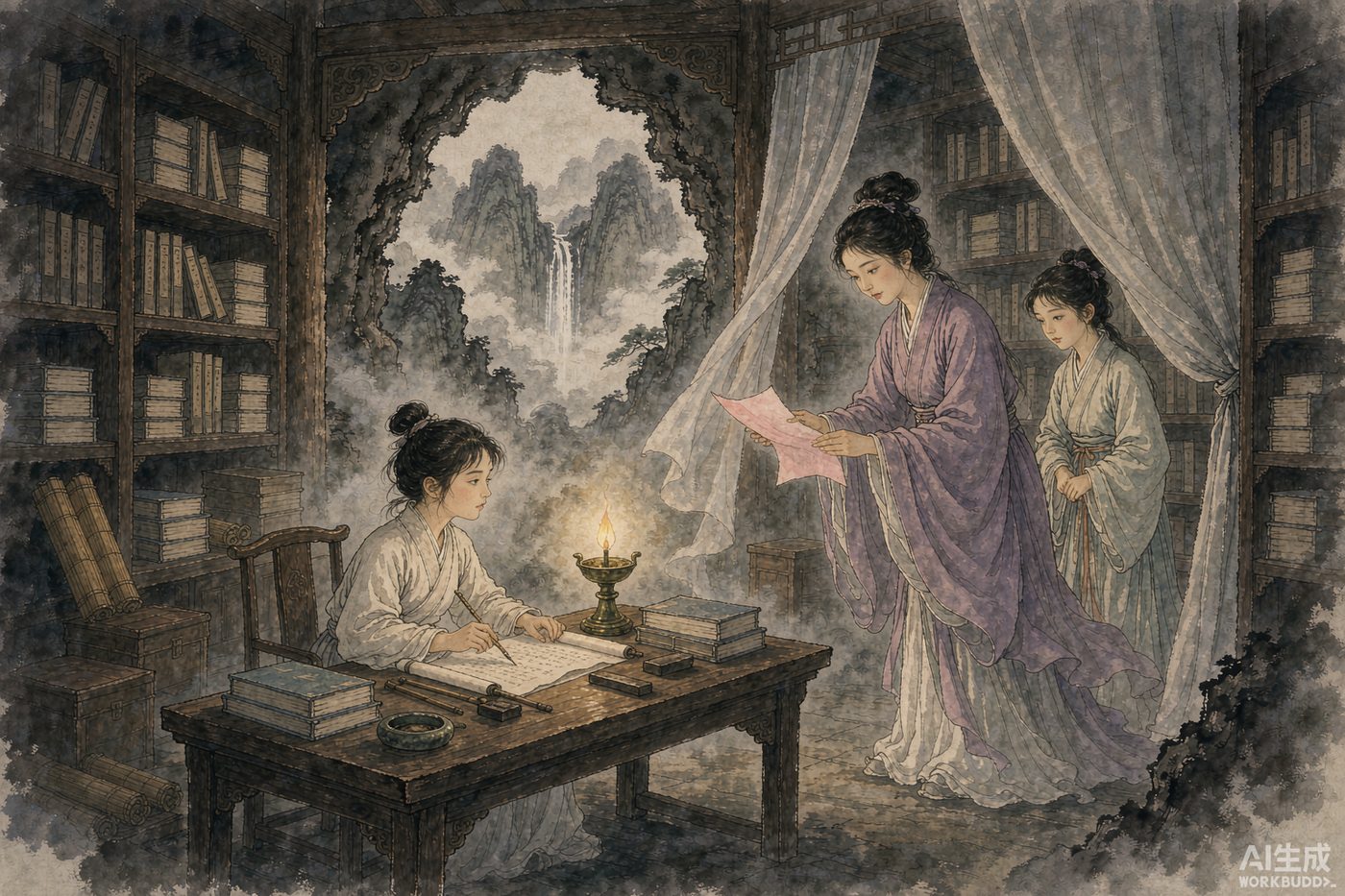
His lady was strict with the household: beyond broom and dust, she set the girl to needlework. Shuer could not learn it, was whipped daily, and only bowed her head and endured.
Later the judge was implicated in a fault and dismissed, returning home. In the jujube grove there were two bandit chiefs: “Second to Zhang Qing,” Liu Biao, skilled with meteor-pellets, five fired at once, never missing; and “Iron-Crutch,” Zhu Jian, who wielded an iron staff and had once smashed the stone drum before the temple of the True Warrior to powder. They ravaged the greenwood, and the thief-takers dared not look them in the eye. The judge knew them and travelled with precautions.
It was nearly dusk when a whistling arrow sounded in the grove. The judge’s thighs trembled and his lady’s face was the colour of earth. Every attendant and guard changed colour.
Shuer stepped forward calmly. “How dare such rats molest your Excellency’s carriage? If they do not wish to live, I can kill them for you.” She begged for his leading horse and rode out empty-handed.
“Dog-slaves!” she shouted. “Do you know Nie Shuer of Henan?”
The bandits laughed. “We want money and notes. What use is a book to us?”
“Your hour has come,” she cried, “and you dare jest!”
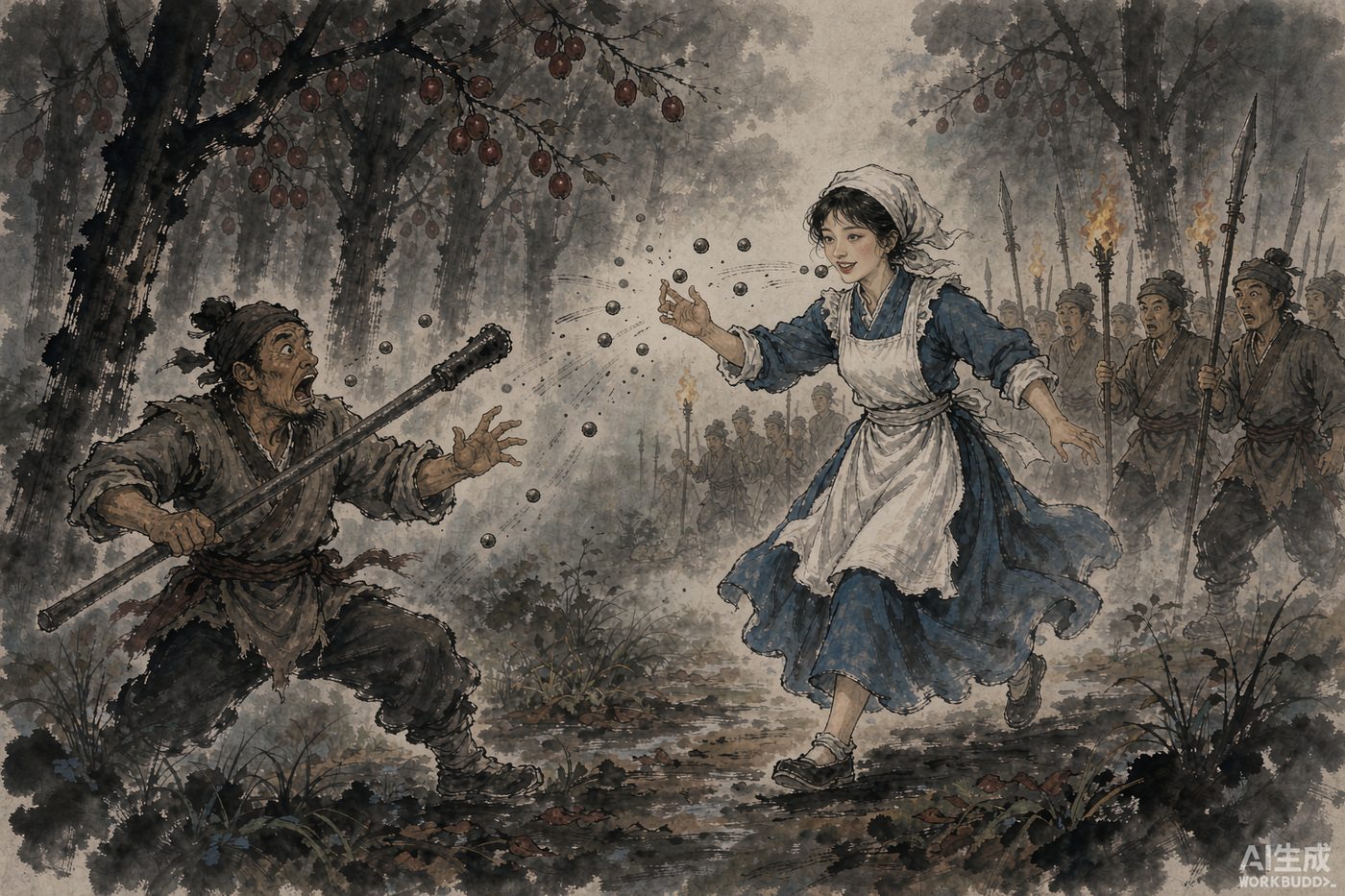
Enraged, a bandit loosed a pellet; Shuer caught it between two fingers of her right hand. Another flew; she took it with her left. A third came, and she met it with a smile and held it in her teeth. Alarmed, he fired again; Shuer lay back along her horse’s neck and trapped the pellet between her insteps in play. The fifth came, and she sent one of her own from her foot to meet it — it rang out and dropped thirty paces away. She sprang up, spat the pellet from her mouth, and laughed: “Is that the whole of your art, you slave?”
One bandit unhooked his iron staff and came at her; Shuer took it from him, bent it into three or four loops, kneaded it like soft cotton, and threw it on the ground. “Your mother’s kitchen stick,” she laughed, “and you bring it to frighten people with?”
Both bandits lost their colour. Shuer then took the pellets from her hands and fired left and right, and both were dead. The rest of the bandits prostrated themselves before the horse and begged for their lives. “You are not worth dirtying my hand,” she said, and ordered them off.
She rode back unhurried and reported: “By your Excellency’s protection, I have not disgraced your mission.” The judge and his lady were astonished, and asked why, possessing such skill, she could not hold a needle.
“Long spears and great swords I had handled since I was eleven or twelve,” she said. “A needle in my hand, I do not know what the object is — that is why I could not learn it.”
They asked why she had simply bowed her head under the whip. “My late father sent me to repay your husband’s great kindness. To resent a small beating would be to repay kindness with resentment — how would I dare?”
His lady was pleased too. On returning home she urged the judge to take Shuer as a concubine. She bore a son who later became a magistrate in southern Yunnan, and who would lead his own officers into the hills to arrest bandits — very much in his mother’s style.