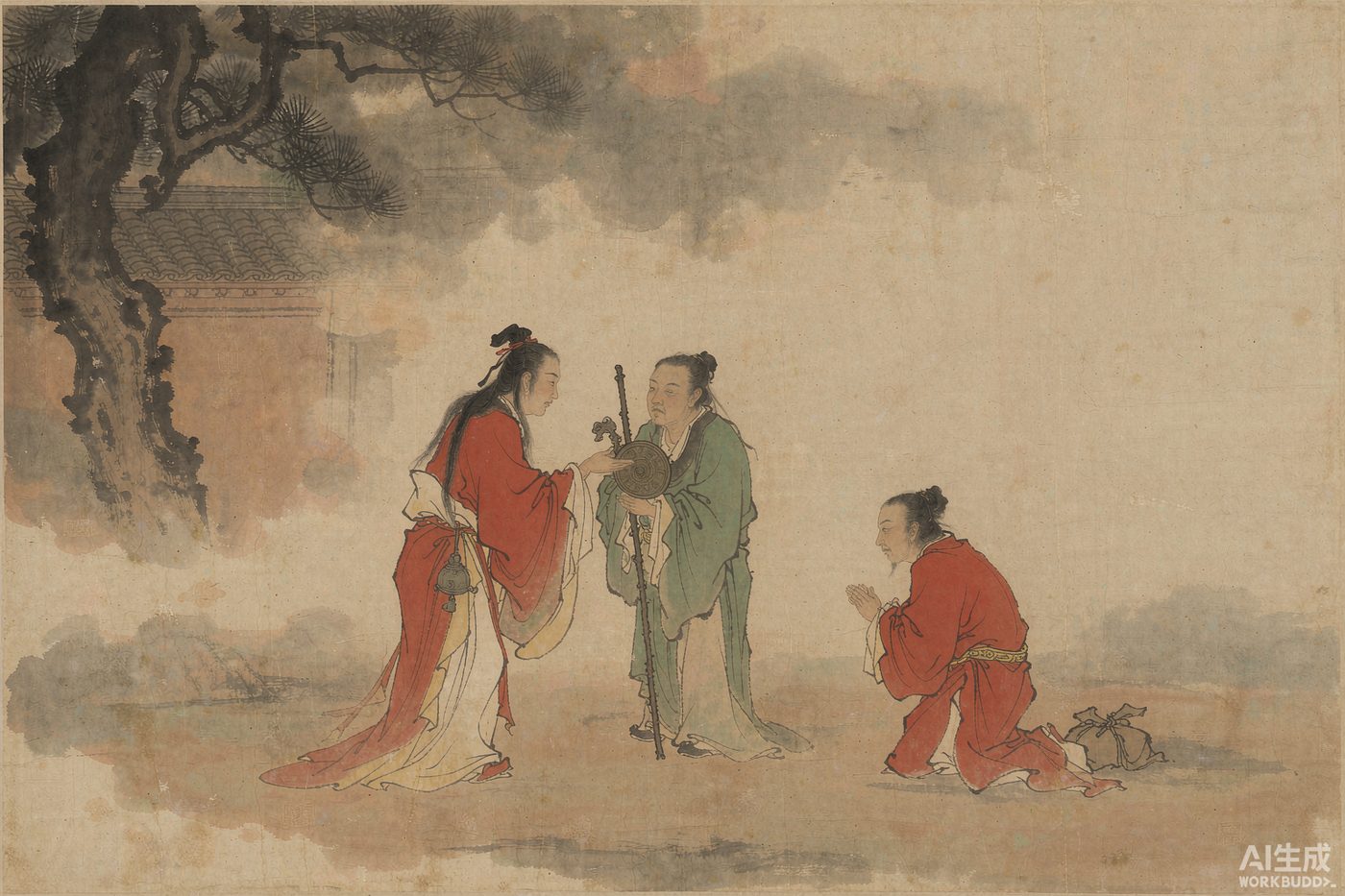
At the Xingjiao Temple in Yangzhou there lodged a man who carried a tiger-shaker and called himself the Mirror-Grinding Old Man. At his belt hung an ancient mirror that looked to be a thousand years old.
Asked what it was for, he said:
“Every human heart has seven apertures. In those who are short of wit, some of them are certainly stopped up. I shine the old mirror on them and learn where the disease lies, then give the right medicine, open the aperture and increase the wit.”
The dull-witted competed to put themselves in his hands, and he had remarkable successes.
A certain rich merchant had a son who at sixteen could not tell beans from barley. He invited the old man to the house and knelt before him, begging him to treat the boy.
The old man took the mirror and looked long, then shook his head and stood up.
“The disease is too deep. I cannot do anything.”
The merchant asked why.
The old man said: “I can treat the acquired; I cannot treat the congenital. Your son’s heart is wrapped on the outside in the vapour of meat and wine — that is an acquired disease and can still be removed. It is wrapped on the inside in the vapour of gold and silver — that is a congenital disease and cannot be cured.”
The merchant pressed him for something anyway.
He said: “Let us try, absurdly.”
He had the boy shut in a room alone — hungry, fed on the dregs of bean curd; thirsty, given bitter water to drink. It went on for half a year. Then the old man took the mirror again.
“The meat-and-wine vapour is entirely gone. But the gold-and-silver vapour blocked him from before birth. What is to be done?”
The merchant said: “What do you mean, before birth?”
The old man said: “When your lady conceived, gold and silver were piled in the inner room, and your son happened to catch the vapour of it, so that the seven apertures were muddied and stopped. Outside he seems to have a golden light; inside he is really the stink of copper. If you want the method to overcome it: go at once to the Hall of Wenchang, take two bushels of ash from the burner where written paper is reverently destroyed, mix it with several pecks of ink, roll it into pills the size of paulownia seeds, and have him take them morning and evening washed down with wit broth. Finish all of it and there may be some help in it.”
The merchant followed the method exactly.
In less than three months the old man took the mirror again. Six apertures were clear and open. One was stopped up and dull exactly as before.
The merchant asked him to treat it. The old man laughed.
“That is called the writing aperture. You are a rich man; you should not have a reader in the family. If I open it, I fear it will bring down the jealousy of the Creator. Leave this one aperture closed, and I give you back what belongs to your house. Cut and scrape too much, and what profit is in it for you?”
The merchant did not dare ask again. The old man took his leave.
After that the boy could manage himself in company and was sharper than he had been — only he could never get a line of a book by heart. His father paid for a purchased office for him, and he ended as a secretary in the provincial administration.
The Duo comment: “The Classic of Terrestrial Prospects says: the vapour of copper money, seen from afar, is blue cloud. This boy came out of a copper mine, and yet he cannot step up and walk on the blue cloud — why? Because he was born in the broad daylight of an open age, and his vapour is not vigorous enough. That the writing aperture stayed shut may not be his fault.”