Feng Yehe of Wuhu was a man of real loyalty to his friends, and entirely governed by his wife. He had no son in middle life, bought a concubine, and was forbidden to share a bed with her. Once, in a corner where nobody was, he spoke to the girl privately — and his wife saw them from somewhere, and called on heaven and beat the ground, and cursed him in ten thousand ways.
Feng was terrified of her, and did not dare answer.
One day a scholar called at his house. Feng asked him to sit and asked where he came from.
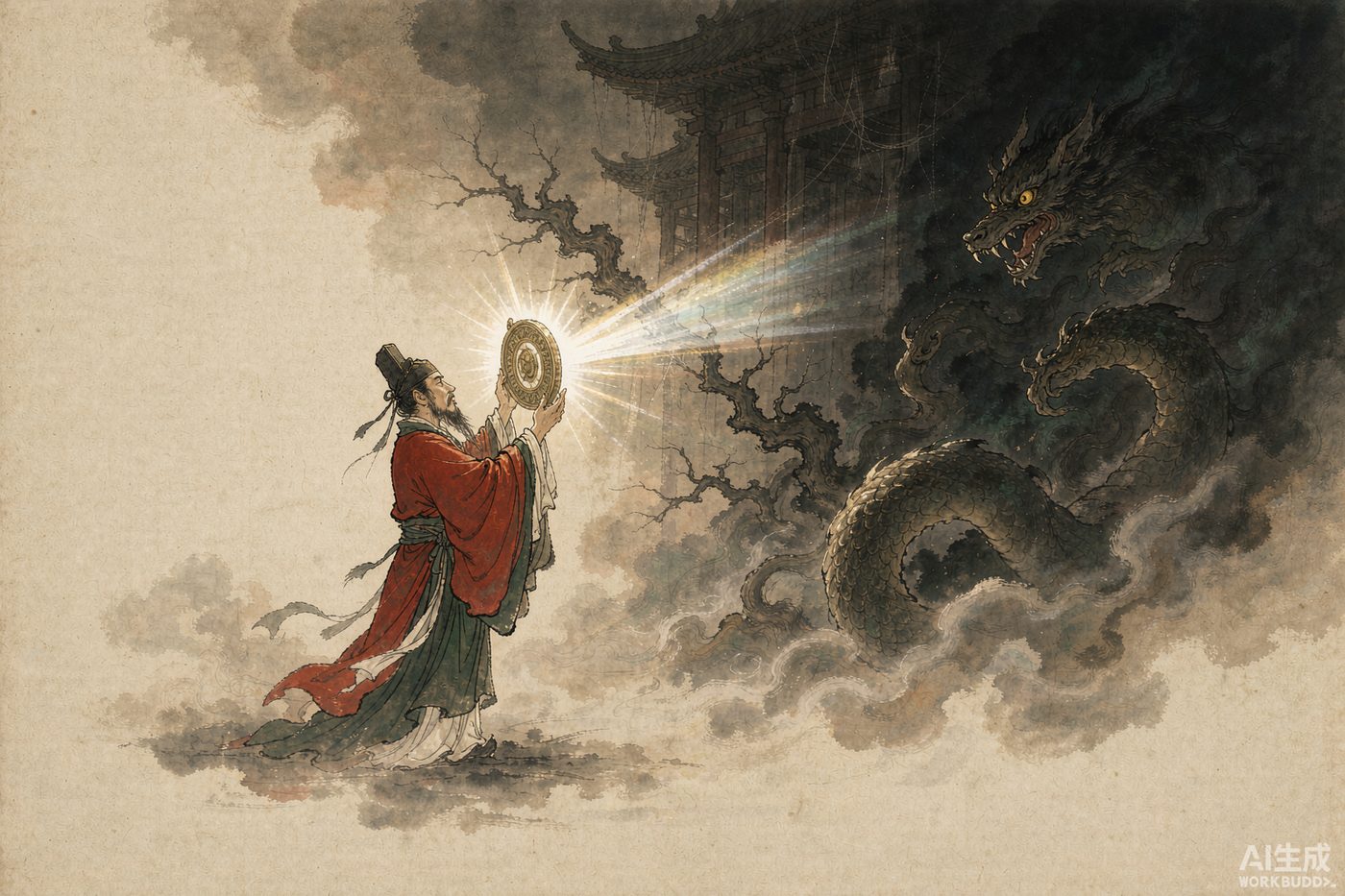
“I am a scholar from the Qin terrace,” said the man. “I am good at seeing a person’s gallbladder. I have knocked about the world a long while, and I have observed that among scholars there is no gallbladder for writing, and among soldiers none for breaking an enemy; those who wear the court sash have none for speaking plainly and remonstrating; and those who swear friendship by the sash have none for being entrusted with a wife and a child. Hearing of your high conduct, I came to have a look at your gall.”
Feng was delighted, and offered to pour his out and show it.
“There is no need, I see it clearly. But it must be hardened with wit and blown up with breath, or there is a risk of losing it altogether.”
Feng said stoutly: “I may not be the Lord of Changshan, all over muscle, but I have lain on brushwood and tasted gall these many years. I do not think I shall end up terrified of a famous name, bawling like an infant in swaddling.” He slapped his thigh and talked loudly, very pleased with himself. The scholar clicked his tongue in admiration.
Presently a lion’s roar broke out in the women’s quarters. Feng took no notice and went on talking and laughing as before.
Then came the sound of a cooking-pot smashing in the kitchen — like Mount Tong falling in the west and the great bell of Luoyang answering in the east. Feng still kept some hold on himself.
Then the sound of a beating in the front hall, and weeping under the rod, and all the maids and servants shouting and trying to pull them apart. Feng began to change colour.
Then an old serving-woman came running in: “The mistress has hitched up her skirts and rolled her sleeves and is waiting behind the screen with the wooden rice-pestle!”
Feng began to get out of his seat.
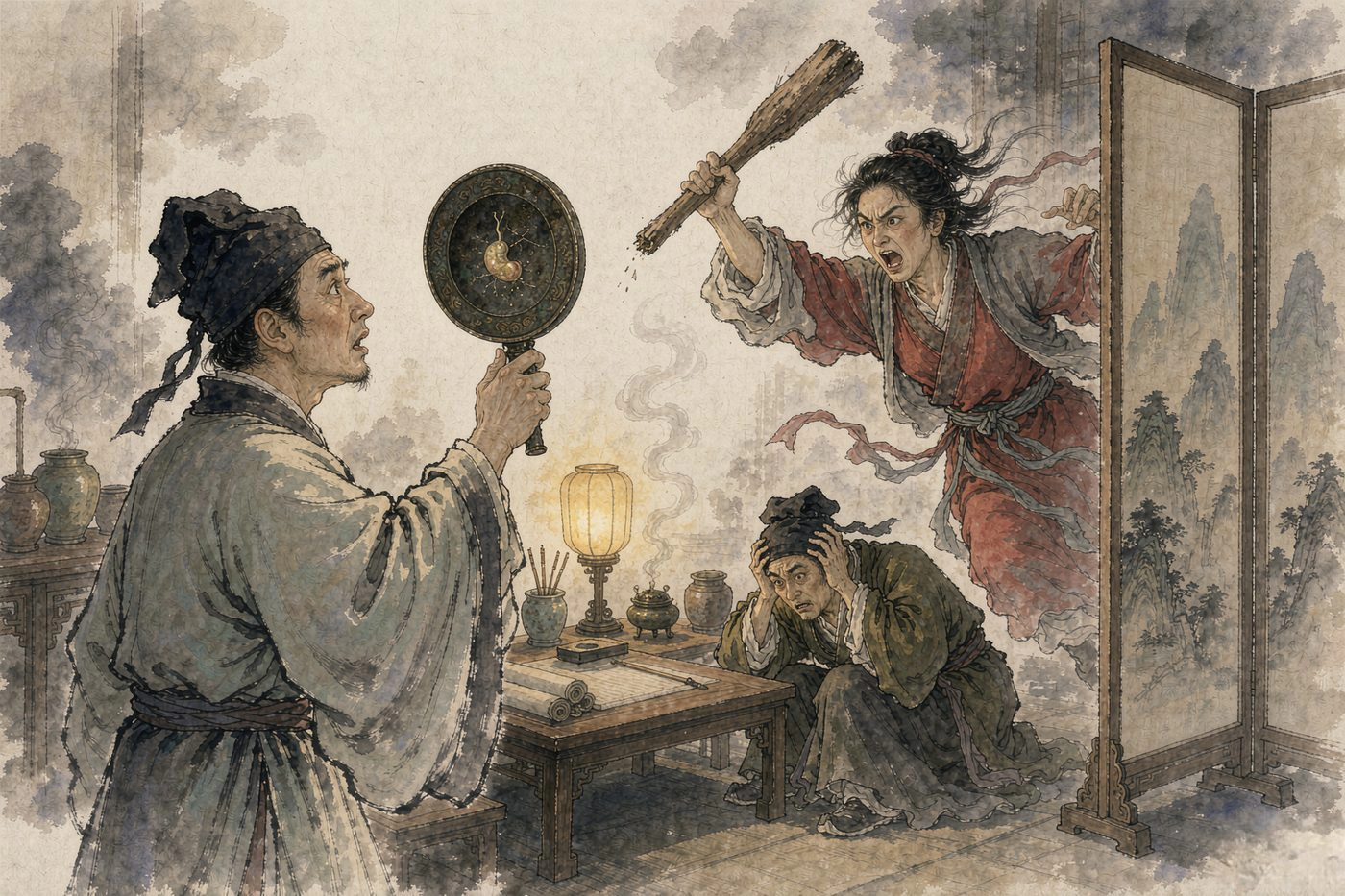
There was a thumping of the pestle behind the screen, and a voice bellowed: “Whose wild young fool is this, teaching another woman’s husband to be a man of great gall!”
Feng’s face went the colour of earth. The scholar stared at him in amazement.
“Extraordinary! At first it was the size of an egg. Then the size of a mustard seed. One more shock and it will surely burst.”
He got up to go. Feng caught at him and held him.
“I came because I had heard you were a man of gall, to get a general impression. I did not expect that the outside alone was large, and that inside you are simply a man with no gallbladder at all.”
Before he had finished, a pestle flew out from behind the screen and struck the scholar’s left arm — and there was a ringing sound, and it was a bronze mirror that fell.
Feng picked it up. Two seal characters were cast on the back: 照胆 — that which shows the gallbladder. It was an object of the Qin.
His wife snatched it and looked at herself in it. Her gallbladder was as big as a wine-jar, and still steaming with angry breath.
Turned on Feng, it was the size of half a grain of millet, and dripping a blue fluid. When they looked closely — it had cracked.
The Duo comment: He is a man and I am a man — why should I be afraid of him? She is a woman and I am a man — how am I not to be afraid? Let this stand as a warning to whoever is not a man. The common weak husband is simply ashamed of his own incapacity, and so brews a shrew. But the man of understanding and strategy, who fears that the ugliness of his household will be dragged into the open, will very often swallow his voice and hold his breath to keep his good name — and that is how the prestige of the inner quarters comes to walk the whole empire. Yuan Zhi catching hold of a foot; the Grand Tutor closing the curtain; Wang Maohong’s ox-cart; Fang Xuanling’s poisoned wine — all of them are warnings. And yet the five tigers of Yanping are feared even by ghosts; without the wound-salve of Du Lanxiang it is not easy to ferry all living beings across. I remember in the gengyin year, recuperating at Red Peony Mountain Lodge, I made a play for my own amusement called The Gilt Belt, to punish jealousy in the shrews of the world, and it was performed in the hall of Observer Song. At the first note from the stage, every man in the seats changed colour and edged away — for the shrew’s jealousy was not yet punished, and the coward’s gallbladder had already fallen. Perilous indeed.