East of the county offices at Qimen there stood an osmanthus tree. It flowered, but the flowers had no smell, and the local people, disliking it, called it the Stinking Osmanthus.
One evening a Daoist came with an old gentleman, walking in the moonlight, and recited poetry beneath it. The Daoist pointed at the tree and laughed.
“That is the seventh tree of the toad palace.”
The old man said: “A flower of the moon’s courts, whose scent is twice that of Vulture Peak. Why is it so wretched here?”
The Daoist said: “I remember, eight hundred years ago, when the lord of the moon was enlarging the Palace of Vast Cold, this tree stood in the way of a corner of it, and he ordered Wu Zhi to move it. It happened to be caught by the high wind of the upper sky and tumbled down into the dusty world, where the Money God picked it up by chance, meaning to plant it on the copper mountain — and at that its scent suddenly drew in. The Money God took a dislike to it, and threw it away here.”
The old man said: “The stink of copper drives a man off; to loathe it is right enough. But to have played such a trick and got nothing by it but a bad name — that is what comes of being contrary.”
The Daoist laughed. “Let me wash this disgrace off the flower.”
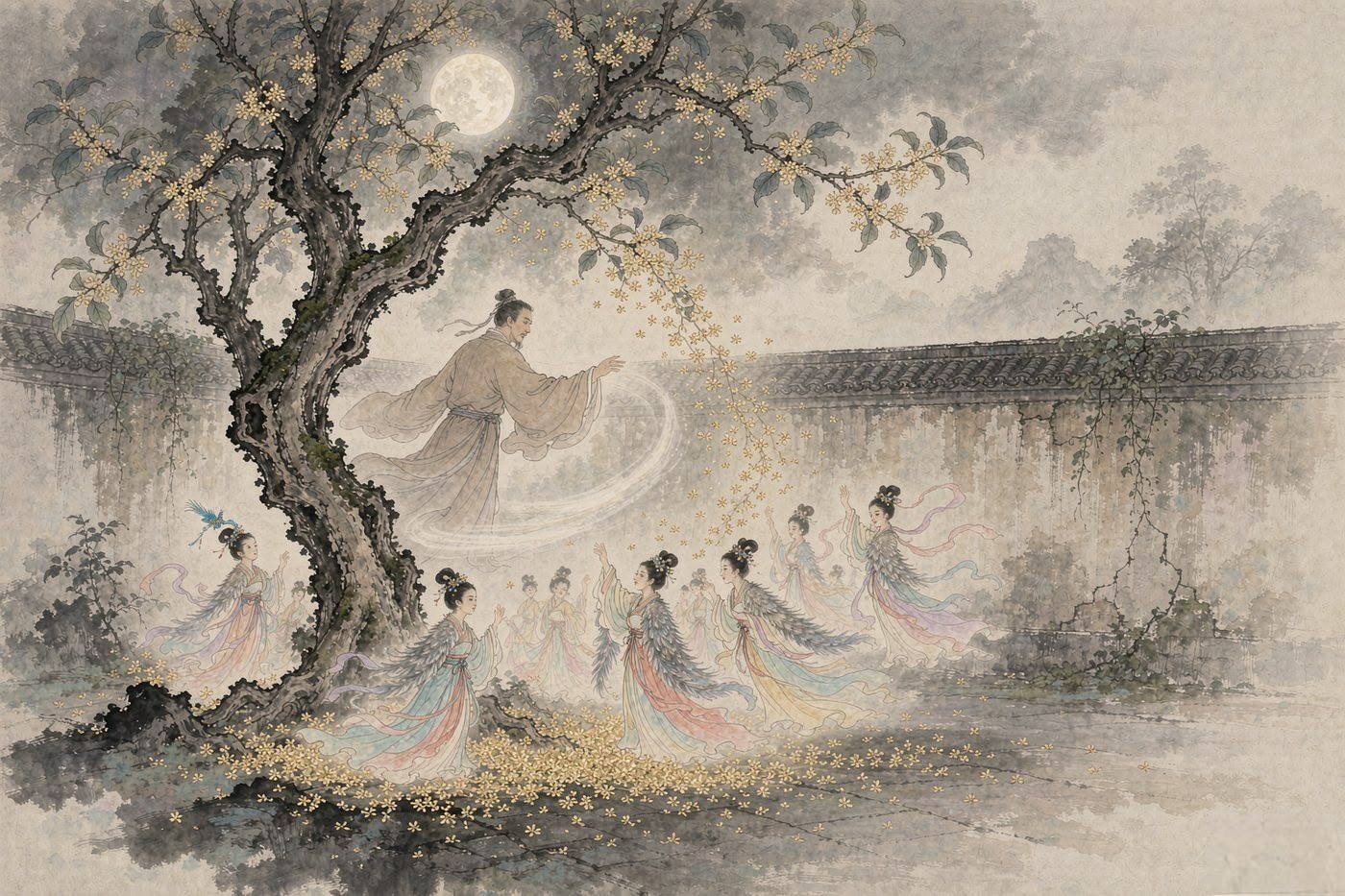
He lifted his sleeve and circled the tree three times. Presently a strange perfume drifted out, and the fragrance carried for several li. A west wind got up abruptly, and the golden grains came pattering to the ground — and in every flower there appeared a beautiful woman, in rainbow skirts and feather robes, dancing and whirling.
Among them was a girl whose hair was dressed in the cicada-wing knot, with a kingfisher phoenix pin at the side; and in the phoenix’s beak was a single red bead, whose light struck against the colour of the moon.
The Daoist said: “Ah Huang presumes on the favour of Chang’e and has long been absent from the heavenly ministry. Tonight she shall sing for me.”
The girl smiled, leaned against the tree, and sang:
The gold wind drifts and the jade dew dries; the Weaving Girl keeps me waiting west of the Silver River. I scorn the dragon for its fishy reek and will not ride it; I mount the bright phoenix and I am gone.
The copper clock turns and the star-shadows sink; high and cold are the jade heavens — on whom shall I lean? I clutch the cassia tree and my tears fall; I am going from this place — let me go home with you!
When the song ended the west wind rose again, smoke flew and mist rolled up, and the women were gone. The fallen flowers were blown back and hung upon the tree as before.
The old man said: “After one night’s sport like this, the flower will keep its fragrance for ten thousand years.”
The Daoist said: “The sound without sound is the true sound; the flavour without flavour is the true flavour. I would rather keep this flower’s truth whole, by leaving it without scent.”
He lifted his sleeve again and brushed at it, and the perfume was entirely gone; and he went off talking and laughing with the old man.
The Duo comment: The green bamboo of Qi Park ended by choking the Hú river, and the tall pines of the Zhong temple ended as fly-whisks; the wood on Cai Yong’s seat, that made such a zither, came up out of a kitchen fire. To return to the plain and go back to the uncarved, and never be disgraced to the end of one’s days — I believe it of this tree. Bing Yuan was tied to a money tree, the age made a god of it, and it became a licentious cult. This tree would not be fooled by the money-slave, and it was right that it should be buried in obscurity with no fine name. And yet, holding to its single fragrance, it was noticed at last by one man alone — and anyone with an ambition could do worse than take it for a model.