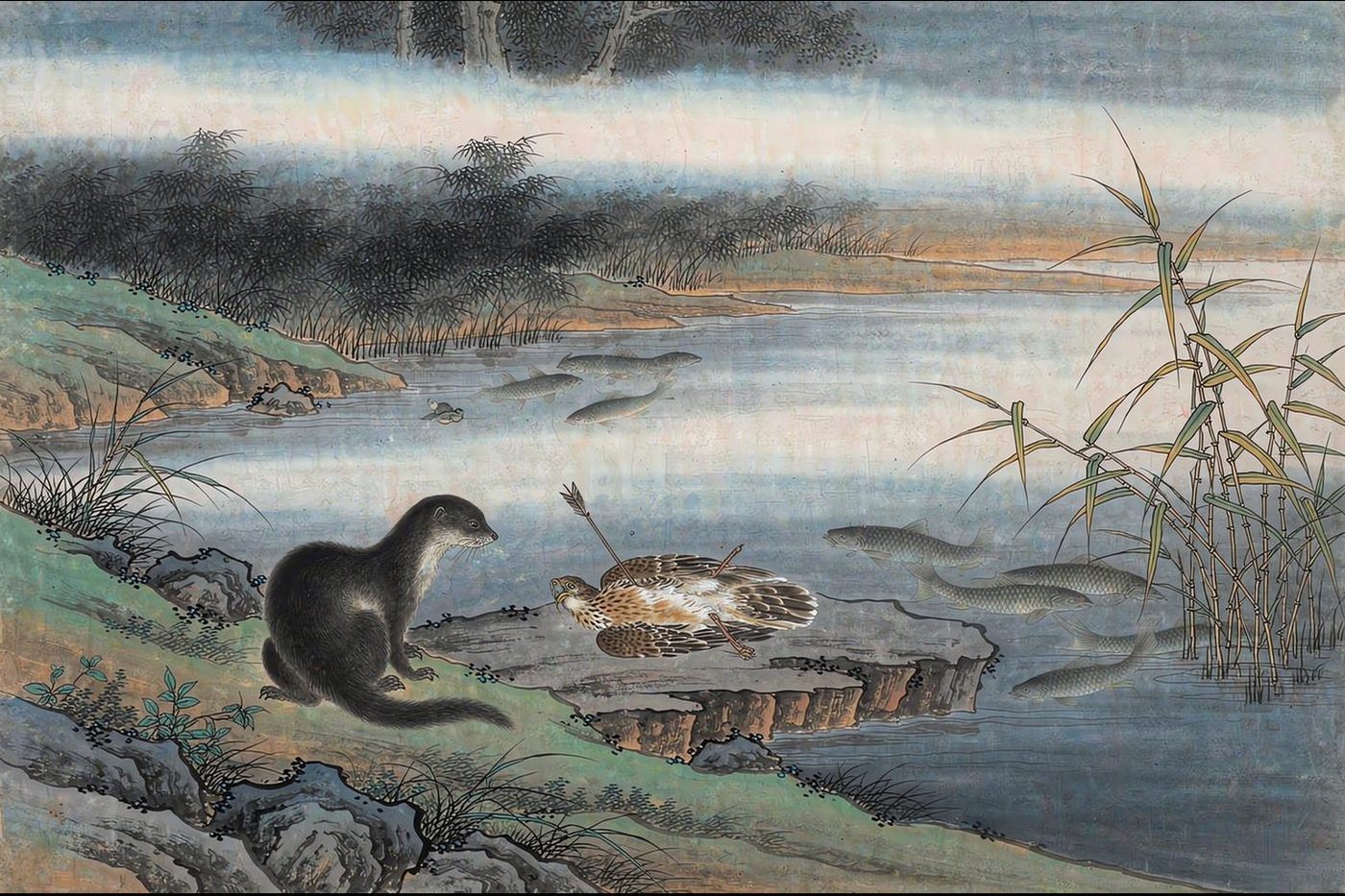
By the shore of the great river there lived a creature of power called the otter.
One day it was swimming along the northern bank when it met a hawk from the woods, and the two of them settled on a flat rock and talked.
Said the hawk: “You are good at catching fish and I am good at catching birds. But the moment small birds see me they scream and clatter their wings and scatter like stars, so that I do not take one in ten. When you look down at your fish from above the weir, can you gather a whole shoal and destroy them?”
Said the otter: “Fish fear me as birds fear you. Do you think they all hate life and love death, and are eager to end up on the dried-fish stall?”
Said the hawk: “I have heard that you drive them off and then call them back. What divine art do you work to do that?”
Said the otter: “It is commonly said that I have some other trick, like the Daoists’ method of driving spirits about. That is nonsense. The tiger has hooked claws, the rhinoceros a terrible horn, the fox a bewitching bead, the gibbon brittle bones — all of it glued on by the writers of marvels. Creation is kindly: to the beast it gives horns it takes away teeth; to the one it gives wings it gives two feet only. Would it then add fangs and claws to the likes of us, and so finish off every kind of thing between heaven and earth?”
“Then what do you do?”
“The reason I drive them off and they come back is this: when I take, I never slaughter more than a few of their number. I sit and take what comes easily, as though it were happening without anyone noticing. They pass me believing there is no danger — and so the taking is never finished and the supply never runs out. That is what is meant by let go in order to take; be sparing in order to be greedy.”
Said the hawk: “What you say is true. But birds are craftier than fish. Fish are the most docile of creatures; they only follow the current. Among birds, the golden pheasant keeps a wife on watch, the goose posts a sentinel, the cuckoo hangs upside down to keep its guard, the parrot uses its tongue to dodge; and besides, sparrows always come into the curtains, swallows must nest under the eaves, pigeons trust the temple bells and crows ride the thwarts of merchant boats. With so much machinery about them, how is the fowler to catch anything? When they all rise together in front of you, is it not too late to be sparing, and to let them go far away?”
Said the otter: “Your ambitions are large. But is it not better to keep an inexhaustible store, against the day when you will want to be satisfied?”
Before he had finished, a hundred birds came across the sky. The hawk struck four or five of them; the rest bolted into the wood.
The hawk could not bear to let them go, and beat his wings and went after them.
And a huntsman had been lying in wait at the side, and let fly — and the hawk was shot through the neck and died.
The otter mourned him, and made an offering on the northern bank, and called his soul, and said:
The kite flies up to heaven; the fish leap in the deep. We two alone made killing our field. Sparing, we took little; greedy, we are thrown away together. Why did you not husband yourself — and carry your resentment down to the second spring?
I give up the trade from today; I wash my hands by the river’s edge. Better an empty belly than a lost head.
The Duo comment: To gather the whole flock and destroy it — the hawk was poisonous. But sparing in order to be greedy — the otter’s secret plot is the more poisonous of the two. And yet heaven repaid the hawk and did not repay the otter. Is it that chanting fish into a bowl is not forbidden to the Buddha’s gate? Or was it the merit of that repentance by the river?