Li the Sixteenth, a townsman of Huangzhou, kept a tea-house below Prospect Bridge. In the spring of the eighth year of the Chunxi era, one night when the shutters were already barred, his servant Cui San was still awake when he heard someone knocking outside.
“Who is it?”
“It’s me.”
Cui took it for his master and hurried to lift the bar. It was a young woman, and she was very beautiful.
He started back. “Where do you come from, mistress? This is the Li family tea-house. Have you not made some mistake?”
“I am the new wife at the Sun family’s, just along the road here. I angered my mother-in-law and she has turned me out. At this hour of the night I have nowhere to go. Let me stay one night.”
“I am in someone’s employ,” said Cui. “How would I dare take it on myself?”
The woman pressed him as though her life hung on it, and would not go. Cui had no choice; he led her to a corner at the side of the shop, gave her a mat, and let her lie down there.
After a while she got up, came to his couch, and spoke low to him.
“I am not used to sleeping alone. Would you like to?”
Cui was beside himself with joy. He kept her the night, and she went at cockcrow. After that she came constantly. Cui was a hired man who had won a beautiful woman; he was content with his luck, and never asked into her circumstances.
One evening she said: “Your wage is no more than a thousand cash a month. That cannot be enough to live on.” And from her sleeve she drew official notes for ten thousand and gave them to him. After that she brought him small sums again and again, and Cui was more pleased with her than ever.
His brother, Cui the Second, had always been a hunter by trade and was often away in other prefectures. Now he turned up suddenly to see how his brother did, and lodged with him for ten days and more. The woman did not come once.
Cui missed her so bitterly that he dreamt of her, and at last he poured out the whole truth to his brother.
“This place is full of ghosts and sprites,” said the brother. “I fear she will cost you your life. You must settle it quickly.”
“I have been with her more than a year,” said Cui, “and I have relied on her to keep me out of want. In everything that is right between us she is my wife. I cannot fasten the name of ghost on her.”
“Then why is it,” said the brother, “that she stopped coming the moment she knew I was here?”
“Precisely because there would be awkwardness between the two of you. It would not be proper.”
“By what way does she come and go?”
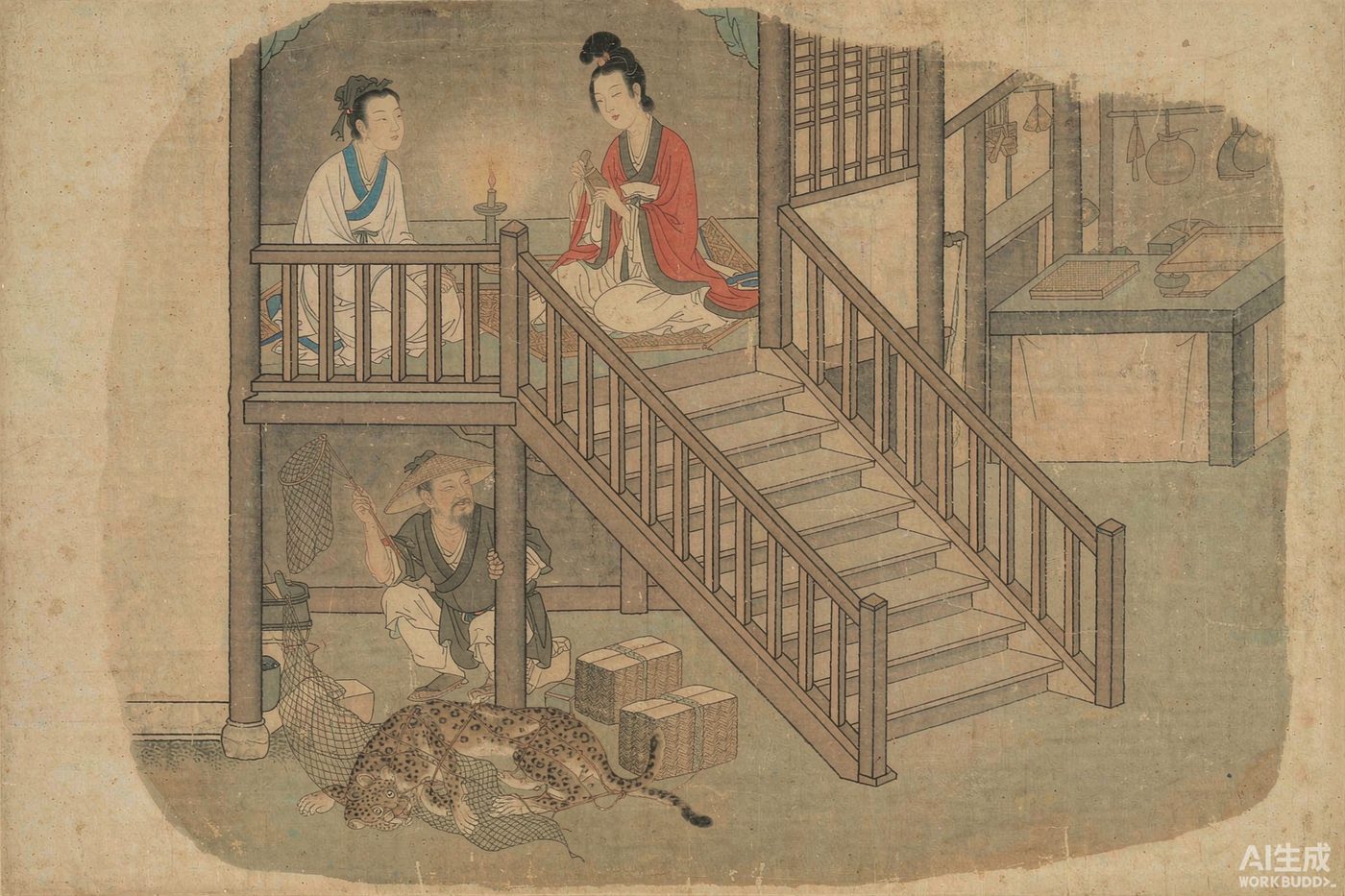
“In at the outer door, and down by the stair.”
That evening the brother went away, fetched his hunting gear, and spread several rolled nets. At dusk he came back and lay hidden. After the third watch there was a sharp creak. He lit a torch in haste and looked — and there in the net was a spotted wildcat, three feet long, dead.
“This is the thing that has bewitched my brother,” said the brother. And he skinned it and cooked the flesh.
Cui was wretched. He wept, and could not get the better of it.
Another day, sitting alone in the room, he became aware of a strange fragrance, rich and strong, and a woman was standing by the lamp, shouting at him.
“I have shown you such kindness,” she said, “and time and again I have relieved your poverty. Why did you lightly trust your mad brother’s talk? Fortunately I had not left the house just then — all you managed was one of my maids killed, and a single gown spoiled.”
Cui apologised humbly.
The woman laughed. “I knew well enough it was not your doing. I hold nothing against you.”
And she stayed on exactly as before. She is there still.