Zhou Mengquan of Kuaiji had been an infant in arms when his father went off to Guangdong and Fujian, and for twenty years there had been no news.
His mother sent him to find out what had become of the man. He slept by water and ate in the wind, and wore himself out doing it, and when he had been travelling more than two months he was still far from the Guangdong border.
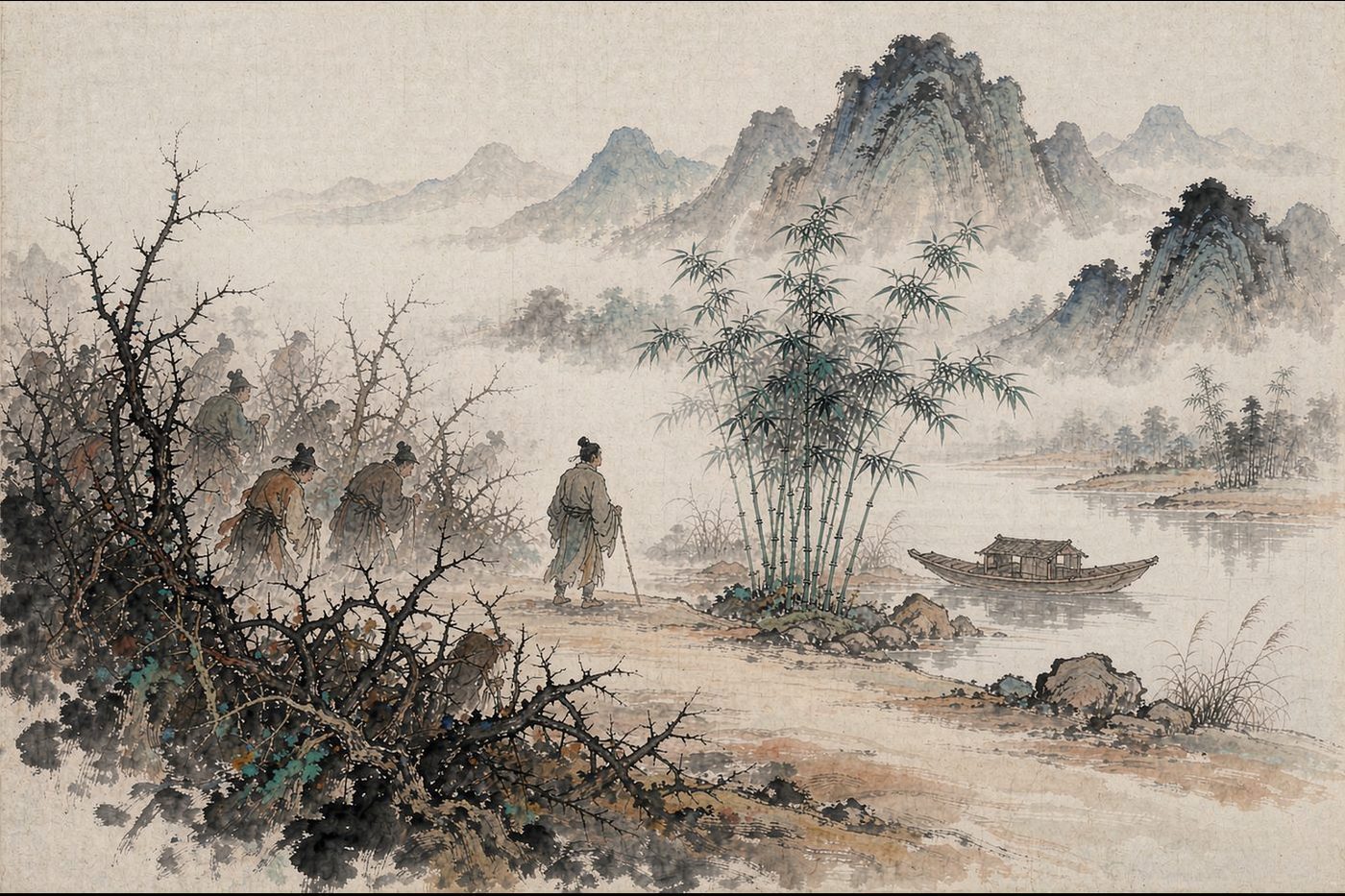
Then a side road bolted away from him into a valley, and there were ten thousand clumps of thorn, hiding the sky and stopping up the ground. Among them were several men in caps and gowns, blundering about with their feet pierced and their clothes hooked, and not seeming to feel it.
Zhou gathered up his skirts to go in, when an old man came towards him leaning on a staff and asked where he was bound.
Zhou told him: to look for his father.
“You are a filial son. You should be walking the broad highway. You should not go into Thorn Country.”
“And what are these men doing here?”
“All their lives their hearts have been smoked in profit and reputation. They run to the hot road, they take the short cut, they pride themselves on a fast step. So they have blundered in here, to make them stumble once on their toes.”
“Why do they not feel the pain?”
“On the roads of the world the thorns are all without shape. Only the man standing aside sees them. The man inside them does not know.”
Zhou said: “Then why do you not open a heart of pity and cut the thorns away for them?”
The old man laughed. “Thorn Country always had two paths. I have cleared one of them already, as a way for loyal ministers and filial sons to come and go. It is only that these people abandon the straight road and will not walk it.”
Zhou asked where it was.
“With thorns in front of you, turning your head is the road.”
Zhou looked round — and there indeed was a broad highway, flat and level, and he took it.
On either side were bamboo and trees, delicate in the wild way that is lovely. The old man said: “That is the filial bamboo of Prince Zi Han, and that is the mutually-yielding tree of Zhang Maoqian.”
They came to a crossing called the Ford of Right, with a boat moored in it called the Barque of Mercy; and the water that wound about it was all living water out of the source, and not a wave rose on it. The old man took Zhou aboard and put him across.
On the bank stood a stone of integrity, engraved in gold and blue with characters like tadpole script that Zhou could not read. The old man said: “The common saying is the far shore of awakening. That is what the Confucians call the shore of the Way.”
Some miles further they came to a gate, inscribed THE GATE OF NO SECOND. Looking along it, it was level as a whetstone and straight as an arrow, and there was no side path to left or right at all.
“Go in here,” said the old man. “Do not step backward. Do not look for a fork. Push on even when it is hard, and you may go all your days without thorns.” And with that he went.
Zhou went in by the gate. The path underfoot was stone, bright enough to reflect a shadow and yet not in the least slippery; he walked at his ease and at first was not much tired.
Then a cliff stood up in front of him, hung about with old trees and vines, going up into the sky. Zhou climbed by the vines — and lost his hold, and fell like a wild goose dropping.
He got up and looked about him: fine grass on a level slope, wild flowers in the path, and it seemed another country altogether. There was a man going by with a load of brushwood, singing to himself; Zhou asked him, and found he was on the far side of the western mountain of Guangdong.
He went into the city in haste and traced his father, and found him in the eastern court of the Vairocana temple. His father had drifted about as a sojourner and had not the face to go home.
They saw each other, and told each other twenty years, and held one another and wept bitterly.
The people of Guangdong were moved by Zhou’s filial conduct and spread the story through their neighbourhoods, and subscribed to send them home with money for the road.
The Duo comment: The broad highway is hacked out of the middle of the thorns. From which it may be known that the two roads — the good and the bad — are not a foot apart. Perilous.