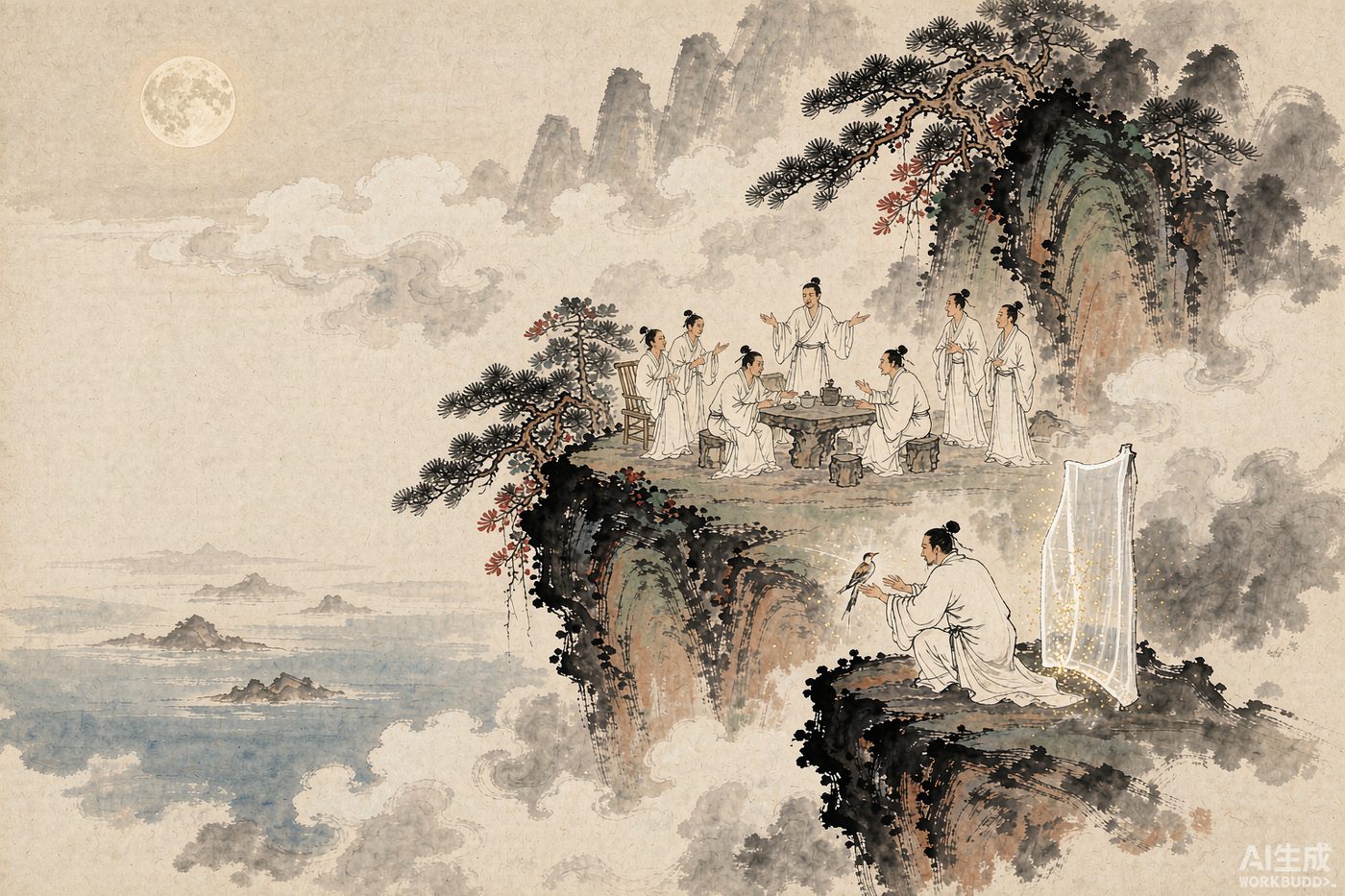
Old Zhao the Third was named Jin, courtesy name Congxian, of Baisha town in Zhongmou county. He had been a Yellow River fascine soldier and had deserted. Meeting Sun Simiao in the jujube wood, Sun taught him the essentials of the Way. After a long time Sun left him, telling him not to leave the county territory, at Chunze village, and saying: “Do not on any account leave here. Without an imperial edict you may not go. Wait until I come again and I will return with you.”
In the renyin year of the Xuanhe era he was a hundred and eight, and was duly summoned to an audience, and lodged in the Baoqing palace. Presently he begged to go home, and when the edict asked what he wanted, he answered: “Your servant was originally on the military register and has no certificate of release. I only beg that one be granted. I want nothing else.” That day an edict ordered the prefect of Kaifeng, Sheng Zhang, to issue it, and he was free to do as he liked.
Of techniques there was nothing he did not understand. He could command ghosts and spirits and knew future events. For others he breathed on and massaged them, and pain stopped at once.
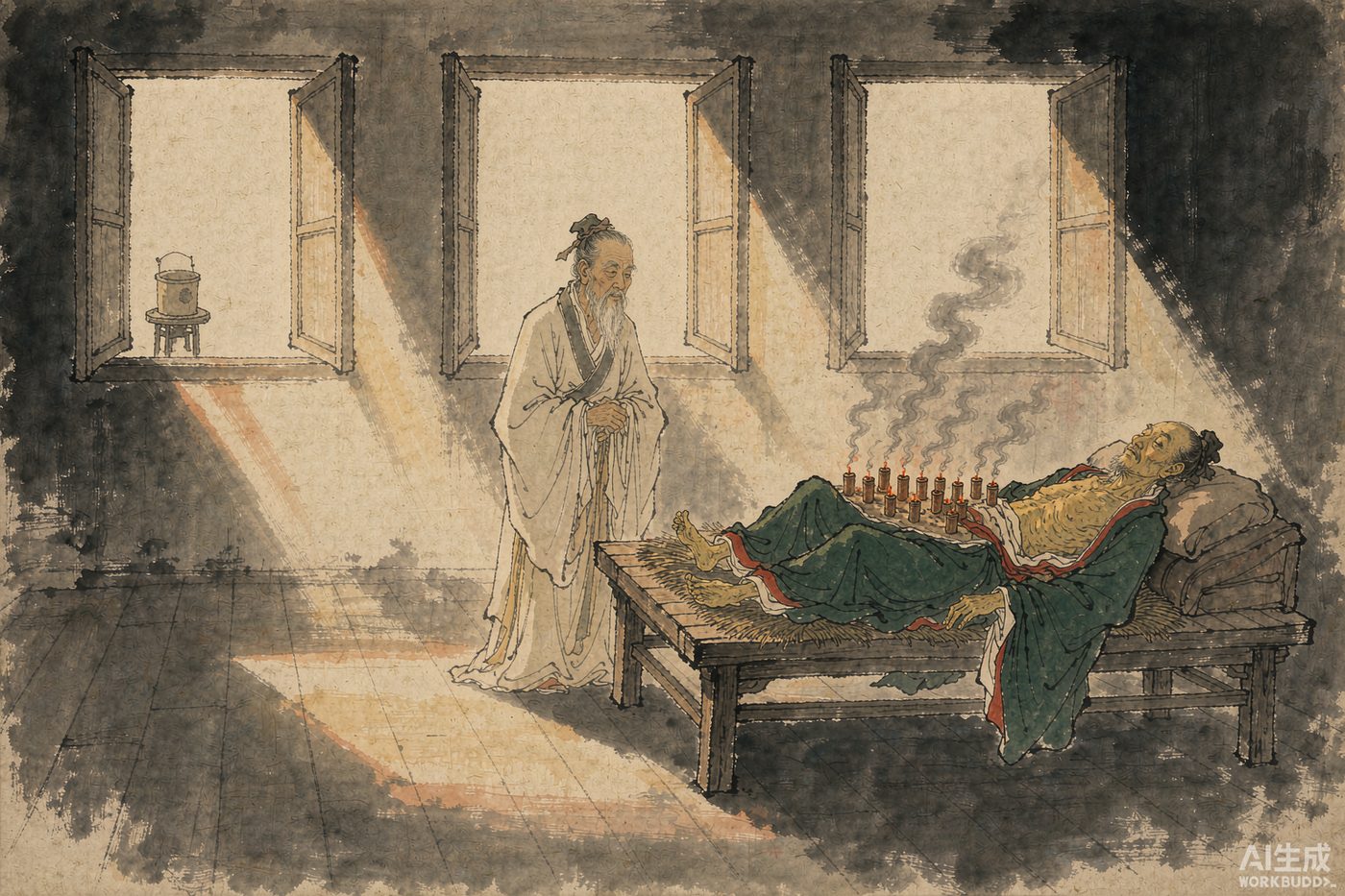
The commander Dun, a Bao yi lang, suffered from a cold illness for two years and was down to skin and bone. One day he was cauterising with moxa when the old man came and asked the origin of the illness, and Dun told him the truth. The old man had it all removed. It was high summer, and he made him open three windows in the house and let the sunlight in, and lie on his back, and rubbed moxa all over his belly, some ten-odd pieces, and used the heat of the sun to burn him. After a while the heat went through his navel and belly and was unendurable, and presently there was thunder in his belly and he passed it downward, and his mouth and nose were full of thick moxa smell, and then it stopped. The next day he did it again, and so for a month the illness was cured, and he was told to go the full hundred and twenty days. From then on his long illness was washed away and he was as strong as a youth.
The old man said: “This is Perfected Sun’s secret method. The world only knows how to cauterise with moxa and does not know how to find the points, nor does it consider the pain and the exhaustion of strength. Daytime is the sun’s true fire; the moxa is spread over the belly and then shone in slowly, and the merit is very great. But the fifth, sixth and seventh months are best. In autumn and winter one should spread thick moxa on the belly, cover it with a padded garment, and iron it slowly with an iron full of ash fire, taking the smell of thick moxa as the measure. That is second best.”
His methods were out of the ordinary and hit the principle, and were all like this.
The Daoist Xi Dongyun of Duemen mountain in Mi county, going to the Dutong ridge by the side of the falling-water pool, climbed and admired its clear seclusion and cool height, and built a room to live in. Presently every kind of demon gathered, and before a year was out misfortunes followed one another. Xi came to the old man and told him why.
The old man said: “Surely you live on the land of the five arrows?”
Xi said: “The theories of geomancy are many, and I have never heard of five arrows. May I ask what they are?”
The old man said: “Peak-top, ridge, hill-crest, slope-back, and the mouth of a soil bag; the straight wind facing the gate, swift as a flying arrow — these are called wind arrows. Steep rapids and racing currents, hanging springs and pouring waterfalls, the sand that strikes the stones with a sound like moving thunder, day and night without stop — these are called water arrows. Hard earth and gravel, barren sandbars, growing no plants and no moist springs, hard iron, foul tin, worms, poison, ants gathering and dispersing as things rot — these are called earth arrows. Layered cliffs and stacked crags, steep walls and sheer rocks, sharp peaks and grim crests, like drawn blades and joined sword-edges, teeth and bones showing — these are called stone arrows. Long forests and old trees, dense shade and thickets, hiding the sky and blocking the sun, hanging vines and creeping creepers, gloomy and cold as among graves — these are called wood arrows.
“The land of the five arrows wounds those who live in it, and none of them can be used. Where the land winds round and embraces, the atmosphere clear and deep, the form broad and imposing, the soil fat and the earth rich, the springs sweet and the stones clear — that is superior land, and there is no need to tie yourself to the stars of heaven and the trigrams of earth.”
Xi obeyed his teaching and lived in peace, and the old man was not seen again.
Zhang Shoupeng’s father wrote a record of it on the peak, and Guo Bixiang got the text and put it at the end of the Kui Che Zhi. I wish to spread it more widely and record it here.