From the Yuanfu era onwards Tongzhou constantly had a creature doing harm, said to be the essence of a white snake. Officials and people suffered a great deal, and even prefects sometimes died in it, so that those who knew did not dare ask for the post.
In the Zhenghe era the son-in-law of a chief minister was determined to have it, being greedy for the generous salary. The chief minister instructed him: “The demonic snake of Fengyi is very vicious. Do not put your body to the test.” The son-in-law’s will could not be restrained, and he took up the post and went.
Three days after taking the seal he gave a great banquet with music for the officials, and suddenly looked at the singing women and said: “I have just taken office and set a banquet. You ought to adorn yourselves and show your celebration. Why are you in white?” The women knew why and did not dare answer.
When the banquet ended he fell ill, and the next day asked his guest officers, who said: “Has your honour just arrived and gone dizzy, seeing something that is not there? There is really no such person.”
His family sent a rider to report to the chief minister, who told the Emperor, and an edict summoned Perfected Zhang the Tranquil to go and deal with it.
By the time he arrived the son-in-law had disappeared. He had been in the prefecture ten days.
Perfected Zhang summoned the gods inside and outside and asked where the snake was, and none answered. He then called the City God and pressed him, and the City God also said he did not know. Zhang was angry and reproached him severely, ordered the yin soldiers to beat him, and applied every torture, and the god said: “That creature’s spirit reaches up to Heaven. If the words leave my mouth, calamity comes at once.”
Zhang said: “My magical power is more than enough to kill it. Now I only want its burrow. If you do not tell me, you will be killed first.”
The god then bowed his head and secretly told him where it was.
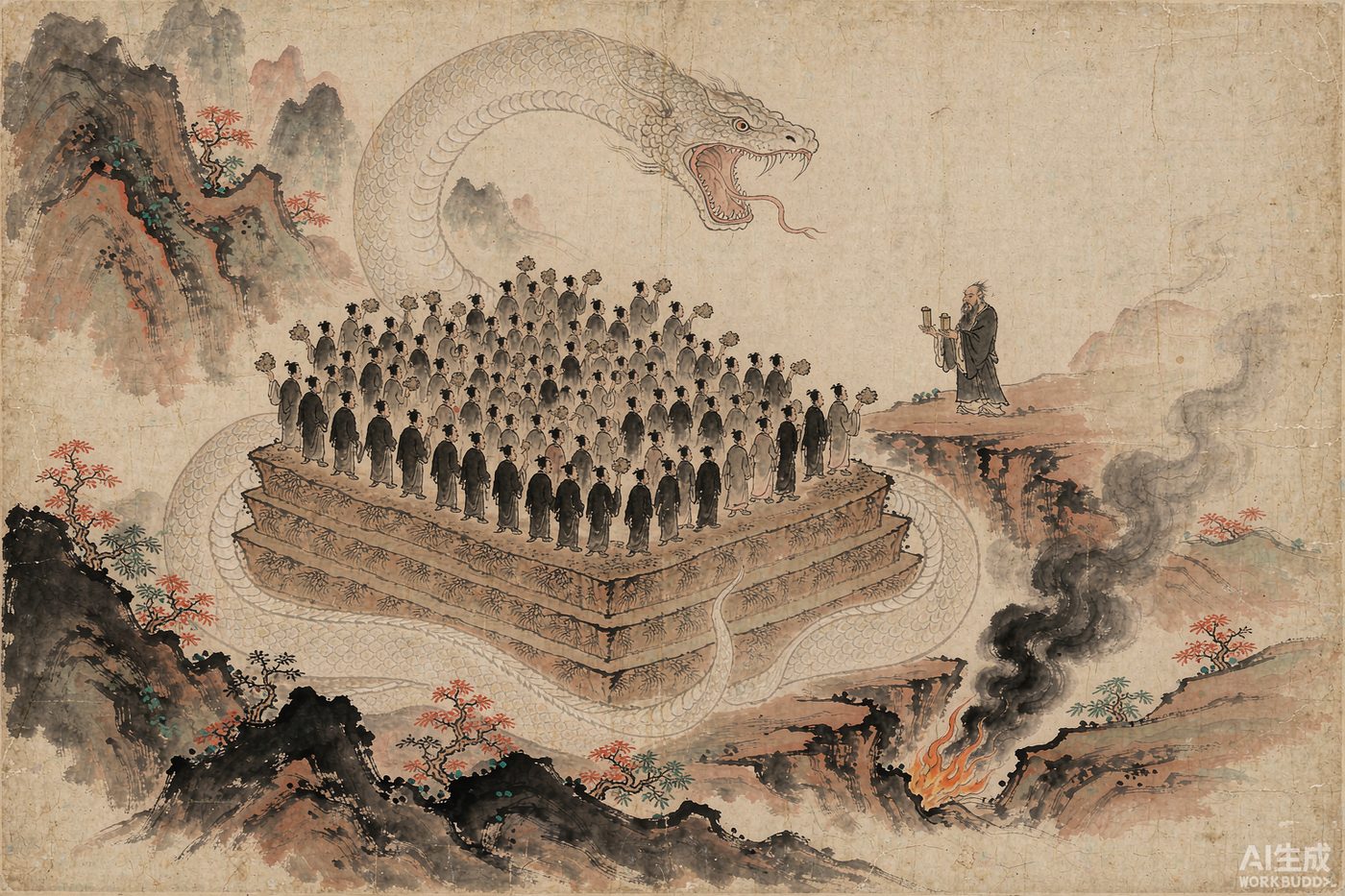
Zhang chose a day and went to it, and three li from the burrow set up an altar of five tiers, several tens of yards across. When the altar was complete he gathered all the officials and people of the prefecture and made them stand on it, and led the Daoists in performing the rite.
First a white talisman flew and there was no sound at all. Then a red talisman, followed by a yellow one, and after a long while wind and cloud rose suddenly, thunder and lightning on all sides, green and black vapour filling the mountains and valleys, and those who saw were terrified. In a while the vapour cleared, and Zhang held his method as before. Presently white qi welled up at the edge of the sky, now yellow, now purple, four or five changes, and everyone on the altar fell over and wept, waiting to be devoured.
Zhang made each man hold a lump of earth in his mouth to resist the evil, and had the prefectural seal brought forward, and said to the crowd: “The white snake’s spirit is exhausted. It will certainly come out. If it crosses the five altars, even I will have no life. If it is no match for me it will stop at the third tier. When evil cannot overcome right, this prefecture will have no more trouble.”
Then fire burst from the burrow and spread to the side of the altar. The great snake opened its mouth in a yawn, meaning to swallow the altar, and raised its head into the sky, higher than the eye could follow, and came gradually nearer, winding its body four or five times round the lower tier. With his left hand on the prefectural seal and his right on the jade seal, Zhang stood squarely facing it. The snake shrank and was defeated, advancing and retreating impossibly, its trunk growing lower and collapsing as though pressed down by a mountain, and it stopped at the third tier.
Then he flew his sword and killed it, and after that they came out one after another, the smaller ones still like pillars, several tens of thousands of them.
Zhang said: “The chief offender is the female, and the species is truly numerous. This is hard to exterminate entirely, but they cannot be pardoned either.” He chose those that had done harm, and told the elders and the strong men of the place to take out their knives and swords and cut down twenty-odd of those like pillars and like roof-beams, all bound by his magical power and submitting to the sword. The rest he gave talismans to the spirit generals and had them driven beyond the border.
Several days later he led the people of the prefecture to look at the burrow. There was a stone bed in the middle, which had been where it coiled and rested, and a mountain of bones piled up, all the people it had eaten in the past. The stench was heard for a hundred li and took a month to fade.
Perfected Zhang was the thirtieth-generation grandson of Heavenly Master Zhang of the Han. All his life he did not marry. When the capital was about to fall he left the city secretly and went home, released his body by death, and hid again on Mount Emei. People of Shu sometimes saw him. The legitimate line of the Heavenly Masters ended with him, and his clan now continues it.