Stories/ 子不语/ The Chaste Girl Who Cried Injustice

The Chaste Girl Who Cried Injustice

貞女訴冤

SourceZibuyu (What the Master Would Not Discuss)
AuthorYuan Mei
EraQing dynasty · from Zibuyu, late 18th century
Written1788
GhostJusticeWrongedCourt
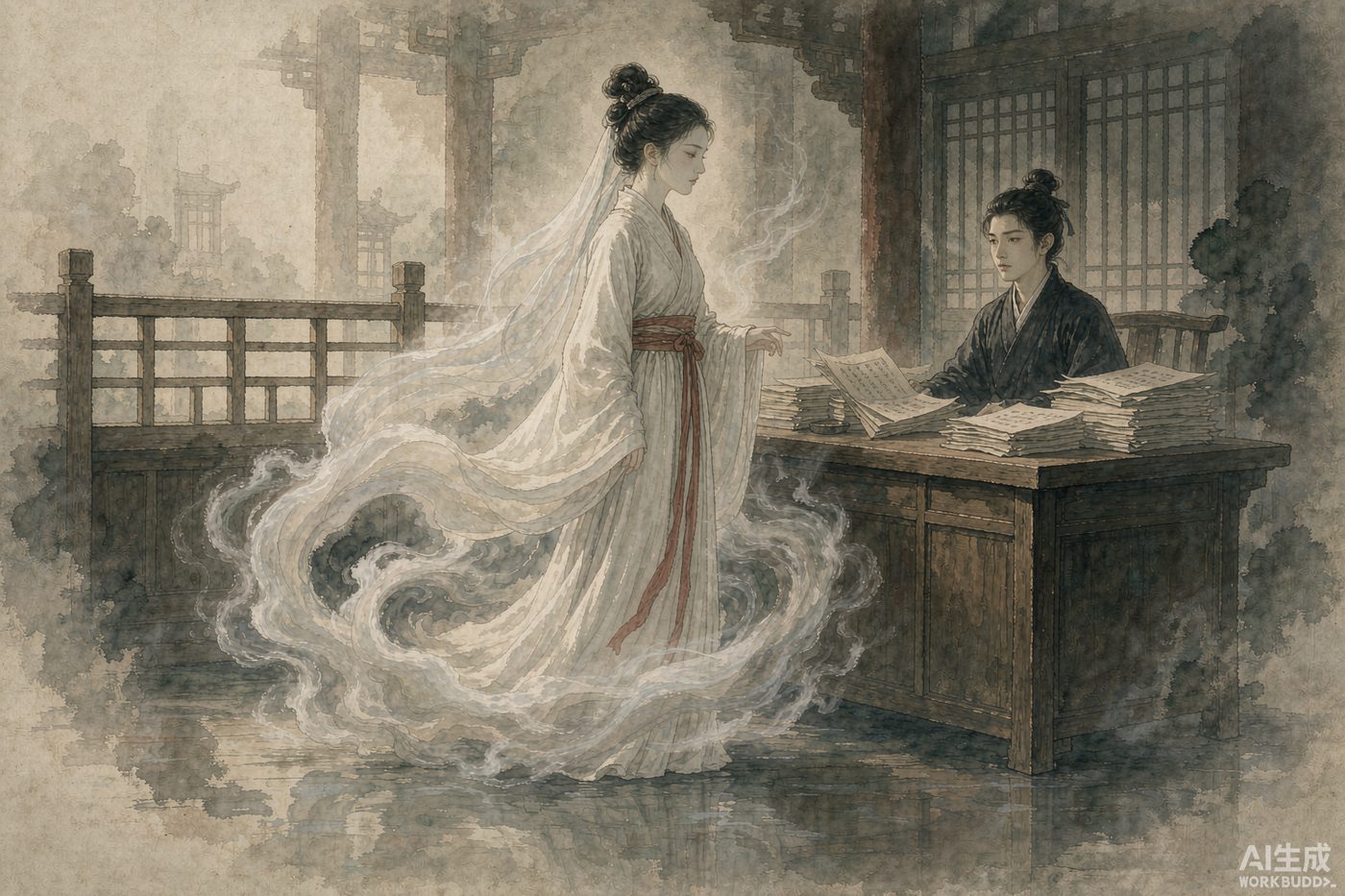
A Qing yamen interior where a pale woman stands amid a swirling wind before a writing desk piled with case documents, a young scholar watching, ink-wash painting
Illustration generated by AI, based on the ancient Chinese text.

Lu Zuomei was prefect of Xunzhou. There came up from the county a case of a woman who, charged with consensual adultery, had killed herself; the county’s report reached the prefecture, the documents lay on the desk, and he was about to endorse it — “as reported, verified and forwarded.”

That night a great wind rose in the private secretary’s room, and there stood, plainly, a young woman; she stood and spoke not, and left only at the fifth watch. The secretary told the prefect, who happened then to be summoned to the provincial capital; he said to his son: “You are bold; tonight you may keep watch in the secretary’s room.”

In the evening the young master obeyed and lodged in the secretary’s study. Sure enough the wind rose as before, the secretary saw the girl again and told the young master, but the young master saw nothing; so he called out: “What do you want?” The girl said: “I am the person in the case upon your desk. I died resisting rape. My parents took bribes and testified it was consensual adultery, sullying my name and virtue. Earlier I complained to the county, but the county too took bribes and would not right me — that is why I have come here to cry injustice.”

The young master assented, and wrote her words in a letter home and sent it posthaste to the prefect. The prefect, returning from the capital, happened to pass through that county, and so wrote to the secretary to send the original case back to the county. Soon the county magistrate came to welcome him. The prefect would not lodge at the official quarters, but first went to the City God’s temple to offer incense, and said to the magistrate: “I have heard by enquiry that the former rape case holds an injustice — is it true?” The magistrate, relying on the parents’ testimony, answered hotly and demanded a hearing.

The prefect, with no recourse, lodged that night in the City God’s temple, and summoned the accused and the neighbour-witnesses to sleep in attendance behind the great hall, and secretly posted men behind the hall to listen. Past the third watch the witnesses spoke among themselves — some cursing the parents’ worthlessness, some pitying the girl’s chastity and courage — and the listeners wrote it down. At dawn he first interrogated the witnesses, showing them what had been written in the night, and all confessed. So the case was settled as rape resulting in death. The girl was honoured and entered into the chapel of chastity and filiality.
Original classical Chinese text · 原文

陸作梅作潯州太守,有和姦自盡一案,縣詳到府,文卷在案上,將批「如詳核轉」矣。其晚,幕友房中起大風,宛然一女子,立而不言,五更始去。幕友告太守,適太守奉調上省,謂其子曰:「汝膽大,今晚可至幕友房伺之。」晚間,公子遵父命,宿幕友書房。果如前風起,幕友又見此女,即告公子,而公子無見也,因大聲問曰:「汝何為者?」女曰:「吾即幾上案中人也,因拒姦至死。父母受賄,證成和姦,汙我名節。曩訴之縣,縣亦受賄,不為申理,所以來此訴冤。」公子唯唯,即以其言寫家信馳告太守。太守從省歸,適經是縣,因札致幕友,將原發回本縣。未幾,縣令來迎。太守不宿公館,先往城隍廟行香,謂令曰:「吾訪聞前姦案事有冤,信乎?」縣據其父母口供,抗詞請質。太守無奈何,即宿城隍廟中,傳犯人及鄰證人等於大殿後陪宿,陰伏人於殿後察之。至三更餘,鄰證等各自言語,有罵其父母之無良,憐其女之貞烈者,聽者取筆書之。至天明,先盤詰鄰證,取夜間所書示之,俱服。遂以強姦致死定案。旌其女入節孝祠。

From 《貞女訴冤》, Zibuyu. Translated in full. 太守 is a prefect; 潯州 is Xunzhou in Guangxi; 和姦 is consensual adultery, here the false charge that let a suicide be ruled 'shameful' rather than 'murdered'; 如詳核轉 is the standard endorsement a superior gives — 'as reported, verified and forwarded' — the administrative rubber stamp; 幕友 is the private secretary, the hired expert who actually drafted a yamen's judgements; 城隍廟 is the City God's temple, used here as an investigative chamber; 節孝祠 is the chapel where the chaste and filial were commemorated by the state.

Source. From Zibuyu (What the Master Would Not Discuss) (子不语), by Yuan Mei , 1788. The original text is in the public domain; this English rendering and the accompanying notes are original work.
Where this fits in the universe: Ghosts · Filing With Heaven: How to Send a Document to a God

Keep Reading

Related Stories

Qing dynasty · the gengzi year of Qianlong, 1780 · 子不语

The Girl Ghost Who Filed Suits

女鬼告狀

A handsome young merchant is possessed by a chaste girl who declares she has filed nineteen suits against him with the City God and now, approved by the Eastern Peak, will take him. He is bound, dies, and returns describing a midnight trial where the girl is slapped and cangued for a false accusation born of unrequited love.

GhostJusticeCourt
Late Ming · the fall of 1643 · 子不语

The Lake God Who Guarded a Corpse

湖神守屍

When the scholar-chancellor He Fengsheng chose the lake rather than capture by the rebel Zhang Xianzhong, a god kept his body from the water for a hundred and seventy days, and told a fisherman in a dream exactly which corpse to pull up.

DeityLoyaltyLake
Qing dynasty · late 17th century · 聊斋志异

The Cricket

促织

The emperor loves cricket-fighting, so every district must supply fighting crickets. One ruined family is saved by a champion the size of a man's little finger — which may be the soul of their dying son.

TransformationJustice