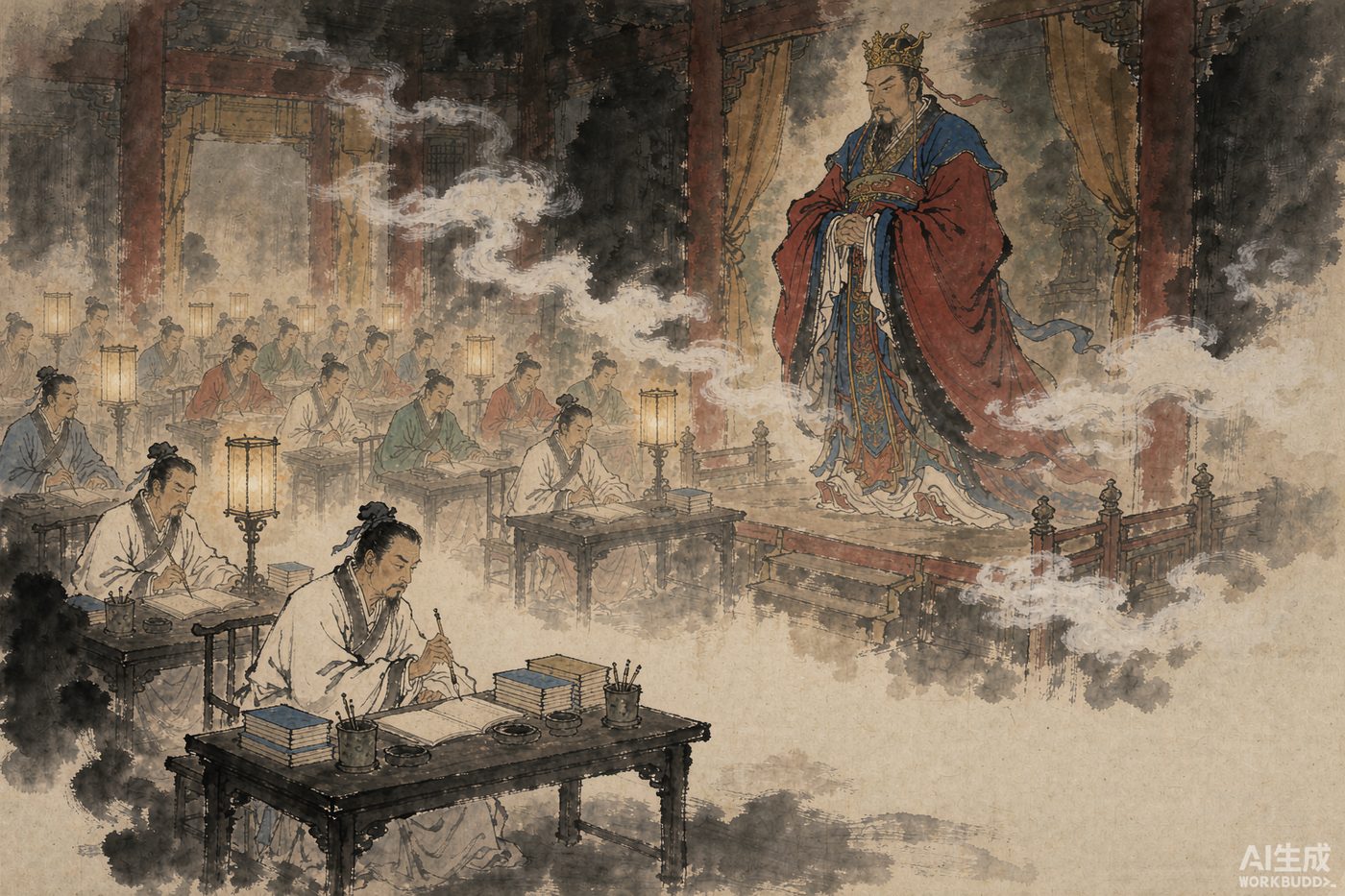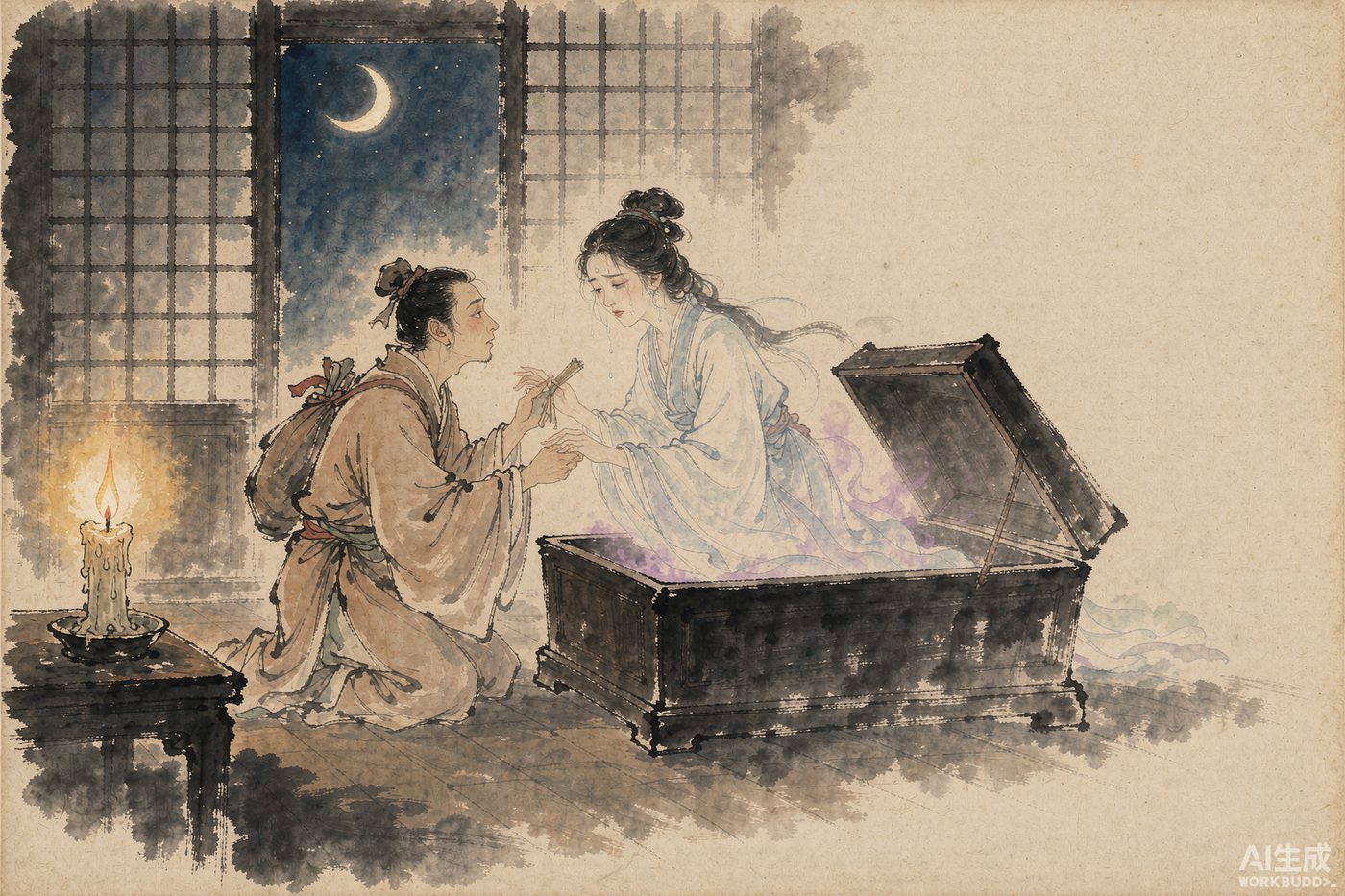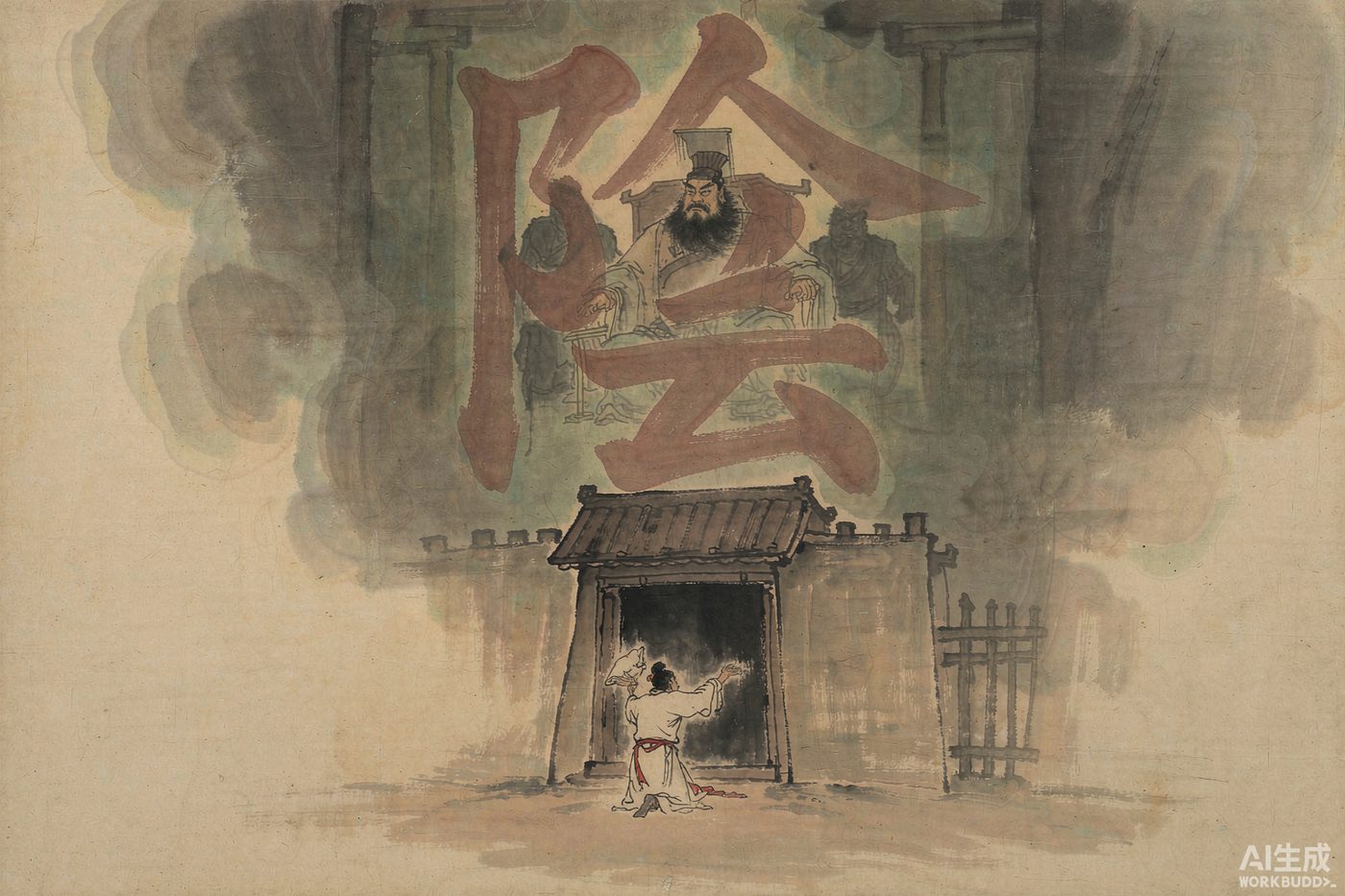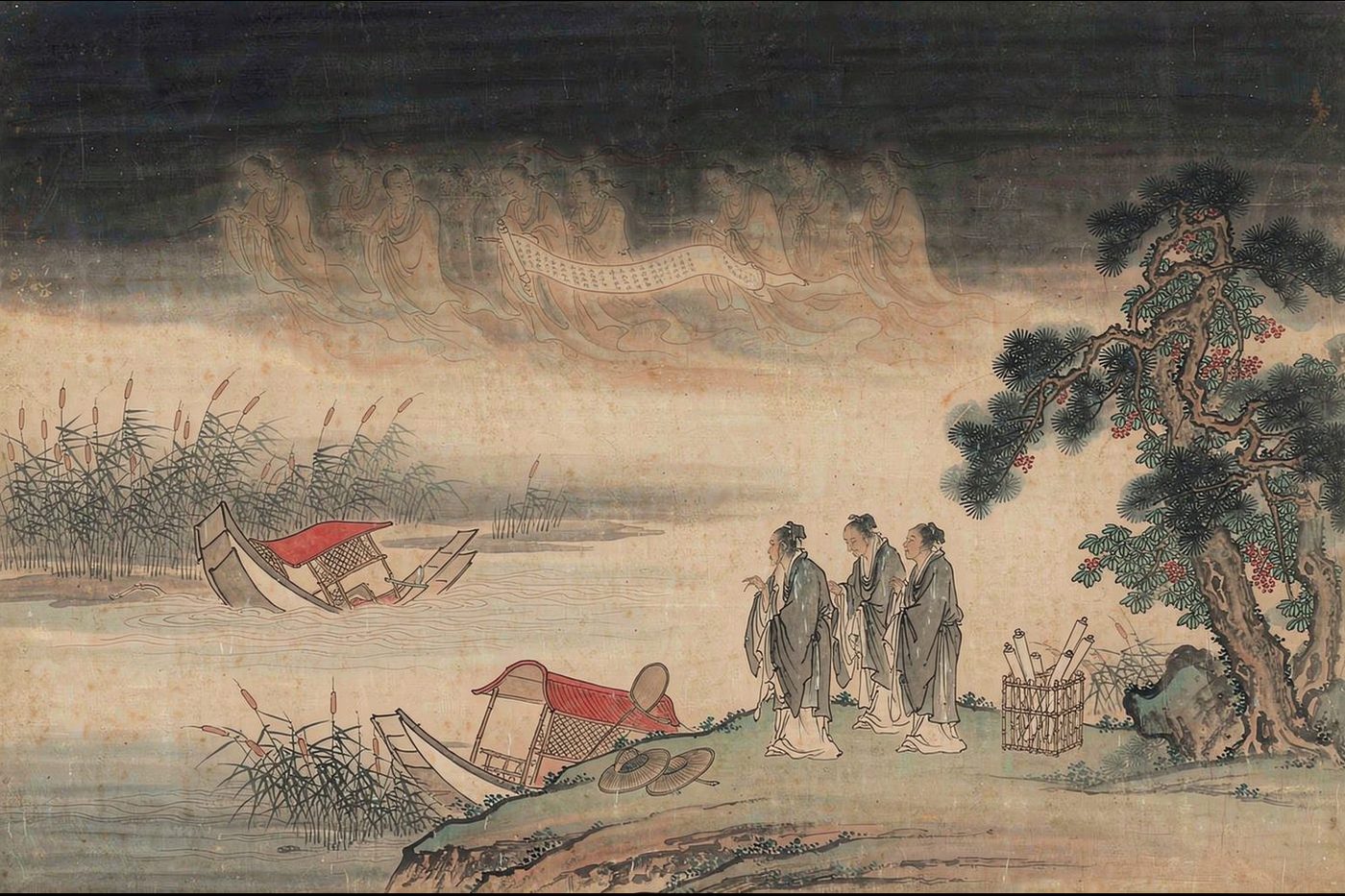
There is a moment in a great many of these stories where somebody does something that looks, to a modern reader, like a genre error. A village walks out at dawn with banners and gongs, and files a petition with a well. A magistrate sentenced to death by a star is told to write a memorial and burn it. A medium who cannot get rid of a ghost does not pray harder; he transfers the case to another office. A woman is made to sign a statement.
None of this is metaphor. In the classical Chinese universe the supernatural is administered, and an administered thing is reached by document. Heaven in these stories is not a place you believe in. It is an office you write to. Five instruments do the work, and the direction each one travels matters.
1. Up: the memorial (疏)
A private person addressing a higher power writes a shu — a memorial, the same word and the same form that a minister presents to the throne. It states who you are, what was done for you, and what you are asking.
The young man who is warned that the Nine-Beam Star has sentenced him to death (The Log in the Bed) recovers, wants to give thanks, and cannot find the god to thank. So he does the only thing available: 具疏并楮鏹焚獻之 — he draws up a memorial, adds paper money, and burns the lot. The memorial is the letter; the spirit money is the postage. Neither is a symbol of devotion. Both are parts of the transmission.
2. Across: the warrant (牒)
Die is the document that passes between offices of equal or adjacent rank, and it is the single most common word in the machinery of these tales.
- In The Crab With the Dipper on Its Back three hundred villagers 詣井投牒請水 — go to the well and file a die requesting water. A drought is an unanswered application.
- In The Warrant That Sank the Boat an earth god defends himself with one: 被城隍司公牒,指名覆此舟 — I received a public die from the City God’s office naming this boat. He still has it. He invites inspection.
- In The Ghost-Seer of Genshan Gate the medium 移牒城隍,令放置酆都宮 — transfers a die to the City God, directing that the ghost be committed to Fengdu. This is a lawyer’s move against a plaintiff: not exorcism, removal of venue.
Note what the second and third have in common. The exorcist in the first story has the rite, the power and the summoned culprit in front of him, and he still loses, because the warrant is in order. A god with correct paperwork is not a god you can arrest.
3. Down: the deposition (狀)
When the process runs the other way, the product is a zhuang — a statement, a deposition, a signed account of facts.
The possessed woman in The Red Snake in the Road is made to give one: 勒供通姓名,具狀言不敢再作孽 — compelled to supply her name and to execute a statement that she will not offend again. The rite does not end with the spirit driven out. It ends with the spirit on the record. Compare the confession in A Robber Ghost’s Confession — 不敢仇法吏,敢仇赃吏, I do not dare to bear a grudge against an honest clerk, only against a corrupt one — which is a legal argument delivered by a corpse.
And in the human courts the same instrument is what a grievance becomes. Xi Fangping’s father in Xi Fangping Sues the Underworld writes out the charges and burns them; the underworld then does something no plaintiff wants, which is to accept service and then rule against him.
4. Over: the imperial instrument (誥命 and 制書)
There is one class of document the underworld cannot keep, and the exceptions prove the rule.
When the earth god in The Warrant That Sank the Boat overturns a boat and impounds everything in it, he returns three items: 三人誥命及制書非籍中所載 — the men’s certificates of appointment and the imperial rescripts were not entered in the register. They came back dry. The seal of the throne outranks the seal of the City God, and a clerk who receives an item not on his list has no authority to hold it. The same logic reappears wherever a talisman carries the weight of a higher seal: the demon-subduing seal from the Zhengyi register that the magistrate closes in his fist in The Wizard Who Could Somersault.
5. How the document travels
A written instrument is useless until it moves. Four channels are used, and the stories are precise about which.
Fire. The standard route upward. Burn the memorial, burn the spirit money, and it arrives.
Water. Charmed and drunk. The ghost-seer 咒棗治水與病者服 — spells a date into water and gives it to the patient to drink. The dose works for a few days, and then it does not.
A body. 附體考召 — the medium has a boy go into trance and holds the summons through him. The boy speaks in the ghost’s voice, miaows, and remembers nothing afterwards. The human is the wire.
A hand. The seal or talisman, carried on the person. This is why the fake wizard’s claim is testable: 道我手內是何物 — tell me what is in my hand. If you have the office, you can read the instrument. If you do not, you cannot.
6. What happens when the file is wrong
The most instructive failures in the collection are administrative rather than cosmic.
In A Lifetime’s Salary a man is shown his allowance for one life and stops drawing it. Fifteen years later the Ministry of Personnel refuses to process his promotion — 安有臥家十五年不任官之理 — and when he finally reaches court the palace ushers stall him again, 以無近歲俸歷, because there is no recent record of salary for him. He dies the evening before the pay date. Nothing supernatural obstructs him at any point. The file has a gap in it, and a file with a gap in it stops.
7. Why this is the useful part
If you are writing in this world, the document is the plot device, and it is a better one than a spell.
A spell resolves a situation. A document takes time, can be refused, can be lost, can arrive late, can be forged, can be outranked, and can be quoted back at you. The village waits fifty days for an answer to its rain petition. The medium’s writ to the City God works, and the ghost he committed comes back for the man who delivered it. The earth god produces his warrant and walks out of the exorcism a free god.
That is the whole appeal of a paper universe: the machinery is legible, the machinery is slow, and the machinery can be turned around on the person who set it going.