Stories/ 夷坚志/ The Debt the Temple God Collected

The Debt the Temple God Collected

資聖土地

SourceYijian Zhi (Record of the Listener)
AuthorHong Mai
EraSouthern Song dynasty · 1180, the seventh year of Chunxi
Writtenc. 1160–1200
Small GodsMoneyJusticeGhost
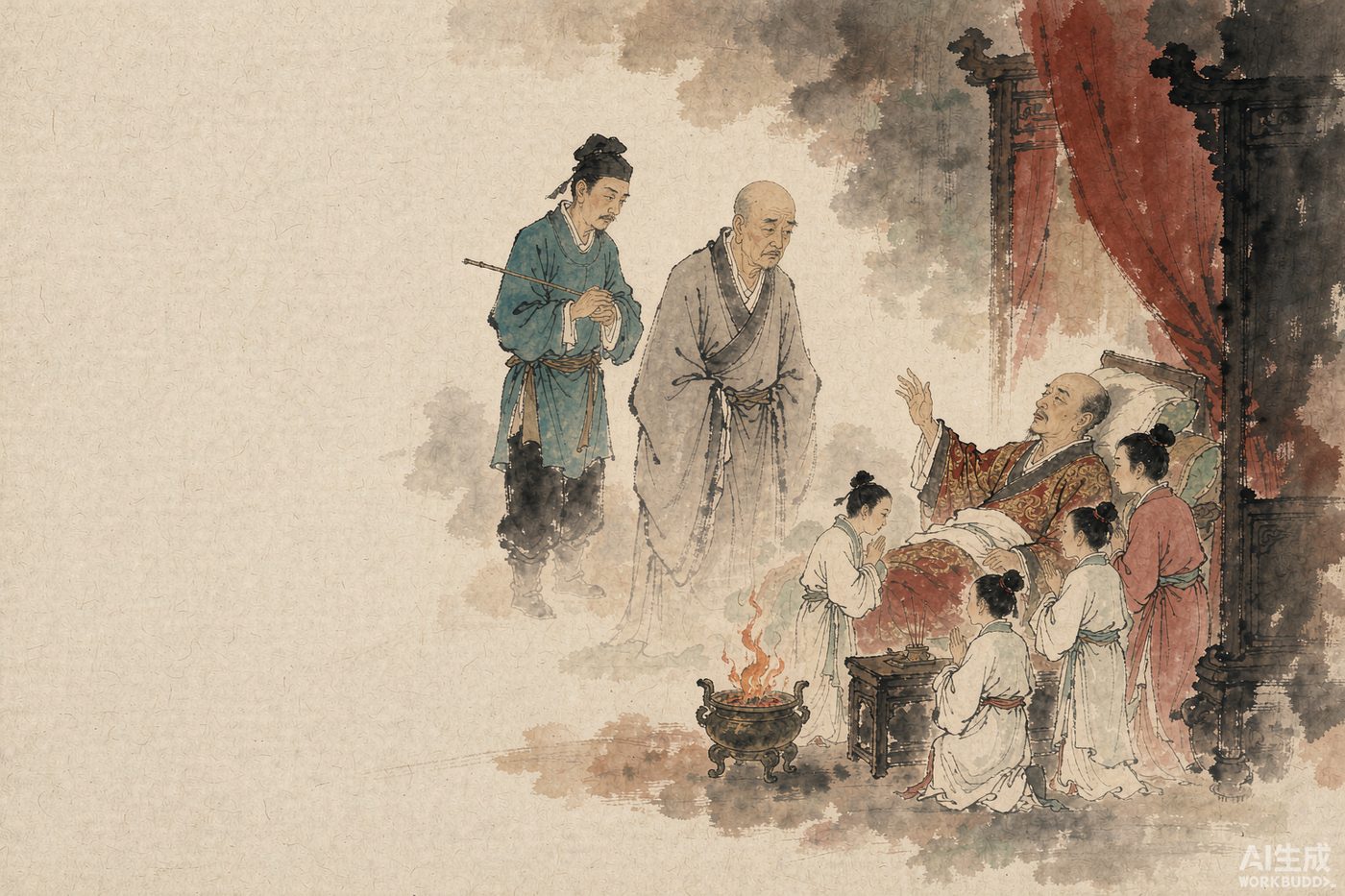
A dying Song official in bed pointing at two unseen figures — a monk in a shadowed robe and an attendant in a low cap — while his family burns paper money in a basin beside him, ink-wash painting
Illustration generated by AI, based on the ancient Chinese text.

Fan Xun, a clerk in the prefectural office at Jianchang, borrowed ten strings of cash from the abbot of Zisheng monastery to take a wife for his son. Twenty years went by; the monk died; Xun too came home from his posting, and in the drift of things the debt was never repaid.

Later Xun fell ill, and his illness grew grave. He called his son Guanguang to him.

“Do you remember,” he said, “that when you married, I borrowed money from Zisheng monastery? Now the sangharama god of that place has sent men escorting the abbot here to demand it. Buy paper money at once and burn it for them.”

And he pointed to the household: “The earth god’s messenger and the abbot are standing here with folded hands. Can none of you see them?”

When the paper money had been burned, he said: “The two have gone. They are on their way to find Academician Xu in front of Bao’en monastery, to settle a matter there.”

That night Fan Xun died.

The gentleman Xu, whose name was Yining, was a man of Laizhou who had just come home on rotation from supervising the army wine depot at Jizhou. Not long after, he too was dead. It was the seventh year of Chunxi.

His father, a grand master of the fifth rank, had lodged at that monastery; the monastery’s people had used its communal property in his name to turn a profit, and so the grand master had come to appropriate a good share of it — and Yining had known of it. That was why it came to this.

The monk Zuojue told the story.
Original classical Chinese text · 原文

建昌孔目吏范荀為子納婦貸錢十千於資聖寺長老經二十年僧既死荀亦歸攝因循失於償逋荀後得疾且篤呼其子觀光謂之曰憶汝娶婦時曾借資聖寺錢今本處伽藍神遣人押長老來索取可急買紙錢燒與之又指示家衆曰土地之使偕長老見在此拱立汝輩不見邪洎焚楮訖又曰兩人已去欲往報恩寺前尋徐省幹理會事也至夜荀死徐生名以寧萊州人方自吉州監贍軍酒庫替囘未幾亦卒時淳熙七年先是徐父奉直大夫寓居彼寺寺之人用常住物假其名以規利奉直因是頗揜有其貲以寧與聞之故致然僧祖珏說

From 《資聖土地》, Yijian Zhi. Translated in full. 建昌 is Jianchang in Jiangxi; 孔目吏 is a clerk in the prefectural administration; 十千 is ten strings of a thousand cash; 資聖寺 is Zisheng monastery and 長老 its abbot; 伽藍神 is the sangharama deity, the guardian god of a Buddhist monastery — here working with the 土地, the local earth god; 省幹 is an honorific for a retired official; 奉直大夫 is a Song honorary rank; 常住物 is the monastery's inalienable communal property; 淳熙七年 is 1180.

Source. From Yijian Zhi (Record of the Listener) (夷坚志), by Hong Mai , c. 1160–1200. The original text is in the public domain; this English rendering and the accompanying notes are original work.
Where this fits in the universe: The Small Gods

Keep Reading

Related Stories

Southern Song dynasty · 12th century · 夷坚志

Three Hundred Cash

許元惠

His father dreams of a guest in black who says he is repaying a loan of three hundred cash. Neither the lender nor the date can be remembered. The next day a black duck turns up.

GhostJustice
Qing dynasty · Qianlong–Jiaqing era · 谐铎

One Cash

一錢落職

He is dismissed for corruption before he has taken up his post, having committed no crime in office. The charge is one coin — trodden on in a bookshop gutter years earlier, by a man who was watching.

SatireOfficialdomJustice
Qing dynasty · Qianlong era, c. 1750–1795 · 子不语

The Scale of Merit

神秤

A revenue clerk is hauled before a green-faced judge of the dead, and his life's record is literally weighed — red slips for good deeds, black for bad, thrown into a scale with golden stars. His whole life comes up wanting. Then one red dossier goes in and outweighs everything.

JusticeUnderworldMoney