Stories/ 谐铎/ The Oracle Slips of General Bu's Temple

The Oracle Slips of General Bu's Temple

卜将军庙灵签

SourceXieduo (Miscellaneous Bell)
AuthorShen Qifeng
EraQing dynasty · c. 1790
Writtenc. 1790
Reading the FateOmensSmall Gods
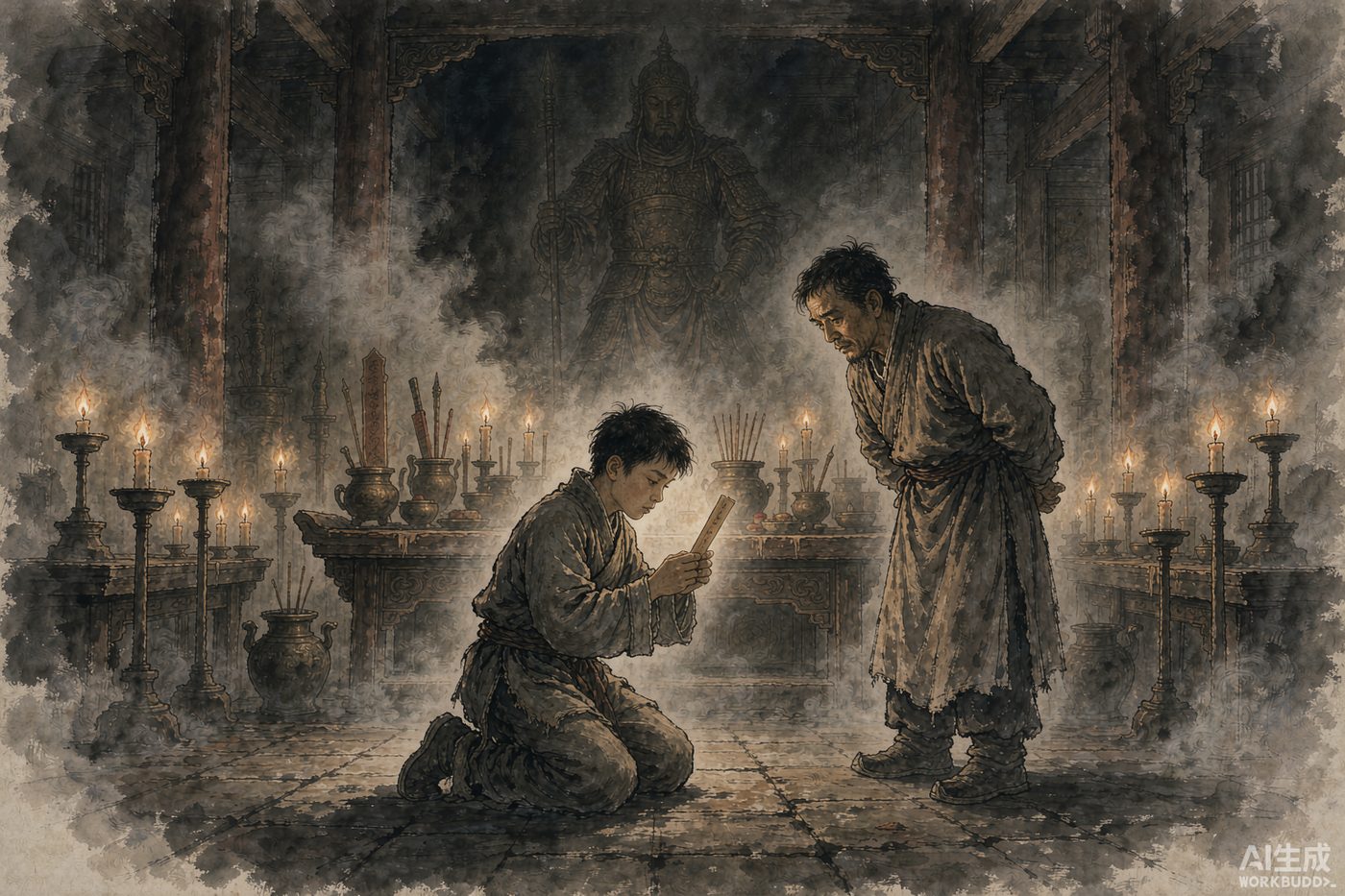
A boy kneeling before a temple altar holding a bamboo fortune slip, a general's statue in shadow behind, lanterns and candles, ink wash painting
Illustration generated by AI, based on the ancient Chinese text.

General Bu’s temple at Yufeng had the busiest incense in the district. At nine I sat the boys’ examination; at fourteen I still had not taken first place among the students. On my late father’s orders I prayed beneath the cliff, and drew a slip:

Many griefs with no one to complain to, / everything at odds and unexamined; / wait until mid-autumn and you see the bright moon, / then your old universe is restored to you.

Beneath, on the question of success, was a line: If the examiner’s name is a mouth-and-wood name, you will be drawn up and climb the ladder for life.

My father said, “Judging by this slip, you have failed again.”

The education commissioner at the time was Liu Shiyan, who took my leading paper for an obscure line from the Li Sao — and then dropped it. “This is the fulfilment of ‘everything at odds,’” said my father. “If you want to enter the county school, you must wait for the autumn session.”

Later Commissioner Li Yinpei supervised education in Jiangsu, with the examination in the middle of the third month, and my father was anxious. But the question set in the hall ran from “He who has seen the sea finds other waters hard” to “of all things, flowing water” — and it happened to contain the two characters bright moon. So I was recognised and promoted, and my place on entry to the school matched my father’s own exactly. So this was what “see the bright moon and your old universe is restored” meant.

In the wuzi provincial examination the examiners were Wang Jihua and Guo Guozhu. My paper was fixed for fifth place, but because my essay on administration used violent language, Wang feared it would cause trouble at re-examination; Guo argued hard for me, and I was placed thirty-first and passed. “The mouth-and-wood theory is now fully proved,” said my father — for Commissioner Li had the surname Mu and the given name Kou, while Duke Guo had the surname Kou and the given name Mu.

After that I sat the metropolitan examinations repeatedly, and was recommended but never passed. The chief examiners never had a mouth-and-wood name. But the examiners who recommended my papers — Ke Jin, Guan Bao, Li Zhongjian — are all firmly verifiable.

Now I am past forty and no longer carry my papers to the capital. Even if the chief examiner were to match the slip exactly, I would have no hope of climbing the dragon gate. This was not a case of my writing failing me; it was that I failed General Bu. An oath made on the bank cannot be forgotten; a man’s ambition is easily broken. A mediocre talent at the end of his road — that is all. How sad.
Original classical Chinese text · 原文

玉峰卜将军庙,香火最盛。予九岁应童子试,年十四,尚不能掇一芹。奉先君命,祷于崖下。得一签曰:"几番愁怨控无门,诸事乖离总不论;直待中秋见明月,方教还汝旧乾坤。"功名下注一行云:"口木姓名如汲引,一生平步上云梯。"先君曰:"味此签意,今番又不谐矣!" 时督学为实庵刘公,以予首艺中用《离骚》僻句,取而复弃。先君曰:"此诸事乖离之验也,汝欲入泮,必俟秋期开考。"后李公因培督学江苏,试期三月中旬,先君忧之。继场中命题,乃"观于海者难为水",至"流水之为物也"。中适有明月两字,遂蒙识拔,而入学名次,又与先君相合,所谓"见明月而还汝旧乾坤"者,其在斯乎? 戊子乡闱,典试为王公际华、国公柱。予文定作经魁,因吏治策中语涉激烈,王公恐碍磨勘,国公力争,抑置三十一名中式。先君曰:"口木姓名之说,今尽验矣!"盖李公木姓口名,国公口姓木名也。 嗣后应礼部试,屡荐不售。主试者绝无口木姓名。而荐卷房师,如柯公瑾、观公保、李公中简,皆确然可证者。今予年逾四十,不复挟策金门。纵主试者若合符节,予亦无登龙之望,此非文章负我,实我之有负卜将军也。息壤难忘,壮心易隳,庸才末路,如此而已。悲哉! 铎曰:"予在婺源时,奉文赴江宁书局。路过胡公庙,掣得一签,末有'一番好事落扬州'之句。予谓所问非所对,大笑置之。甫至金陵,而盐台全公聘书至,制府委赴扬州,谱供奉新乐府,始信神明无戏言也。"

From 《卜将军庙灵签》, Xieduo. Translated in full. 掇一芹 means to take first place among the students; 入泮 is to enter the county school; 乡闱 is the provincial examination; 经魁 is the top-five ranking in a provincial paper; 磨勘 is the re-examination of papers for faults, a real risk of disqualification; 房师 is the examiner who recommended a paper. 铎曰 is Shen Qifeng's closing comment, offering a second, smaller instance of the same phenomenon.

Source. From Xieduo (Miscellaneous Bell) (谐铎), by Shen Qifeng , c. 1790. The original text is in the public domain; this English rendering and the accompanying notes are original work.
Where this fits in the universe: The Small Gods · Reading the Fate: The Doom Is Fixed, the Address Is Not

Keep Reading

Related Stories

Qing dynasty · Qianlong era, c. 1760–1800 · 谐铎

The Girl Who Read Faces

屏角相郎

A poor girl of Jiangyin reads faces for a living, and reads her own: her fortune is to be a widow for thirty years. So when a talented painter comes to ask for her, she takes him — because his face says he will die young, and the two short fates fit together. They are happy for less than a month.

FateWomenPoetry
Qing dynasty · c. 1790 · 谐铎

The Crow That Knew a Man Before His Rise

祥鸦

Everyone says magpies report good news and crows bad, so the author feeds the crows in his courtyard instead. Through three decades of examination failure and one family success, the crows prove to be the only honest omen-bearers in the story — and the magpies arrive last.

Reading the FateOmensAnimals
Qing dynasty · c. 1790 · 谐铎

Why the Star-God of Literature Is Blue

奎垣真像

Why is the Star of Literature painted with a blue face and a demon's grin? Because the God of Wealth once lost a lawsuit to the God of Prose, and the Star was sent in wearing a borrowed face and carrying a golden measure.

Reading the FateImmortalsSatire