At the beginning of the Qiandao reign, the palace eunuch Chen Yuan was punished for a crime and banished to Chenzhou; an edict confiscated his household goods and put them up for sale. Lü Yiqing, an assistant director of the Palace Works, obtained two objects.
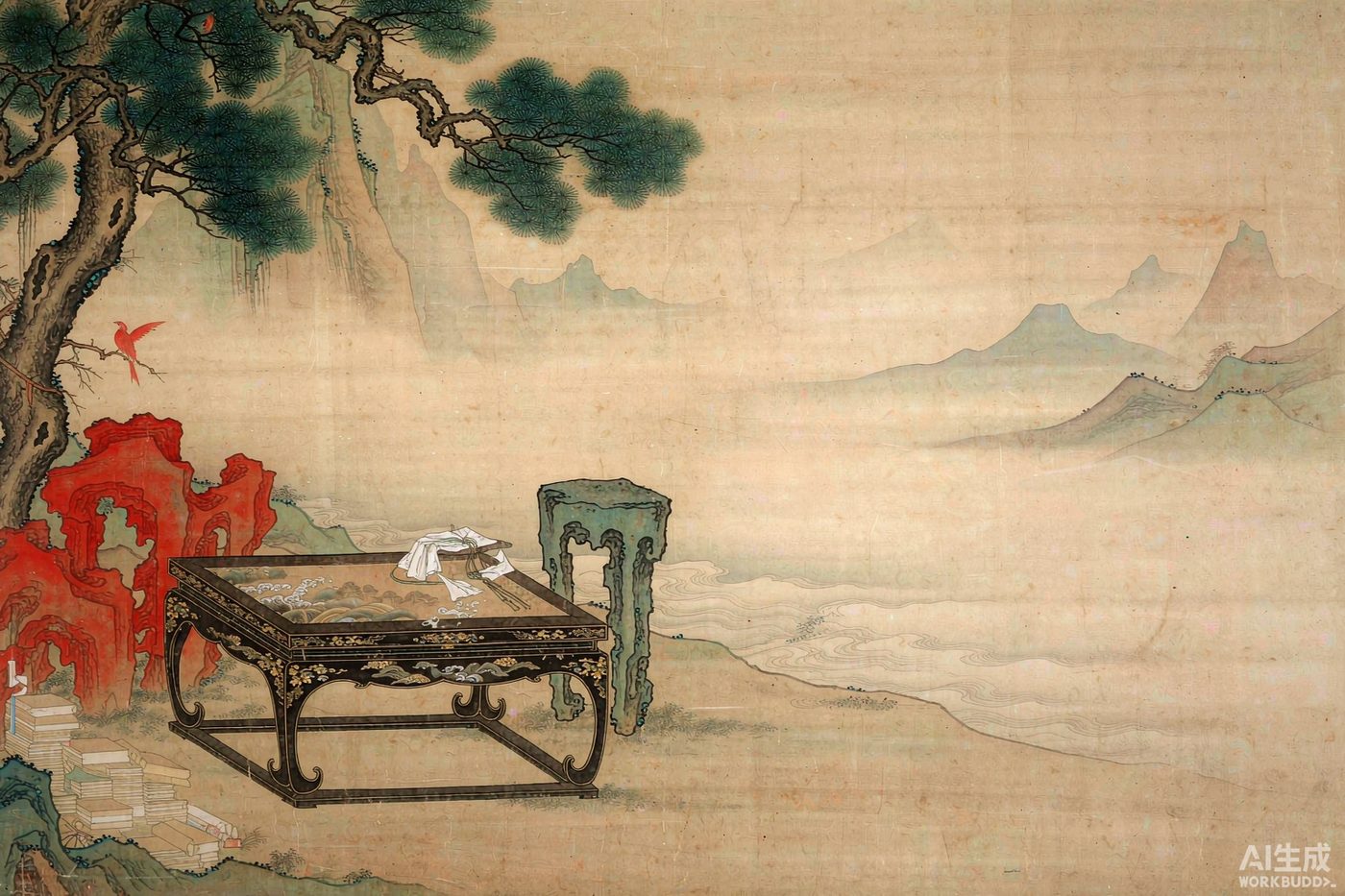
One was a qin stand, cut from the “moon stone” of Guozhou: purple in color with a fine grain, bearing a minute landscape of dense woods and tall bamboo and a riverside village, of a workmanship beyond description. At each of its four feet hung a slip-on shoe of aloeswood, tied with a green silk cord.
The other was a chess table, a foot and a half high and two and a half feet wide, hollow within to store the chess box; around the rim was a rail, the board of agalloch eaglewood divided by ivory lattice; outside that, several bands of ebony, rosewood and white sandalwood, the border of aloeswood carved with water waves, the waves filled with gold and the wave-crests with silver — fragrance assailing the sense of smell. Everything else matched.
His residence was east of the Secretariat; he built a tower against the adjoining wall, and beneath it a terrace, and whenever he entertained guests with music he always did so there. A scholar from Fujian sent him a written warning: “West of your house are the Three Academies, full of poor and cold exam-candidates who resent others’ wealth; if you move even slightly, you may become a censor or remonstrance official, or be able to harm you.”
After that he no longer went there. The letter got mixed in with old papers, and so the outside world came to see it. The eunuch’s extravagance reached the utmost; his crimes were beyond numbering, yet still he slipped the net. When Gaozong inspected his inlaid couch and crystal trays, he said the palace itself had none such.