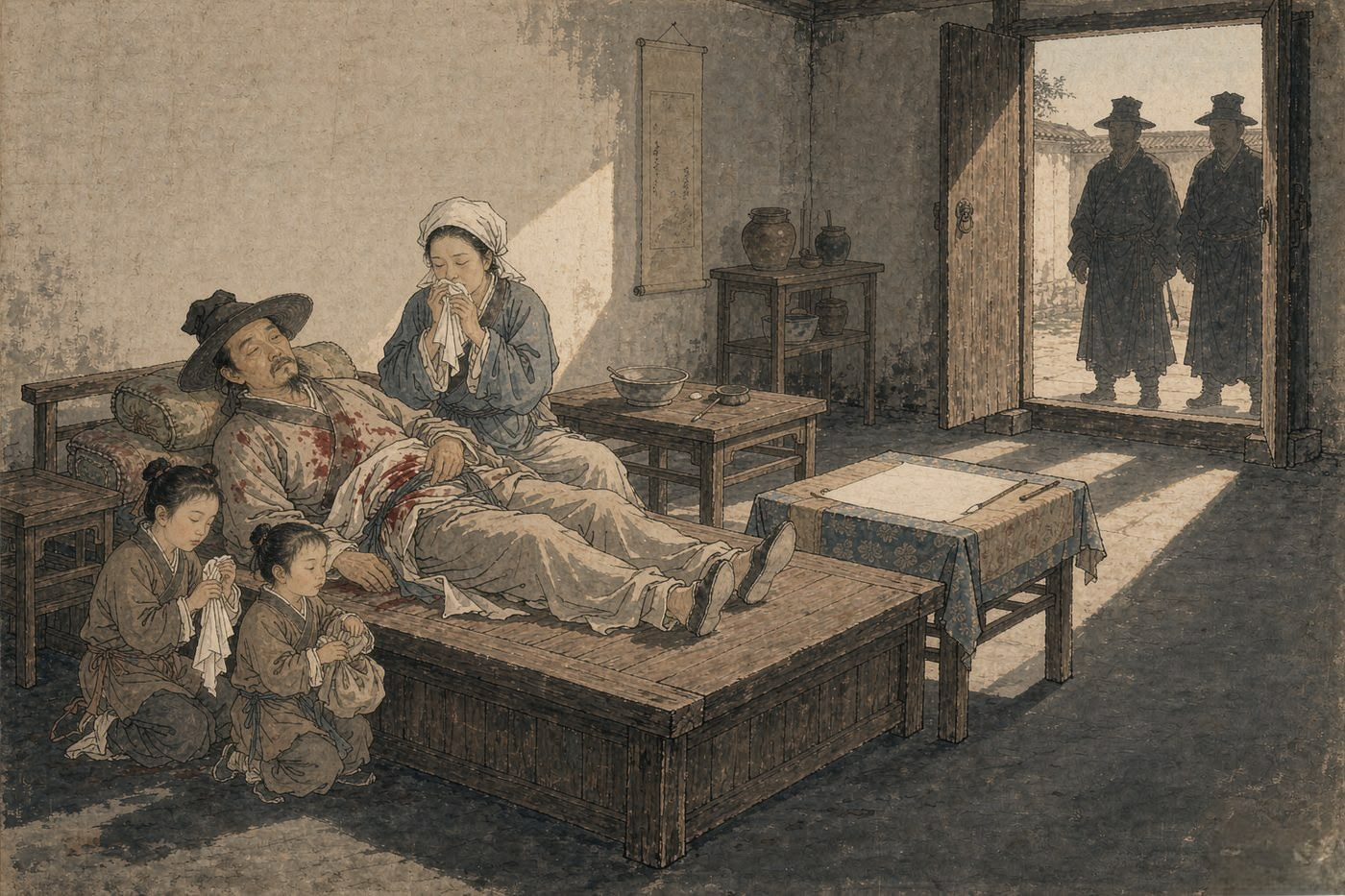
Zhang the Twenty-second was a broker at the pottery shops of Poyang. He had an ugly face and a wide mouth, and the market called him Catfish. In the guisi year of the Qiandao era he fell so far behind with what he owed in taxes that he could not pay, and he and his wife hanged themselves one after the other. Their son was still small. Chen Fang, the son-in-law who had married into the family, took charge of the house.
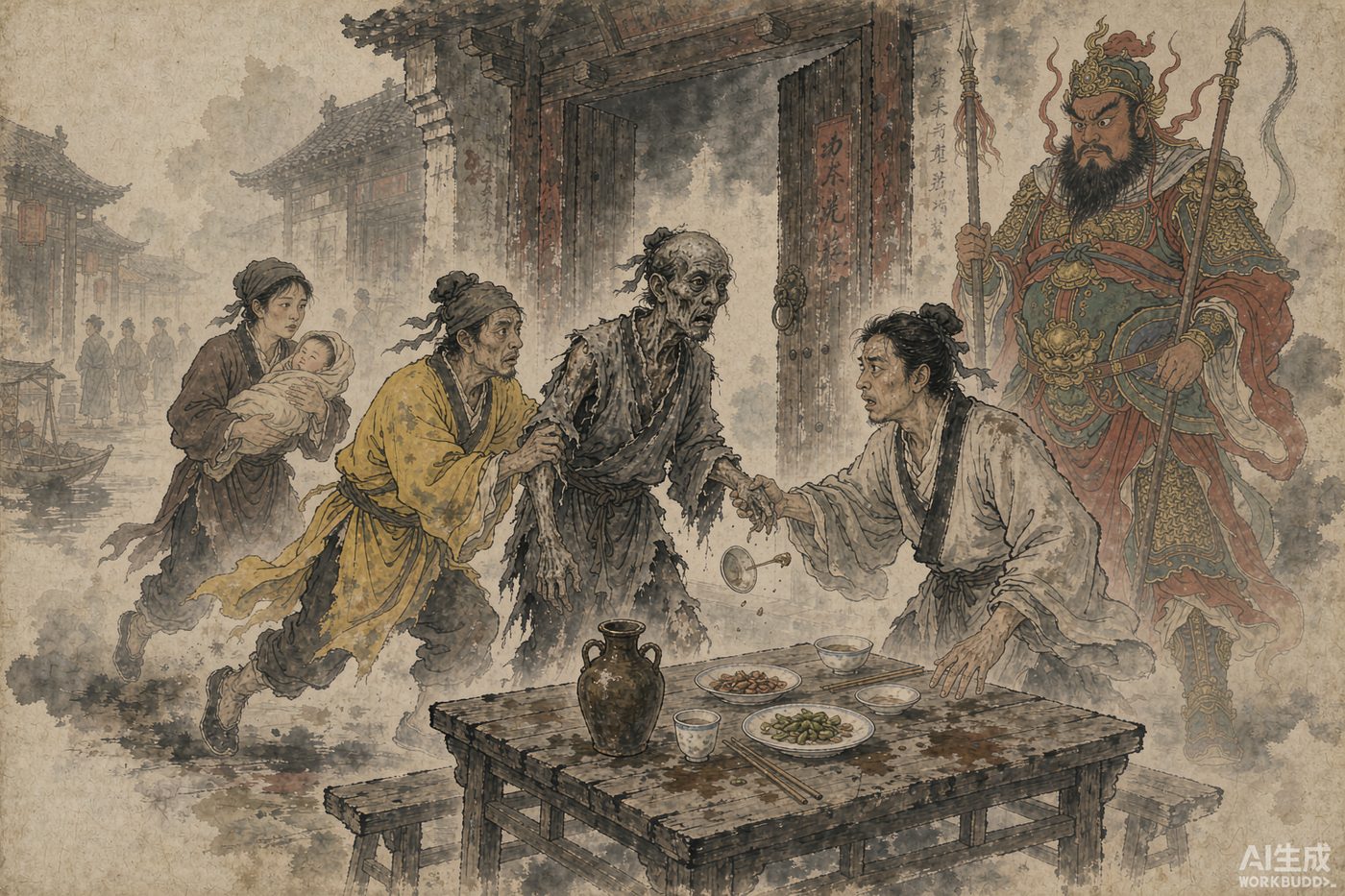
In the gengzi year of the Chunxi era, Fang went with a neighbour named Zhu to the fish ponds at Duchang to dun the fishermen for a debt. They were drinking in a tavern when Fang saw Zhang coming towards him with a runner in a yellow coat at his shoulder. Even as he wondered and took fright, Zhang was in front of him, shouting in a hard voice:
“I knew you were here. I have come for your life.”
Fang bowed twice, cupped his hands, and asked him to sit down. He would not.
“I’ll go and fetch your mother-in-law,” he said, “and settle this with you together.”
In a little while he was back with his wife after all, carrying an infant. He swung an iron ruler at Fang. Zhu wrested the ruler out of his hand and said to him:
“Your daughter was given to a husband, and the husband came here with me. If you kill him now — would it not be better to lay an information?”
Zhang said: “I have been dead seven or eight years, chained in the courts of the dark, and the suffering is beyond measure. My son-in-law has done nothing whatever to get me out. And this infant died young because of a single blow from him. How is this to be allowed to rest?”
Just then two archers from the commandant’s office came by. They saw the struggle and did not know they were looking at ghosts, and they spoke up too:
“If you beat a man to death in broad daylight without cause, you will certainly land us in it.”
Zhang turned to the runner in yellow. “Take this man away for me.”
The runner said: “I must first file a plaint at the court of the Lord of Mount Tai and get a warrant before I can seize anyone. How could I take it on myself?”
The commotion ran on until dusk. Zhang and his wife and the runner took a room for the night where the wine was; Fang, Zhu and the two archers lodged in the room next door. There was nothing to tell the living from the dead. Zhang reviled Fang the whole night through. He also sent the runner back to his house for money; after a long while the man came back carrying two thousand.
The archers asked him where it had come from.
“I took it from under the table at Zhang’s house,” he said. “At first the door-god on the left refused me, but the door-warden on the right announced me, and so I got it.”
Next morning they all went on together. At the sandbank of Binzhou, northwest of Poyang city, the three of them suddenly were not there.
Fang reached his lodgings still hearing Zhang’s voice distinctly. He took to his bed, and after more than ten days he was better. Fortunately, he did not die.