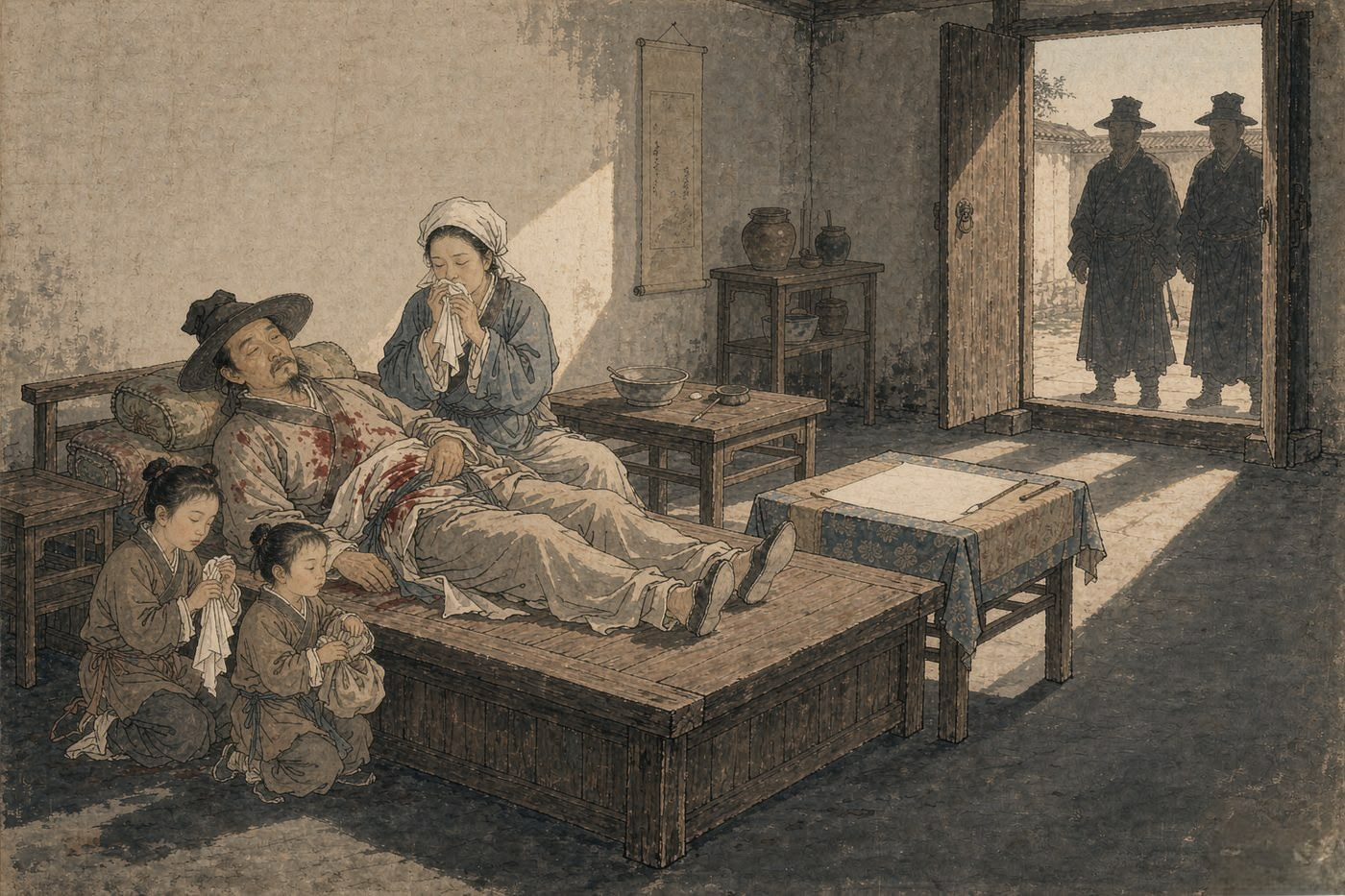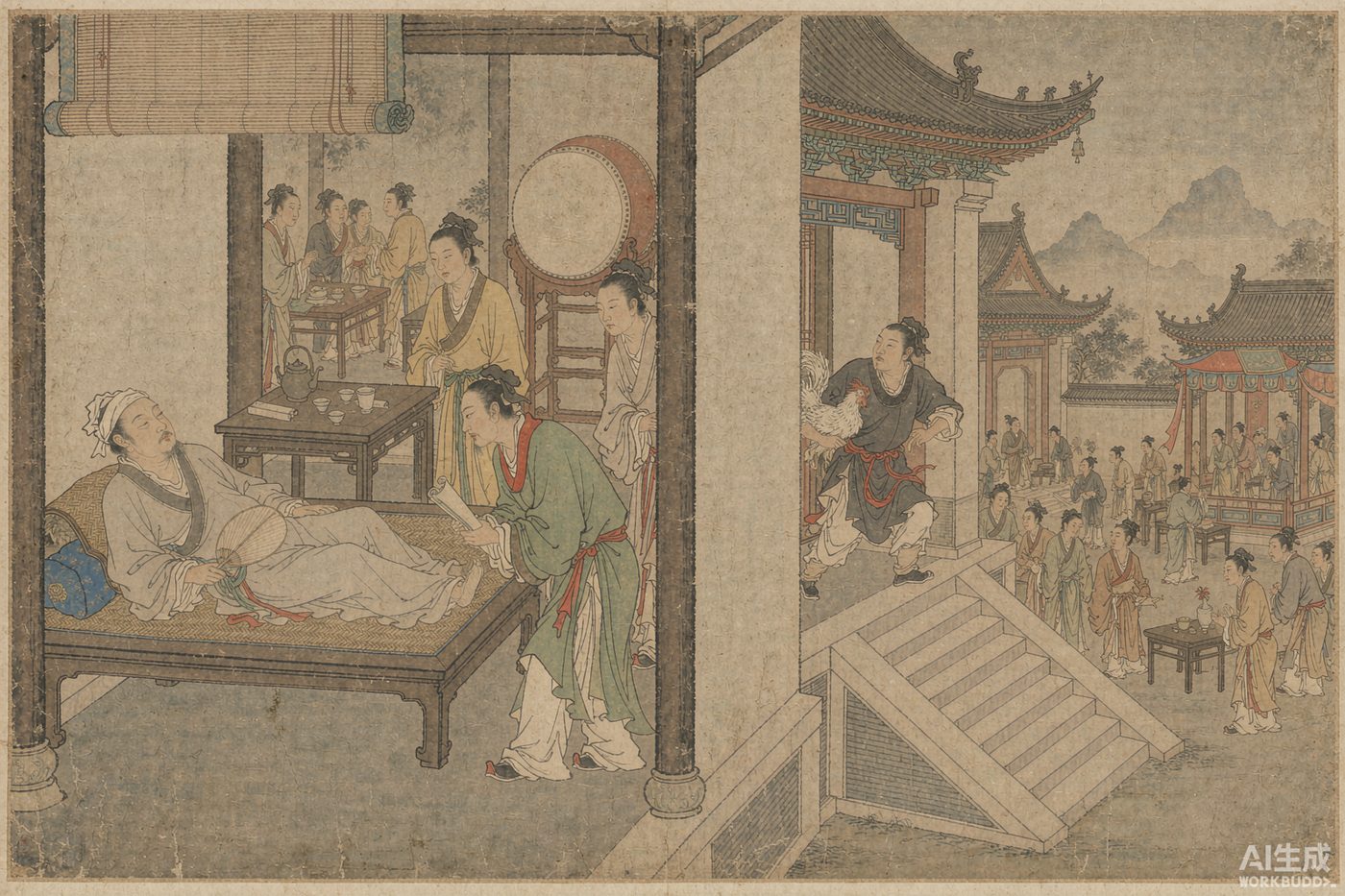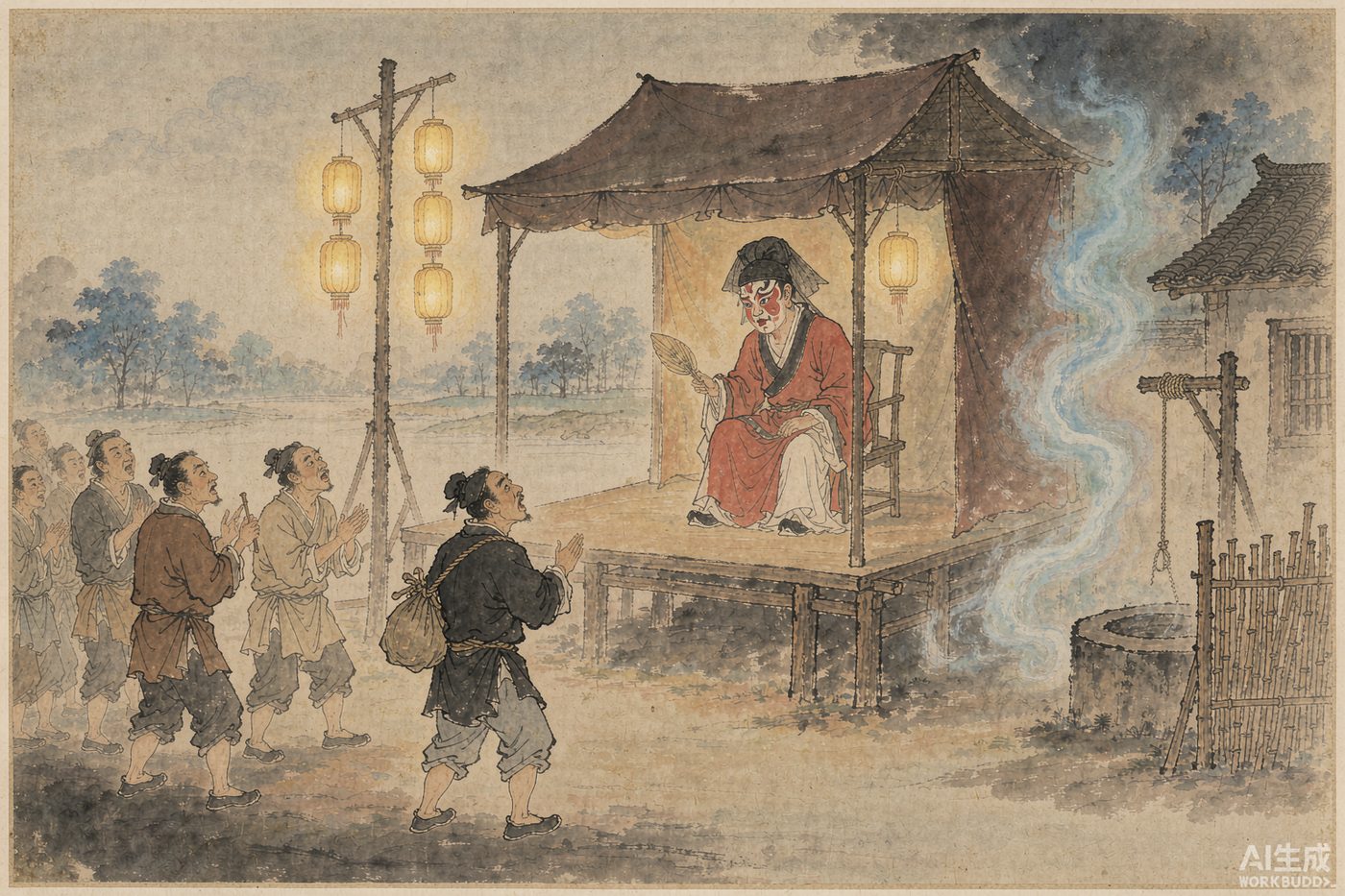
In the Qianlong era a stage was put up in front of the yamen at Sanshui in Guangdong, and plays were performed. One day the piece was Bao Zheng Breaks the Earthenware Pot.
The painted-face actor had just taken the stage and seated himself as Bao Zheng when he saw a man with his hair loose and a wound on him kneeling on the stage in the attitude of one presenting a grievance. The actor started up in fright and backed away. There was an uproar from the crowd below, and the noise of it reached the county offices.
The magistrate sent runners to enquire, and the actor told him what he had seen. The magistrate had him brought in.
“Go back on stage dressed exactly as you were,” he said. “If you see it again, bring it here to the county hall.”
The actor did as he was told, and the ghost duly appeared again.
“I am only a counterfeit Dragon Diagram,” said the actor. “Better that I take you to the county hall and ask the authorities to right your wrong.”
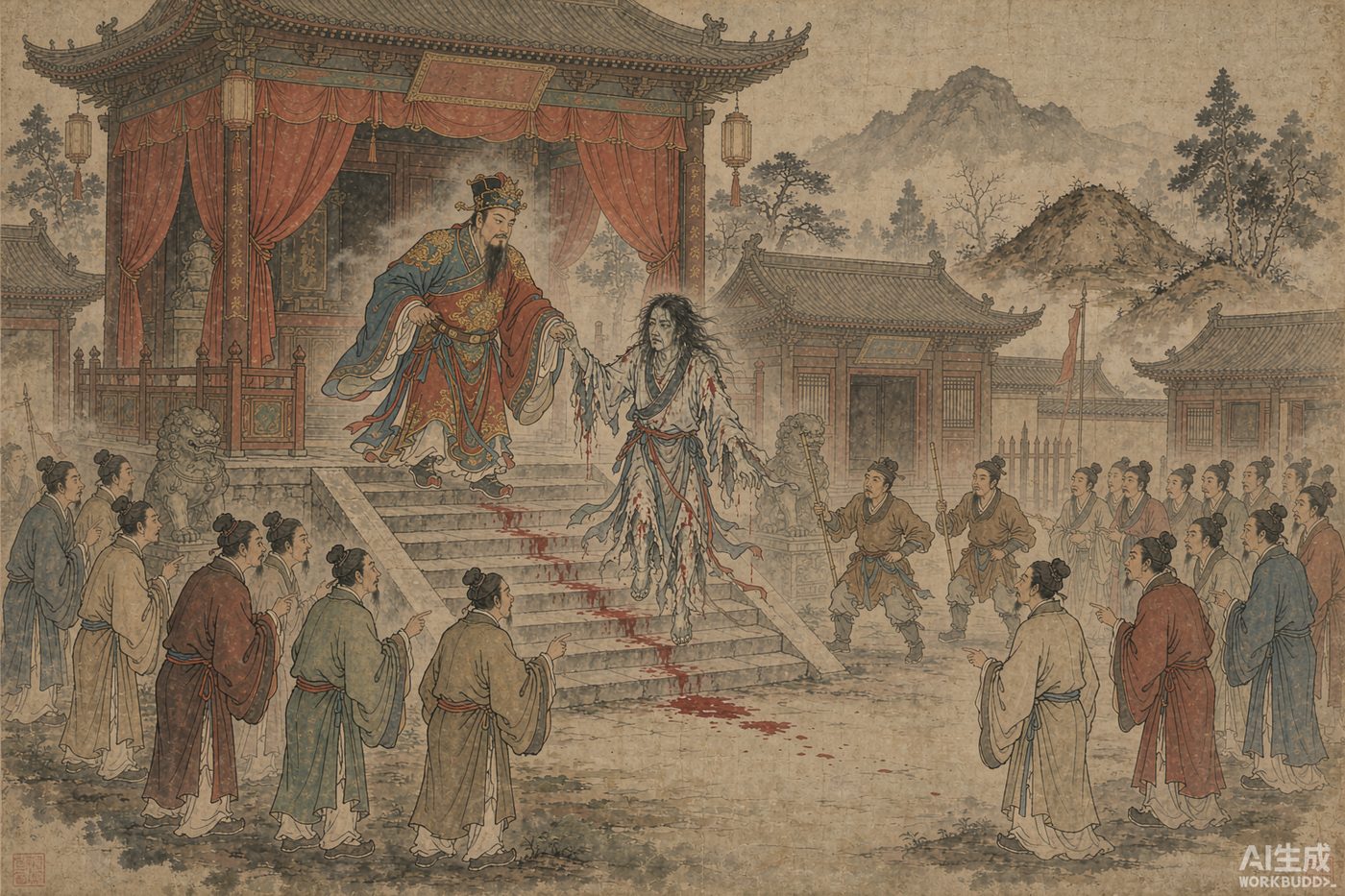
The ghost nodded. The actor rose, and the ghost followed him to the hall.
“Where is this ghost?” said the magistrate.
“Kneeling on the pavement below,” said the actor.
The magistrate called out to it loudly. He saw and heard nothing at all. He grew angry and moved to have the actor beaten. Then the actor saw the ghost get up and walk out, beckoning with its hand. He told the magistrate, who at once sent the actor with two runners to follow it, see where it vanished, and mark the spot.
The actor followed the ghost several li into open country and saw it go into a grave mound — the mound where a wealthy local man, Wang the Imperial College student, had buried his mother. They stuck bamboo twigs in the ground to mark the place and went back and reported.
The magistrate went out in his chair to look, and had Wang brought in and closely questioned. Wang would not admit anything, and asked that the grave be opened to prove his innocence. The magistrate agreed. They had not dug two or three feet when a corpse came into view, its colour as though it were alive.
The magistrate was delighted. He turned to Wang.
Wang cried out that he was wronged. “There were several hundred people at the funeral,” he said, “and all of them watched the earth go down, and there was no such body. And if there had been one, it could never have been kept out of so many mouths. How is it that nobody has breathed a word for years, and it has waited for this actor to come and speak?”
The magistrate allowed the force of this. Then he asked: “Did you stay to the finish before you went home?”
“I went home as soon as my mother’s coffin was lowered,” said Wang. “Everything after that was the labourers’ work.”
“That is it,” said the magistrate, laughing. “Fetch the labourers, quickly.”
When they came and he saw the look of them, he shouted: “Your murder has come to light. There is no more concealing it.”
The labourers were terrified. They knocked their heads on the ground.
“After the student Wang went home,” they said, “we were all resting under the mat shelter when a lone traveller came carrying a pack, asking for a light. One of our number felt that there was silver in the pack, and we plotted together to kill him and divide it. We took an iron hoe and smashed his skull, and buried him on top of the mother’s coffin, and heaped the earth over him, and the mound was finished by morning. The student Wang was so pleased at how quickly it was done that he gave us a generous reward besides. Nobody knew.”
The magistrate brought them all to law.
It is said that when they were burying him the labourers boasted among themselves: “This will never be unravelled. For this to be righted, Judge Bao would have to come back into the world.”
The ghost heard them say it. And so, when an actor took Bao Zheng’s part, he seized the hour and came to lay his plaint.