Stories/ 夷坚志/ The Wet Nurse's Relics

The Wet Nurse's Relics

李氏乳媪

SourceYijian Zhi (Record of the Listener)
AuthorHong Mai
EraSouthern Song dynasty · 12th century
Writtenc. 1160–1200
BuddhistWomenKarma
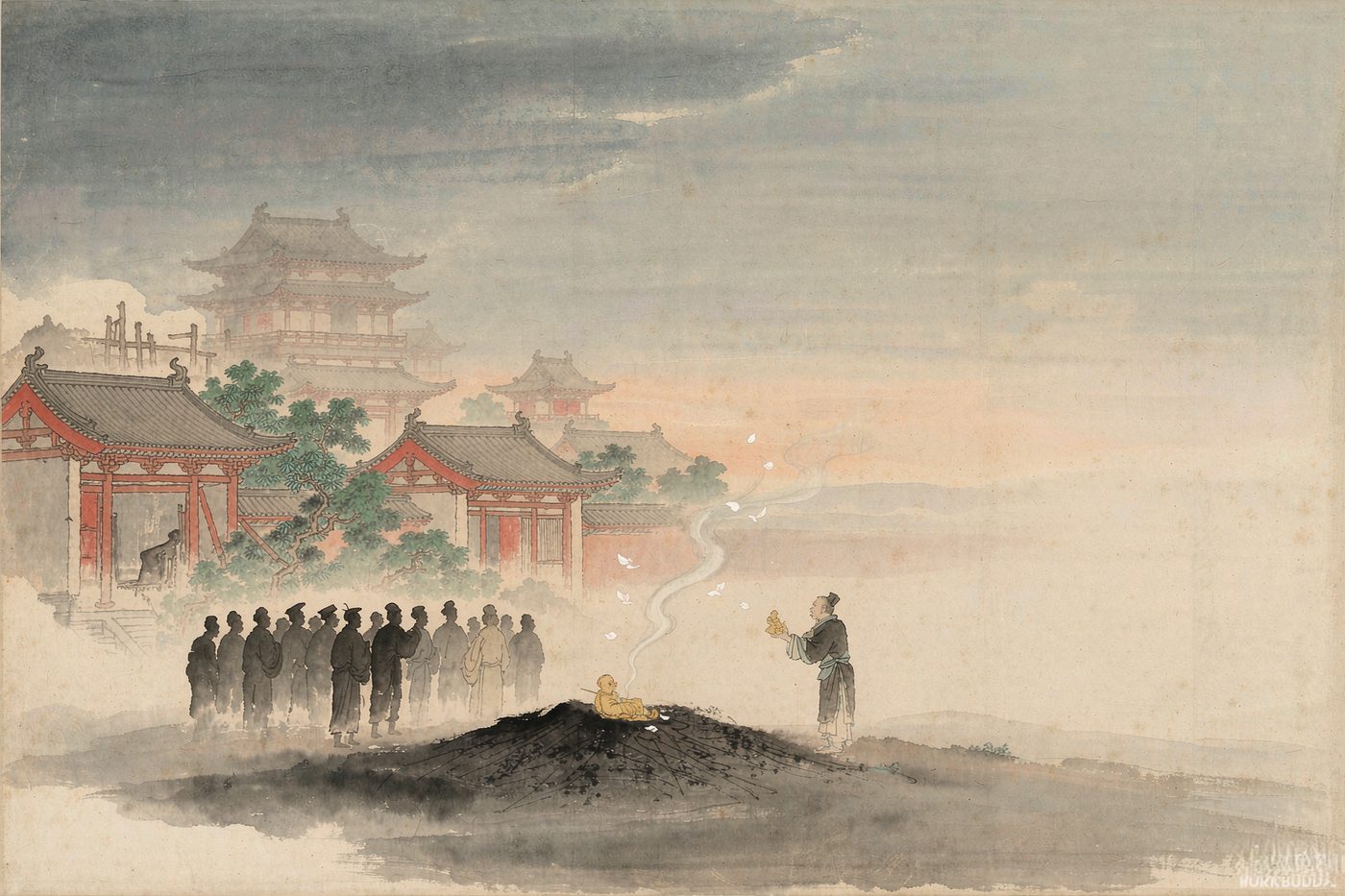
A funeral pyre in a monastery yard at dawn with a crowd gathered and lotus-scented smoke, and in the ashes small golden relics shaped like seated children
Illustration generated by AI, based on the ancient Chinese text.

In the sixteenth year of the Shaoxing era Li Yuanzuo was superintendent of the Fengguo mint at Jianzhou. A daughter was born to him, and he bought a commoner’s wife, née Chen, to be her wet nurse.

When the girl grew up, the woman would no longer speak of going home. She was by nature fierce and perverse, always competing with people, and thought nothing of anyone of her own station.

In the fourth year of the Qiandao era the daughter married into the Wang family; and because the old woman was always scolding, they did not take her with them.

Three years later Li was a ministry director in the Ministry of Revenue, and Chen died at Lin’an. Her coffin was lodged at a monastery, and Li ordered a servant to have her cremated, intending to take the bones home.

The next day the servant went to collect the ashes. He had not come out again when he heard a great clamour of voices. He looked, and there were some dozens of people, old and young, gathered standing about the place of the fire.

“The burning body smells like lotus,” they said. “You can smell it outside. This is an extraordinary person. We came to see.”

The servant stayed the night on account of it.

At first light he called for monks to recite the scriptures. Before they had assembled, people were running up from near and far. And the ashes were full of śarīra, and everybody scrambled to get them. The servant, being anxious about the bones, had no time to look for them, and only got a dozen or so to bring away. They were the colour of liquid gold and bright enough to see your face in, and they were shaped like little children, not an inch high.

Li was astonished, and asked among the older women and the maids: “This old woman was harsh and hard all her days. What merit can have done this?”

And they all answered: “She had no other good works. Only this — every morning, up very early, she would recite the Lotus Sutra ten times and more. She could not remember the whole text. She only ever kept two or three lines of it: there is a jade immortal sitting in a lotus bowl — every day a clear bell and clean water. That is all we ever heard from her.”

In a former life she must have reviled people and heaped up the karma of the mouth. Yet by twenty-six years of reciting she was rewarded so.

It is, they say, what a firmly held good intention will bring about.
Original classical Chinese text · 原文

李元佐以紹興十六年監建州豐國監,生女子,買民妻陳氏為乳母。女既長,因不復肯言歸。媪賦性獷戾,常與人競,視同列無如也。 乾道四年,女嫁王氏,以其好罵,弗與之俱。後三年,李為戶部郎,陳死於臨安,寄櫬僧舍。旋命僕為火化,將以其骨歸。 明日僕往收燼,未出,聞呼聲甚衆。視之,則有老幼數十人,聚立火所,曰:「火尸香如蓮花,聞於外,是異人也,故來觀之。」僕為留一宿。 黎明,呼僧誦經,未集,遠近已奔湊。視灰中皆舍利,衆競取之。僕切於拾骸,不暇尋覓,只得十餘顆以歸,色如泥金而光明可鑑,其形若小兒,高不盈寸。 李始嘆異,訪諸嫗婢:「此媪平日險忍,有何功力致然?」皆云:「無它善業。但每朝早起,即誦蓮花經十餘遍,不能記全文,唯止憶三兩句——有蓮花盆裏坐著玉仙人,每日清鍾浄水——聞如是而已。」 媪前生罵人,當積口業,而用二十六年誦經之故,獲報乃爾,亦其善念堅固所致云。

From 《李氏乳媪》, Yijian Zhi, 丙志卷七. Translated in full. 舍利 (śarīra) are the pearl-like relics left after the cremation of a saint; 蓮花經 is the Lotus Sutra. The two lines she could remember are not from the sutra as we have it — they are what a woman with no education made of it.

Source. From Yijian Zhi (Record of the Listener) (夷坚志), by Hong Mai , c. 1160–1200. The original text is in the public domain; this English rendering and the accompanying notes are original work.
Where this fits in the universe: How Souls Move On · The Corpse That Does Not Become a Ghost

Keep Reading

Related Stories

Southern Song dynasty · Jin era, 12th century · 夷坚志

The Temple Boy Who Became a Donkey

普光寺行童

A drinking, whoring temple boy falls ill, and a short donkey's tail pushes out through his skin. His family want to kill him. The monks say no — this is a public warning, and it must be kept working.

MonsterTransformationJustice
Southern Song dynasty · Shaoxing jiaxu (1134) · 夷坚志

The Peacock Sutra

鄒智明

A plague demon is driven off by a peacock's tail, and reports that there is still a nail in the sick man's head. The cure is a pile of burned paper money — and the illness turns out to have an address.

DeityGhostJustice
Qing dynasty · Qianlong–Jiaqing era · 谐铎

The Dog Who Could Read

識字犬

Shen Qifeng's own dog learns to read, refuses to eat leftovers, refuses to sleep with the bitch he is given, and ends by barking at fine clothes and fawning on rags. It does not end well.

AnimalSatireFate